Cal-Lift Achieves Premier Partner Status with Kalmar Ottawa for 2022

We are proud to announce that we have achieved Premier Partner Status with Kalmar Ottawa for 2022. We are equally proud to represent American-made Kalmar Ottawa Terminal Tractors and Yard Spotters.

Kalmar sets a high bar for product sales, service, parts and customer service for their users and we are pleased that our team has met these objectives and service parameters.

We will continue to strive to provide our customers with the right Kalmar product for their unique applications and back it up with superior service and parts. Visit our Kalmar showroom to learn more about their line-up. The Kalmar Ottawa T2 has set the bar even higher providing the optimal terminal tractor for your operation. All Kalmar Ottawa’s are built at the US manufacturing plant in Ottawa, Kansas. Along with being the original manufacturer of terminal tractors, Kalmar Ottawa was the first to offer machines with an automatic transmission, a rear door entry, integral air conditioning units, power cab tilt and ABS brake systems. Kalmar Ottawa terminal tractors were also the first on the market to receive DOT/EPA certification – a paramount classification for distribution and industrial customers whose operation entails shunting trailers between yards via public streets and roadways. 

We value and appreciate all our great employees and customers that made this possible.

Cut Emissions and Get Credit with LCFS

What is Low Carbon Fuel Standard?
The LCFS is designed to encourage the use of cleaner low-carbon transportation fuels in California, encourage the production of those fuels, and therefore, reduce GHG emissions and decrease petroleum dependence in the transportation sector. The LCFS standards are expressed in terms of the “carbon intensity” (CI) of gasoline and diesel fuel and their respective substitutes.

Learn More About LCFS

We Have Equipment Solutions to Help You Get Credit
Cal-Lift carries a variety of electric powered material handling and transportation equipment that can help
you eliminate emissions in your operation and get credit for doing so. Our electric line-up includes:

  • CLARK Electric Forklifts, Stackers, Reach Trucks, Order Pickers, Task Vehicles and More
  • Kalmar Ottawa Electric Yard Spotters and Terminal Tractors
  • Taylor Machine Works Electric Container Handlers

If you have considered eliminating emissions, now is a great time to convert. To learn more and get a quote, just give us a call at 800-322-5438 to speak with one of our representatives about our electric powered products.

Visit our website to see our line-up of electric forklifts, terminal tractors and container handlers.

Kalmar Electronic Stability Control

To comply with the standards set by the Department of Transport and the National Highway Traffic Safety Association for trucks that operate in approved applications, all new Kalmar Ottawa T2 Terminal Tractors can be equipped with an optional Electronic Stability Control system.

This added safety feature ensures safer load handling and is the first of its kind in the Terminal Tractor industry. When you order a new DOT/EPA compliant Kalmar Ottawa T2 Terminal Tractor with either a 116”, 126” or 136” wheelbase our new Electronic Stability Control (ESC) system can be fitted as an option. 

Enhanced Safety

Your new DOT/EPA compliant diesel truck not only can be fitted with ESC, it also has an Anti-Lock Braking System
(ABS) and a Traction Control System fitted. Making your truck even safer when being operated on public roads.

What is the Difference Between ABS and ESC?

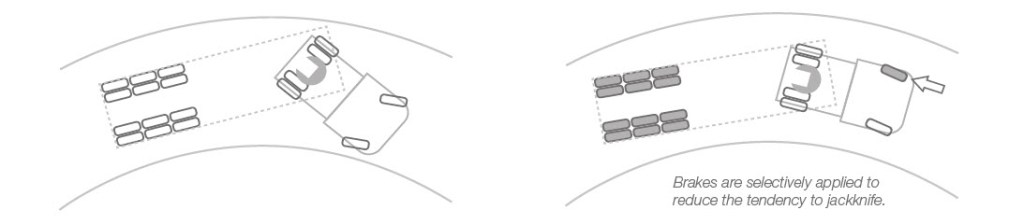
Anti-locking braking systems stop your wheels from locking up when you apply the brakes, this allows for the driver to maintain control without the vehicle skidding. While the ESC system is able to apply the brakes to individual wheels to help maintain stability, particularly when the truck is at risk of jackknifing or spinning. This is done by the system automatically reducing the engine throttle and selectively applying the trucks brakes.

Cal-Lift is your source for Kalmar Ottawa Terminal Tractors. Learn more about Kalmar’s Line-up of products, then contact us at 800-322-5438 for a demo and quote.

CLARK S-Series Forklift “Smart-Dash”

Smart Dash is programmed to provide operators with real-time information and on-board diagnostics. The dash integrates with multiple truck options including optional backup camera, optional load weight scale, operator checklist and telematics. The dash intelligence also provides the ability to limit access for unauthorized operation of the truck or changing settings via password protection.

The optional Load Weight Scale will display the lifted load value on the main screen in large, easy to read text. The Smart Dash allows the customer to “tune” the truck to their specific requirements. The truck’s maximum speed can be set and password protected directly through the screen. Learn more about the S-Series.

The Flu, Its Cost and How to Avoid it

FluEach flu season in America, between 5% and 20% of American’s contract the flu. This leads to 111 million lost productive work days, which costs American business approximately 7 billion dollars! In addition, the direct costs (doctor’s visits, medication, hospitalization) cost individuals over 4.5 billion dollars a year! Source: CDC Whether it’s in your accounting department or forklift operators, you want to limit an outbreak at your company and contain any outbreak that does occur.

The effects of lost productivity can have a great effect on your ability to deliver products and services and provide customer service, which can lead to a negative impact on your bottom line. But there are things you can do to lower the risk at the department level and facility level. It all starts with planning and communication.

  1. Developing a plan to combat influenza? Businesses plan for all sorts of calamities and naturally occurring disasters. Does your company have a preparedness plan to prevent a flu outbreak? A tremendous amount of information is available to help you plan for and combat an outbreak of the flu a http://www.flu.gov/planning-preparedness/business/
  2. Educate your employees and take steps to encourage vaccination.One study showed a decrease in over 71% in hospitalizations when a flu vaccination was administered to adults of all ages (source). Flu vaccines not only reduce the chances of contracting the flu, but it also reduces the effects of the flu if an employee contracts it, thus enabling them to get back to full productivity sooner.
  3. Use Resources.The CDC has a great Business Tool Kit to help you educate your employees about the flu, how to prevent it and what to do if you think you are coming down with it. Visit the CDC Business Tool Kit Webapge.
  4. Proper sanitary proceduresare also essential during the flu season. Placing hand sanitizers throughout your facility and encouraging if not outright requiring their use will help contain the spread of the virus, should an employee become infected. There are additional steps you can take to prevent the spread of the flu, including increasing janitorial services or assigning teams to assist in the sanitization of routinely used and shared points, such as water fountains, door knobs/handles, bathrooms, and kitchens.
  5. Send them home!If an employee starts to show the signs of influenza, it’s important to remove them from the facility as soon as possible and require that they remain home until symptoms have subsided, particularly a fever.
  6. Seek immediate attention. If you or anyone around starts to feel fatigue, loss of appetite, lethargy, fever or any of the other first signs of the flu, get to a doctor and ask about anti-viral drugs. These drugs can cut your misery in half, as well as your time off work, and productivity.

The effects of flu season can be dramatic if left unaddressed. But developing a plan to deal with the flu and spreading education before the flu spreads itself around your facility will help you maintain your business productivity during this flu season.

Our focus is frequently on productivity, and this is not always about equipment and processes. Sometimes peripheral components can have an impact on our bottom lines, and it is important to us to serve as your partner in addressing all facts of productivity. We encourage you to visit the flu.gov site to learn more.

Forklift Fleet Optimization

TLI Forklift Fleet OptimizationPurchasing a new forklift or other material handling equipment can be expensive, but that’s just a fraction of what it costs to operate it efficiently, or inefficiently. Getting the most bang for your forklift buck means understanding the products you move and establishing baseline costs as a start. Here are 10 tips for optimizing your forklift fleet.

  1. Assess your fleet’s total cost. The cost of your forklift or material handling equipment is typically only about 20% of your total long-term cost. Find out what service is costing, parts, labor, break-downs, rentals, additional equipment kept on hand for break-downs, overtime resulting from down time etc… This can be a real eye opener.
  2. Optimize your forklift fleet by material flow. Determining what each piece of equipment is moving, where, when and how often can help you determine productivity and equipment choices. This way you can determine a lift truck’s cost per pallet move, rather than cost per operating hour.
  3. Find an integrated dealer that understands all facets of your business. Work with a company that not only sells equipment but understands all facets of material handling. These types of dealers can provide you with total solutions which encompass all the areas of your material handling operation.
  4. Get out of the service business. Get information and quotes for full maintenance leases from your dealer. You dealer knows your equipment better than you, and can maintain it to be more productive. Full maintenance takes the guess work out of total equipment operational costs by eliminating “surprise” repairs that often occur over time.
  5. If you perform your own service, look into parts programs. Parts availability is key to maintaining uptime, so an effective parts distribution network facilitated through a lift truck manufacturer and its local dealer is essential to keep your fleet running. Some dealers can provide parts for multiple brands and types of trucks. In addition, dealers will sometime consign parts to your facility, further improving your parts availability and uptime.
  6. Stay on top of equipment advancements. Like most facets of business, material handling advancements can improve your operation and productivity. Attend ProMat, stay connected with industry resources and work with a dealer that is on top of providing the latest in material handling products including forklifts, storage and retrieval and material moving equipment.
  7. Look into fleet management. Knowing the cost of operating equipment, where and how it is being utilized is key to allocation efficiency and productivity. Software programs are available that can provide you with this information. Work with a dealer that can provide these solutions to your operation.
  8. Invest in training early and often. Build a robust and active training program. Safety and productivity go hand in hand. Well trained operators and employees are proven to be more productive and safe. Training reduces your product and equipment damage costs, injury, insurance and many other latent costs of fleet and equipment operation.

Optimizing your materials handling operation takes a bit of work. However, working with an integrated materials handling partner will take a lot of the load off your shoulders and help you operate a more efficient and effective materials handling operation.

Give us a call at 800-322-LIFT to speak to one of our material handling professionals.

Tips to Lower Your Material Handling Costs

Reducing your costs means increasing your profits and increasing your profits has never been more challenging than in recent years.  Our experience with hundreds of various types of operations, utilizing hundreds of pieces of equipment in more than a thousand ways, has exposed us to thousands of variations in facilities, equipment, and applications. In working with these diverse clients, we have recognized commonalities that, when implemented, resulted in lower total operating costs for materials handling most of the time. Following are five that we highly recommend:

Choose Application-Specific Equipment – In other words, “buy the right equipment for the job at hand.” We often see equipment being used in applications for which they were not designed. That results in accelerated wear, increased damage and ultimately, increased costs. Working with professionals who can survey your applications and recommend the right equipment for each job is one of the most important things you can do to decrease overall costs.  Using the proper equipment with the right specifications means efficient, productive results.

Planned Maintenance – Your fleet equipment works hard. And hard-working equipment needs proper maintenance.  Working with a professional and reputable fleet service provider that serves you at appropriate intervals is the key to catching small maintenance issues, before they become larger and much more expensive. In addition, well-maintained equipment operates more efficiently, experiences more up-time and results in improved operator morale.

Invest in a Robust Training Program – Operator safety training is required by OSHA, and a daily inspection of equipment is one of OSHA’s requirements. Most companies train their operators regarding safe operation, but more often than not, the training stops there. Clients that invest in training employees to perform daily inspections, and to know what to look for, see results. If you install a process for equipment that will eventually need repair, you can ensure that unsafe equipment stays off the operating floor, and small repairs can be handled before they blossom into colossal nightmares.

Work With Single-Source Dealerships When Possible – The more work you can assign to a qualified and reliable supplier, the fewer calls you have to make. In turn, the supplier becomes more familiar with your equipment, facility and applications. This leads to greater efficiencies for you. It also allows your supplier to better understand your operation and thus make logical suggestions that can reduce your costs, increase your efficiency and productivity, and ultimately improve your bottom line.

Fleet Management – Whether you do it yourself or assign responsibility to your materials handling partner, fleet management is a key part of knowing the useful economic lifespan of your equipment. And economic lifespan may vary by application within your operation. If you keep a finger on the pulse of your maintenance expenses and know when it’s time to trade in or re-lease, that process will more than pay for itself in the long run.

There are hundreds of other things you can do to minimize the total operating costs of your facility. We have addressed some of them in previous feature articles. We hope that you have found these Top Five useful.  If we can assist you further, or provide you with more information, please contact us at 888-322-LIFT.
Section 179 Improved for 2018

Section 179 Header

With the passage and signing into law of H.R.1, aka, The Tax Cuts and Jobs Act, the deduction limit for Section 179 increases to $1,000,000 for 2018 and beyond. The limit on equipment purchases likewise has increased to $2.5 million.

Further, the bonus depreciation is 100% and is made retroactive to 9/27/2017 and good through 2022. The bonus depreciation also now includes used equipment.

See the fully updated 2018 Section 179 Calculator to see how this tax deduction affects your company.

2017 Section 179 Tax Information (Last Year)

The Section 179 deduction is $500,000 for 2017, with a 50% bonus depreciation in place until late September (see 2018 information for change).

Click Here for the fully updated Section 179 Calculator for tax year 2017 (Last Year).

Answers to the Three Most Common Section 179 Questions

How Much Can I Save on My Taxes in 2018?
It depends on the amount of qualifying equipment and software that you purchase and put into use. See the handy Section 179 Calculator that’s fully updated for 2018, and includes any/all increases from any future legislation.

What Sort of Equipment Qualifies in 2018?
Most tangible business equipment qualifies. Click here for qualifying property.

When Do I Have to Do This By?
Section 179 for 2018 expires midnight, 12/31/2018. If you wish to deduct the full price of your equipment from your 2018 taxes and take advantage of the new higher deduction limits, it must be purchased and put into service by then.

Many businesses are finding Section 179 Qualified Financing to be an attractive option in 2018, especially since the expected Federal Discount Rate increases don’t leave much time for action. Please apply today.

More Section 179 Deduction Questions Answered

Welcome to Section179.Org, your definitive resource for all things Section 179. We’ve brought together a large amount of information regarding Section 179, and clearly and honestly discuss the various aspects of IRS §179 in plain language. This will allow you to make the best possible financial decisions for your company.

Section 179 can be extremely profitable to you, so it is to your benefit to learn as much as possible. To begin, you may have a lot of questions regarding Section 179 such as:

Check out our line-up of new forklifts or used forklifts, then contact us at 800-322-5438 for more information or a quote.