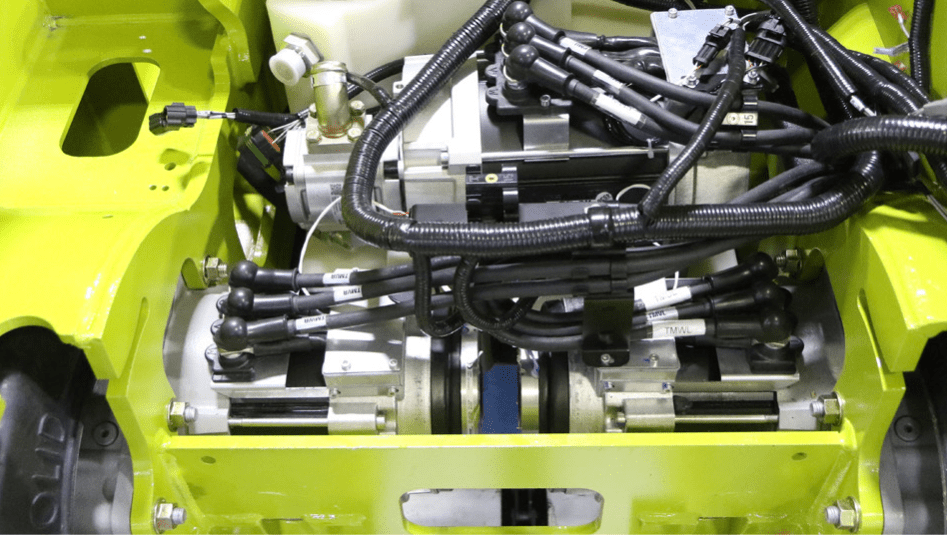
Taylor Machine Works X280 Forklift Refurb

Instead of buying new equipment, consider letting us take your old, tired forklift, and make it like new again! This Taylor X280 had done it’s job, performed well, but had seen better days. The customer was having a hard time letting it go and purchasing a new one, so we said “hey, let’s take this machine and make it like new again!” Below are the results.

Have a forklift, yard spotter or other piece of material handling equipment, that perhaps you’re just not ready to let go? Give us a call at 800-322-5438 for a quote on letting our team of refurb pros make it like new again!

Where’s My Forklift? The Surge in Demand for New Material Handling Equipment

Since December 2020, when the forklift industry experienced a record order month, orders have exploded month after month. The chart below shows just how strong the demand for forklifts has become.

If this trend continues, which we expect it to, orders for 2021 will be up over 60% from the previous 3 years. This increase, combined with shortages in microchips which manage so many functions on forklifts, as well as other supply-related delays due to Covid 19, have greatly elongated lead times for new equipment orders.

What may normally be a 10 week lead time for a new lift truck, has increased to 8 to 10 months, with some specialized equipment waiting over a year for delivery. This shortage of equipment has created a ripple effect into other areas of our industry, namely rentals and used equipment.

It is getting increasingly more difficult to obtain rental equipment and used equipment, as these are being used to plug the holes created by the delays in new equipment delivery. We do expect this to begin to ease as chip manufacturing begins to catch up, but it will be several months before this occurs. Chip manufacturers are simultaneously playing catch-up for automobiles, other heavy machinery as well as nearly any vehicle managed by electronic components, which is nearly all equipment!

We are suggesting to customers to plan their 2022 needs, and place those orders very soon in order to prevent delays for 2022 equipment needs. We will certainly keep all of you posted on the progress our industry makes and work hard as always to find you the equipment you need.

Taylor Announces Relationship with Proterra

Taylor Announces Electric Vehicle Innovation Powered by the Best-in-Class Battery Technology by Proterra

Louisville, Mississippi – Taylor Machine Works, Inc. has always been at the forefront of innovation and problem solving throughout its 94 years of manufacturing. As a result of the ever-changing manufacturing environment and the influence of electric vehicle technology, Taylor felt an immense responsibility to design and manufacture zero-emission material handling equipment that would integrate seamlessly into the existing customer workflow. In 2019, Taylor first accomplished this by engineering the ZLC Series designed to load and unload shipping containers weighing up to 75,000 pounds in port environments. The battery-electric ZLC Series met the stringent zero-emissions standard without interrupting the demanding processing sequence required by the world’s busiest ports. Utilizing state-of-the-art electric motors and environmentally responsible battery packs, the ZLC Series plug-in battery electric vehicle was equipped with enough energy to smoothly transition from combustion engines to reliable electric power.

Now Taylor is venturing into a new relationship with Proterra Inc, the leading innovator in commercial vehicle electrification technology. Taylor will power the next-generation Taylor ZLC Series electric container handler with 904 kilowatt hours (kWh) of energy and the ZH Series electric forklift with 225 kilowatt hours (kWh) of energy using Proterra’s industry-leading battery technology. These all-electric container handlers and forklifts will support various heavy-duty applications, including container handling in port environments and other heavy-material handling industrial settings such as warehouses, plants, worksites, mine sites, steel yards, lumber yards, and others. Taylor expects to deliver the first Proterra powered Taylor vehicle to customers in 2022. Taylor and Proterra will also be working together to help ports and other customers electrify their heavy-duty, material handling machinery by delivering charging and infrastructure solutions.

Proterra is a leader in the design and manufacturing of zero-emission EV technology solutions for commercial applications. Proterra battery technology leverages industry-leading energy density and a customizable design to fit within various Taylor industrial material handling and container handling products. Taylor believes this new relationship with Proterra will be the most important next step for the Taylor product line.

“We are excited to continue the high standards of manufacturing material handling equipment with the battery-electric Gen 2-ZLC Series container handlers powered by Proterra,” commented Hal Nowell, Director of Sales for Taylor Machine Works, Inc. Matt Hiller, Director of Engineering added, “Electrification of mobile material handling equipment is an exciting and challenging effort but is also developing very quickly. Taylor is readying our customers for the new choices they have in the ways energy is used in their businesses. Taylor has always provided our customers with stable and forward-thinking technology and this continues in the EV space with our strategic Proterra partnership. Proterra offers the experience needed to stay ahead of the curve and add to the solid support which Taylor customers demand.”

Robert Taylor Sr., President and Chief Operating Officer of The Taylor Group of Companies, stated, “This new relationship with Proterra, who like Taylor is an American manufacture, is truly a milestone in Taylor manufacturing history. Our commitment to the electric market for material handling and container handling equipment will be a strategic engineering collaboration between Taylor and Proterra. We believe that Proterra’s vision for EV battery technology and their commitment to zero-emission standards align with the Taylor vision.”

“Electrifying heavy-duty equipment is a win-win for our ports and our communities. It means protecting our health and the air we breathe at the same time we meet the needs of the world’s busiest ports and other industrial settings with new technologies,” said Gareth Joyce, President of Proterra Powered & Energy. “We are excited to partner with a trusted, industry-leader like Taylor and deliver our proven EV technology to power the next generation of material handling machines.”

Our customers can depend on Taylor “Big Red” equipment. Our heavy-duty material handling and container handling equipment is more versatile, more efficient, and more able to tackle the demands of tomorrow. Our past growth is an inspiration for our future, and Taylor will continue to build with our watchwords Faith, Vision, and Work.

As supplier the authorized distributor of Taylor products, OEM parts, service and rentals to northern and southern California, we are proud to represent the Taylor line of products. Their commitment to their customers, employees and country is unparalleled in our industry.

To learn more about our Taylor line-up, please visit https://www.cal-lift.com/taylor.

Training vs. Teaching; Knowing the Differences

Training is imperative for not only safe operation of forklifts, container handlers and yard spotters, it improves productivity and your bottom line. We know that very experienced operators are worth their weight in gold. But how can we take a new operator and get them to that point quicker? The key lies in truly training them, not just teaching them the fundamentals then handing them the key.

Not to mention that in many cases, particularly in forklift operation, training is a requirement and failure to provide adequate training can result in costly fines as well as legal costs and civil awards if sued.

Too often we become focused on the regulation and the direct costs of non-compliance, namely fines and potential lawsuits. However, if we focus on truly making cultural changes in our organizations that revolve around a safer workplace, many other cost-savings will occur, including:

  1. Reduced worker’s compensation claims & premiums
  2. Reduced equipment and plant damage
  3. Improved maintenance conditions of equipment
  4. Improved productivity
  5. Enhanced employee morale

This is just to name a few. Too often satisfying OSHA becomes the goal and we “miss the forest for the trees.” Training is a never-ending process. Why? Because nothing is ever stagnant in a warehouse situation. There are almost daily changes involving equipment, processes, personnel, products or facilities, and the list goes on. Each change requires training or re-training to make sure each employee can become familiar and comfortable with the changes.

Re-training must take place each time “a condition in the workplace changes in a manner that could affect safe operation of the truck” , according to OSHA. To see a list of all conditions under which refresher training must occur, click HERE. This rather ambiguous definition could mean anything from a change in the products you carry (depending upon how they are handled) to changes in how you store your products. So as you can see, having a once-a-year operator training day would not even provide your company compliance with the letter of the regulation, much less keep your facility operating at an optimal level as it pertains to safety and productivity.

Let’s look at the differences in the pure definitions of teaching vs. training.

Train – To instruct as to make proficient. To guide the mental, moral, development of, etc…
Teach – To show how to do something. Instruct. To give knowledge, insight, etc…

Most traditional “training” programs are in-fact barely more than “teaching sessions.” In order to fully train, you must first start with the trainer. OSHA regulations regarding forklift operator training state: All operator training and evaluation shall be conducted by persons who have the knowledge, training, and experience to train powered industrial truck operators and evaluate their competence.” 

This means the person you are relying upon to meet these standards will need more than a three-day class in operator safety training. He or she will need to have significant experience with material handling equipment and all facets of operation as well as the ability to express what he or she knows in a logical manner so that the material is effectively transferred to your operators. This is very important particularly if your goal is truly training, and not simply compliance.

To learn more about how the human brain learns and how to “train” read “The Four Levels of Learning.”

The Four Levels of Learning

When you were learning to tie your shoes, it wasn’t a one-time demonstration by your mother. Rather it was a tedious task for both of you. Teaching and learning can be quite difficult and frustrating for the trainer and the trainee. Understanding how people learn and what it takes to become proficient at any task underscores the importance of a continual training program for your forklift operators, or for anyone that’s learning anything in your organization to help keep it running.

Unlike learning to tie your shoes, your company is a dynamic, flowing organization. Things are rarely the same next year as they are today. New equipment, new employees, new products, new fixtures, the variable set goes on and never ceases to change. Adapting to these changes means understanding how we learn and the stages of learning we all pass through before become proficient at anything. Being able to identify where each employee is in the process helps you minimize the training costs and maximize productivity. Let’s start at the first level of learning.

The Unconscious Incompetent – Before you wore shoes, you had no idea that you didn’t know how to tie them. This is the most ignorant stage of learning, but is the first. There are many things your employees don’t know, that they don’t know, but you do know. It’s important to understand this. We often assume “they know how a Clark forklift operates.” But do they? Personal interviews or questionnaires are frequently used to determine what someone knows, and doesn’t know, which leads us to the next level.

The Conscious Incompetent – “Oh, these are shoes and I see I have no idea how to secure them to my feet.” Or, you know know that you don’t know something. For example, do you employees know how dangerous a forklift can be? At level one, they likely do not. But being introduced to the dangers, or “learning” the dangers, makes them safer. At level one, you may hop right on the lift truck and drive away, not knowing how deadly of a situation you just created. However, now you are armed with knowledge and understand there is much more to learn.

The Conscious Competent – At this level, a person has learned a task or process, but is conscious of the process and has to give it thought while they are completing the task. “I’m coming up at an aisle intersection, what am I supposed to do? “….”oh, yes, hit the horn and slow down” they might be thinking. The key is, they’re thinking. Some like this level, but having to think takes time, and a fraction of a second can have dire consequences in a material handling situation. The ultimate goal through continual training and practice is to achieve the level of activity where you perform a task and give it no thought, or “The Unconscious Competent.”

The Unconscious Competent – It is at this level is where you desire to take your employees regardless of what task you’re asking them to perform. Whether it’s a process for loading or unloading a tractor trailer or how to change a forklift battery. When a person performs a task precisely without giving it thought, he or she is now at his/her most productive level and will maximize the safety of your facility. Like tying your shoes, which you don’t think about any longer, what once was a frustrating process now becomes second nature. It is at this level you are most proficient.

Getting your employees to the “Unconscious Competent” stage takes much more than a one-time classroom and hands on training situation. It’s takes a process for continually exposing your employees to information, having them practice, slowly at first. Building confidence with a supportive environment where they are not “hurried to perform” allows them to grow and learn at their own pace. Some will get there quicker than others, but the ultimate goal is to have them all performing without a lot of thought about what they are doing. This allows them to give time to think about how they can make what they’re doing….even more productive, or safer.

Forklift Safety Day 2021, What You Can Do to Celebrate

The Industrial Truck Association has announced Forklift Safety Day, to be held Tuesday, June 8. While most of us won’t be able to attend the DC festivities as they are virtual due to Covid 19, there are things you can do to take advantage of this day to help create awareness about the dangers that forklifts present and how to minimize the potential for accidents that can result in injury or death, damage to your facility, equipment and financial losses.

We’ve compiled a short list of things you can do to improve safety on and around your forklifts, and create more attention to forklift safety.

Forklift Operator Training

Make sure all your forklift operators have been trained and that their refresher training is up to date, if applicable or necessary.

Free Forklift Safety Downloads

Pedestrian Training

Take some time to gather any staff that operates around forklifts, but not on them, to refresh them about the dangers of this equipment and how to be sure to use safe procedures when they are in an area of your facility where forklifts are being operated.

Forklift Maintenance

Make sure all your forklift’s maintenance is up to date. If you have a Planned Maintenance Agreement, this would be a good time to review it with your service provider to ensure all standard checkpoints as well as unique equipment attachments are being inspected and maintained properly.

Make sure you forklifts have proper safety equipment and that it’s operating properly. Lights, horns, back-up alarms, seat belts, fire extinguishers etc… 

Make sure you have lock-out kits to ensure that forklifts that do not pass an inspection are locked out immediately until repairs are made.

Learn more about our maintenance and service offerings

Site-Specific Review

Review any unique “site specific” features your facility may have and be sure your operators are aware of proper handling of equipment while on or around these features (ramps, areas where floors can be slick, floor substrates that vary etc…)

Forklift Operator Training

Make sure that training is part of your company’s orientation for anyone that will or MIGHT operate a forklift. Remember, employees that have not been properly trained aren’t even allowed to sit on and start a forklift, much less move it out of the way of anything.

Forklift Fleet Analysis

Review all your forklifts for possible replacement. Old forklifts, or those that are getting “up there” in hours, might be potential threats. Review safety records and maintenance logs for your equipment. You might find this could be a good time to replace some or even all of your forklifts.-

Our goal is to help you operate safe, efficient and productive forklift equipment. To discuss forklift safety, operator training – or to get a quote on new equipment, please contact us at 800-322-5438.

Taylor Machine Works Cushion Tire Forklifts

When people think of Taylor Machine Works, they often think of their behemoth pneumatic tire forklifts used in lumber, logging, concrete, port operations and more. But Taylor also has a very extensive line-up of cushion tire models perfect for smooth surfaces.

Taylor XHC-600L, 60,000lb. Capacity Cushion Tire Forklift

Taylor’s XHC (pictured above) is perfect for steel, rigging, aluminum, automotive and more. Powered by a Cummins Tier 4 Electronic Diesel engine that drives 175 HP, and lift’s 60,000lbs to a height of 130″ with its 2-stage telescopic mast.

Taylor XHC-250S, 25,000lb. Capacity Cushion Tire Forklift

So maybe you don’t need 60,000lbs. of lifting, Taylor’s XHC-250S provides plenty of muscle with its 25,000lb. capacity, driven by a Cummins 4.5L Tier 4 Diesel kicking out 140 HP!

Taylor Machine Works was built on the premise, “We engineer and build what you need.” This is just as true today as it was in 1927. Taylor Big Red designs, engineers and manufactures American made industrial forklifts and material handling equipment for a number of industries including: Steel, Aluminum, Wood, Lumber, Concrete, Precast, Breakbulk, Intermodal, Ports, Rail and Stevedoring. And in California, Cal-Lift is your source for Taylor Machine Works products, service, genuine parts and rentals.

See our line-up of Taylor Cushion Tire Forklifts, and contact us at 800-322-5438 for more information or a quote.

CLARK Material Handling to Add Electric Forklift to S-Series Line-up

Building on the success of it’s S-Series internal combustion models, CLARK Material Handling will soon ad to the line-up it’s first S-Series Electric model.

The SE15-25T 3-Wheel model will complement the internal combustion models with many of the features that make the S-Series line-up SMART, STRONG and SAFE.

The SE15-25T, with capacities up to 5,000lbs. electric will be built at CLARK’s Lexington, KY manufacturing facility and a few of the advancements will include:

  • All-electric braking system with regen motor braking
  • Spacious operator compartment
  • Reduced-height overhead guard
  • Industry leading initial step height
  • Great right-angle stacking ability
  • The only OEM with a 5,000lb capacity electric three-wheel
  • Tall and short battery compartment options

CLARK’s new S-SERIES three-wheel electric lift truck extends their legacy with a SMART – STRONG – SAFE lift truck that meets the challenging and changing needs of customers. For use in manufacturing, warehousing, bottling and logistics – along with a variety of other instances – this new electric lift truck may soon become the workhorse you’ve been looking for. And while they are launching it the coming months and really can’t show it to you yet, that doesn’t mean you can’t be one of the first to hear about it! Follow this link and be among the first to get information on this great new truck! Or just scan the QR code below.

TaylorTrak Pro; Monitor Your Taylor Equipment from Anywhere

TaylorTrak Pro®Provides Real Time Information to Help Maintain Healthy Fleets and Reduce Cost.

TaylorTrak Pro® Hardware is integrated into your equipment, interacting with our robust Taylor Integrated Control System (TICS) to ensure your equipment is communicating with you.

TaylorTrak Pro®provides access to machine data through WIFI or cellular network coverage. It enables comprehensive and flexible remote monitoring, asset tracking, maintenance scheduling and much more.

USER-FRIENDLY INTERFACE

TaylorTrak Pro® gives you easy, intuitive access to comprehensive information about your equipment’s performance and condition. Plus, with customizable alerts sent directly to a smart device, you’re always aware when a critical need arises.

  • Accurate, up-to-date information available across multiple platforms (desktop, tablet, smart phone)
  • Instant status updates on individual pieces of equipment
  • Alert notifications sent via SMS text and email to the proper personnel
  • Customizable alert preferences based on the level of information you request
  • Current status of all engine parameters
  • Alert notification of critical engine parameters
  • Current fuel level and total fuel usage graphs/reports

ADVANTAGES OF TAYLORTRAK PRO®

ANALYTICS &
REPORTING

  • Optimize Work Flow
  • Instance Access to Historical Data & Time Based Reporting
  • Compare Overall Fleet Performance
  • Detailed Performance Data Delivered to Your Fleet Manager
  • Tire Pressure Monitoring System

SCHEDULED
MAINTENANCE

  • Plan & Track Maintenance. Use recommended Taylor Service Intervals or customize to fit your needs.
  • Receive alerts to notify you of approaching “scheduled” maintenance
  • Track individual machine and fleet maintenance history
  • Easy access to your Local Dealer Service Network

GPS MAPPING &
SITE BOUNDARY MANAGEMENT

  • Real-time GPS equipment location on easy-to-use maps
  • Ability to Geo-fence an area and receive “Breach” alerts
  • GPS “Breadcrumbs” – Historical trails of where a piece of equipment has been over customized time-frames
  • Easily identify asset locations through color coded GPS map pins

Cal-Lift is Northern and Southern California’s source for American Made Taylor Machine Works high-capacity material handling equipment. Visit our Taylor Machine Works page to learn more about the Taylor line-up. We are also your source for OEM Taylor parts, service, planned maintenance and rentals.

Give us a call at 800-322-5438.

Kalmar Electronic Stability Control

To comply with the standards set by the Department of Transport and the National Highway Traffic Safety Association for trucks that operate in approved applications, all new Kalmar Ottawa T2 Terminal Tractors can be equipped with an optional Electronic Stability Control system.

This added safety feature ensures safer load handling and is the first of its kind in the Terminal Tractor industry. When you order a new DOT/EPA compliant Kalmar Ottawa T2 Terminal Tractor with either a 116”, 126” or 136” wheelbase our new Electronic Stability Control (ESC) system can be fitted as an option. 

Enhanced Safety

Your new DOT/EPA compliant diesel truck not only can be fitted with ESC, it also has an Anti-Lock Braking System
(ABS) and a Traction Control System fitted. Making your truck even safer when being operated on public roads.

What is the Difference Between ABS and ESC?

Anti-locking braking systems stop your wheels from locking up when you apply the brakes, this allows for the driver to maintain control without the vehicle skidding. While the ESC system is able to apply the brakes to individual wheels to help maintain stability, particularly when the truck is at risk of jackknifing or spinning. This is done by the system automatically reducing the engine throttle and selectively applying the trucks brakes.

Cal-Lift is your source for Kalmar Ottawa Terminal Tractors. Learn more about Kalmar’s Line-up of products, then contact us at 800-322-5438 for a demo and quote.