CLARK NPX Narrow Aisle Reach Truck

Rugged and reliable, the CLARK NPX series forklift offers superior controllability, excellent front and rear visibility and high-speed operation to help increase productivity and profit while helping to improve operator safety and ease of maintenance.

Silent-staging upright helps to reduce shock and vibration. Nested I-beam rails provide strength and rigidity. Cylinder and hose routing design provides open field of vision improving operator confidence.

The NPX operator compartment and controls are designed with the operator standing at 65 degrees from center. This provides the widest range of flexibility and visual confirmation when traveling and handling loads to maximize productivity.
The contoured full-support backrest, padded armrest and tiller position are fully adjustable to customize the operator compartment; reducing fatigue and maximizing productivity.

Visit our CLARK Forklift Showroom.

Factors Reducing Safe Lifting Capacity of Your New Forklift

You just purchased a new forklift. Along with your purchase you made sure your forklift operators were trained properly.  Operators’ knowledge of safe lifting capacity equals a lower risk of property damage, injury or death.

Your forklift was shipped from the manufacturer with a data plate indicating lift capacities at various heights based on its equipment options, for example, side shifters, carton clamps or other attachments. Once you put the forklift into service, there are several factors that can, over time, dramatically reduce the safe lifting capacity of that forklift. Below we have highlighted the major factors effecting lift capacity.

Forks – The continual use of forklifts results in normal fork wear. The amount and rate at which they wear depends upon the weight of the loads handled, how they are handled (what type of substrate is coming in contact with the fork) and how often loads are handled (duty cycles). A 10% reduction in fork surface (wear) results in a 20% reduction in the safe lifting capacity of your forklift. A forklift rated to lift 5,000 lbs is reduced to 4,000 lbs once the forks are 10% worn. At this point the forks must be replaced.

Daily Inspections are required by OSHA – While a daily measurement of fork wear is not required, it is good practice to conduct a fork wear inspection on a regular basis, based on previous “FORK” criteria previously mentioned. During daily inspections, forks should be visually inspected for cracks or bends. Both reduce the safe lifting capacity of your forklift and create a dangerous operating condition.

If the load you are carrying changes requiring a need to use longer forks, the load center changes. This results in a reduction of safe lifting capacity. It will be important that you work with the manufacturer to determine the new safe lifting capacity of your forklift with the new fork configuration.

Environment Conditions – If your forklifts are working outside, winds, soft or uneven ground can effect the safe lifting capacity of your forklift. Be aware of your weather and terrain and make adjustments to your load.

Chains – Chains should be inspected as part of any normal Planned Maintenance Program. Your service technicians should be properly trained to measure chains to determine when they need to be replaced. When a 3% elongation results in a 15% reduction in safe lifting capacity the chains should be replaced. Never attempt repairs on chains that are worn. Replacing them with the proper chains per manufacturer’s specifications is recommended to ensure a safe working environment for your employees.

Load Center – The data plate on your forklift indicates safe load capacities at given fork load centers. Not every pallet received by your facility is loaded according to the forklift manufactures specifications. It is important for safe operation to recognize and adjust your lifting practices to ensure safe handling of materials. As a rule, for every inch beyond the manufacturers recommended fork load center, one hundred pounds of lifting capacity is lost at a lowered height of six to eight inches.

Upon replacing the following, verify:

  • Tires – Verify they meet manufacturer’s specifications. Especially if changing the type (cushion or pneumatic) or the size.
  • Batteries – Verify they meet manufacturer’s specifications. If you have purchased a used forklift this can be an issue. Seek assistance from a professional that you are equipping it with the proper battery.
  • Attachments – Anytime you add an attachment of any kind, regardless of how benign it may seem, work with a professional or the manufacturer to determine if the attachment affects safe lifting capacity – if so, how much.
  • Engines – You might never replace an engine. But if you do, be certain the replacement engine meets or exceeds the weight of the current engine and that the configuration of the replacement engine does not affect the center of gravity of the forklift. This is particularly important if you purchase used forklifts. Ask the seller if the engine has been replaced or altered in any dramatic fashion. If it has, be sure the forklift has been re-rated for safe lifting capacity.

There are sites on the Internet like www.lifttruckcapacitycalculator.com that can assist you in re-rating your forklifts after minor changes such as attachments or other alterations that may affect their safe lifting capacity.

Working with a partner like Matthai Material Handling to institute and manage a Planned Maintenance Program is the best way to guarantee that your forklift fleet is always operating safely and your employees are not in danger. Planned Maintenance Programs have also been proven to be the best way to maximize the productivity of your forklift fleet by reducing down-time. These programs will pay for themselves over and over again throughout the life of your forklifts.

Cal-Lift Receives Honors from CLARK

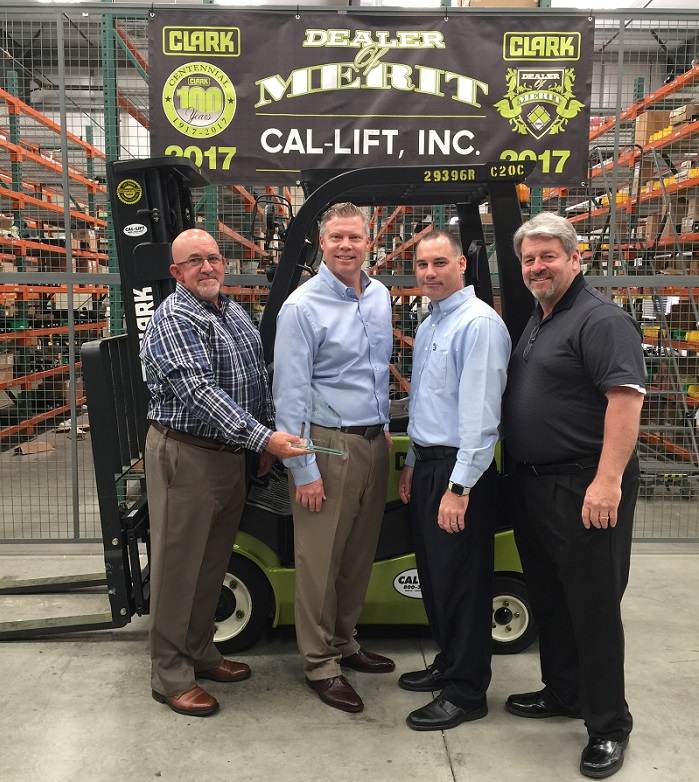
At the recent annual celebration for CLARK Material Handling dealerships, Cal-Lift Inc. was honored to be recognized as a CLARK “Dealer of Merit.” This award is reserved for dealerships whose service, parts and sales departments exceed CLARK’s stringent qualifications.

“We are very proud of all of our employees who helped make this possible” said our President, Mark Maechling. “Without the dedication of each and every employee at Cal-Lift, these types of honors would not be possible” he added.

Cal-Lift, Inc. believes that by operating at a high level of ethics and responsibility, we are best able to serve our customer’s short, and long-term goals, and is represented in our Mission Statement.

“We are Cal-Lift.  We succeed because we make a difference for our customers and manufacturers by providing the right equipment supported by superior parts and service.

Our success depends upon us being a customer-focused team. We empower our people to make good decisions. We partner with our manufacturers to deliver the highest value equipment solutions.  We seek to forge strong long-term reciprocal relationships with our customers.

By doing all the above, we establish the foundation to maintain consistently strong and stable financial and market performance.”

Along with our Dealer of Merit Award, Cal-Lift’s Rental Manager, Charlie Schwasz was recognized by CLARK as “Rental Manager of the Year.” Charlie received this national recognition above all other CLARK dealership’s rental managers because of his dedication to providing the rental equipment our customers need, when they need it, and making sure that it is in top operating condition. All of us at Cal-Lift Inc. congratulate Charlie and thank him for his dedication to our customers.

PHOTOS:

DOM Award - smLeft to Right (Mike Marrs, VP Sales, Cal-Lift; Mark Maechling, President, Cal-Lift; Herb Michelli and Rick Dalhke, CLARK Material Handling)
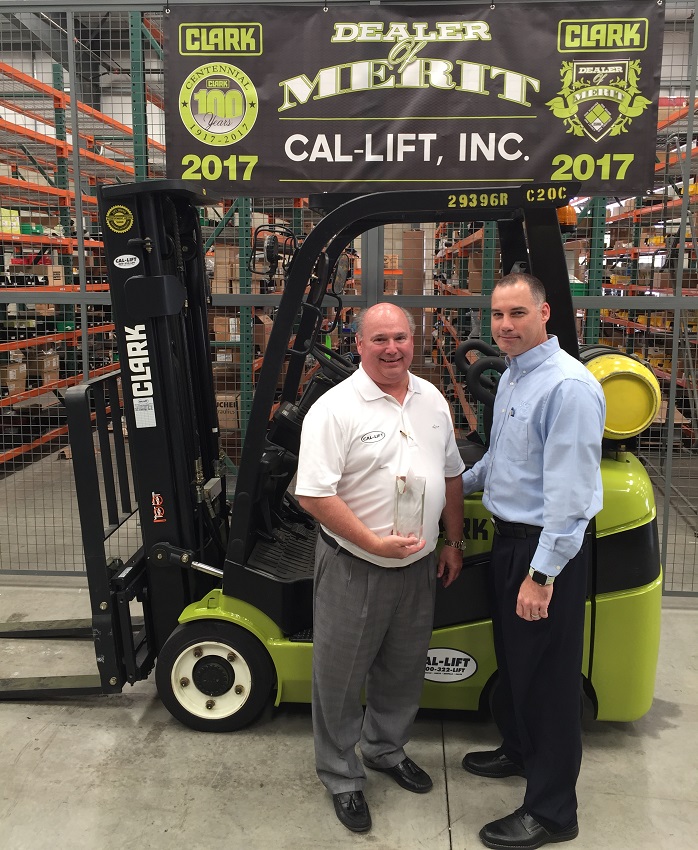
Charlie SchwaszLeft to Right (Charlie Schwasz, Rental Manager, Cal-Lift Inc.; Rick Dalhke, CLARK Material Handling)

CLARK GEX Electric Forklifts

4,000lb. – 10,000lb. Capacities

100% All AC Electric, 80 Volts

Solid Pneumatic Tire

See more specs at our website.

Electric forklifts like the GEX are a rare breed. Many models are not engineered or equipped to work outdoors in the elements. Not the GEX! CLARK Material Handling’s GEX is built to perform indoors and outdoors, with capacities to handle the tough applications traditionally reserved for internal combustion models. GEX’s features include:

80 Volt, 100% AC Electric Power

  • HIGH PERFORMANCE – Rivals IC truck performance in speed, acceleration and gradeability
  • MORE EFFICIENT SYSTEM – Higher voltage = lower line loss & heating = greater efficiency
  • BETTER SUITED TO RAPID CHARGE – Only requires one receptacle via single battery connector
  • INCREASED BATTERY CAPACITY – GEX 20/25 can accommodate 54 kwh battery; GEX 30/32 can accommodate 60 kwh battery

Drive Motors and Axles

FEWER PARTS & MINIMUM WEAR = LESS DOWNTIME

  • Enclosed, brushless
  • Thermal and stall protection
  • Dual/powered reversing for tighter turns
  • Suitable for Wet Applications
  • Same motors for E & EE

Regenerative Braking/Wet Disc Brakes

THREE FORMS OF REGENERATIVE BRAKING

  • Accelerator release (Proportional to accelerator position)
  • Change of direction (Proportional to accelerator position)
  • Service brake (Foot brake)

WET DISC BRAKES

  • Enclosed and oil cooled for smooth, quiet operation
  • Built with long life lining material
  • Less downtime

To learn more about CLARK’s GEX, get a demo or a quote, please contact us at 800-322-5438. We’re Southern California’s source for CLARK forklifts, OEM parts, service and rentals.

Section 179 Renewed for 2017

section-179-header

Jan 1, 2017 –   Section 179 is still affected by the “Protecting Americans from Tax Hikes Act of 2015” (PATH Act) that was signed into law on 12/18/2015. This bill expanded the Section 179 deduction limit to $500,000, where it will remain for all of 2017. For those interested, you may read the summary from the Ways and Means committee here.

Section 179 Deduction: Until further notice, Section 179 will be permanent at the $500,000 level. Businesses exceeding a total of $2 million of purchases in qualifying equipment have the Section 179 deduction phase-out dollar-for-dollar and completely eliminated above $2.5 million. Additionally, the Section 179 cap will be indexed to inflation in $10,000 increments in future years.

50% Bonus Depreciation will be extended through 2019. Businesses of all sizes will be able to depreciate 50 percent of the cost of equipment acquired and put in service during 2015, 2016 and 2017. Then bonus depreciation will phase down to 40 percent in 2018 and 30 percent in 2019.

IMPORTANT THIS YEAR: Section 179 for Current 2017 Tax Year
Section 179 can provide you with significant tax relief for this 2017 tax year, but equipment and software must be financed and in place by midnight December 31, 2017. Use this 2017 Section 179 Calculator to see how much the Section 179 tax deduction can save your company.

2016 Section 179 Tax Information (Last Year)

The PATH ACT passed in December of 2015 affected 2016 and beyond, making the Section 179 deduction for 2016 $500,000. In addition, the 50% Bonus Depreciation was reinstated.
Click Here for the fully updated Section 179 Calculator for tax year 2016 (Last Year).

Answers to the Three Most Common Section 179 Questions

How Much Can I Save on My Taxes in 2017?
It depends on the amount of qualifying equipment and software that you purchase and put into use. See the handy Section 179 Calculator that’s fully updated for 2017, and includes any/all increases from any future legislation.

What Sort of Equipment Qualifies in 2017?
Most tangible business equipment qualifies. Click here for qualifying property.

When Do I Have to Do This By?
Section 179 for 2017 expires midnight, 12/31/2017. If you wish to deduct the full price of your equipment from your 2017 taxes and take advantage of the new higher deduction limits, it must be purchased and put into service by then.

Many businesses are finding Section 179 Qualified Financing to be an attractive option in 2017, especially since the expected Federal Discount Rate increases don’t leave much time for action. Please apply today.

More Section 179 Deduction Questions Answered

Welcome to Section179.Org, your definitive resource for all things Section 179. We’ve brought together a large amount of information regarding Section 179, and clearly and honestly discuss the various aspects of IRS §179 in plain language. This will allow you to make the best possible financial decisions for your company.

Section 179 can be extremely profitable to you, so it is to your benefit to learn as much as possible. To begin, you may have a lot of questions regarding Section 179 such as:

We’ll answer all of these questions, and make certain that you come away with all of the knowledge you need to make smart business decisions in this 2017 tax year regarding equipment and/or software purchasing and Section 179.

Why? Because if you’ve been thinking about buying or leasing new equipment and/or software, it’s definitely to your advantage to use this excellent tax break.

Successful businesses take advantage of legal tax incentives to help lower their operating costs. The Section 179 Deduction is a tax incentive that is easy to use, and gives businesses an incentive to invest in themselves by adding capital equipment. In short, taking advantage of the Section 179 Deduction will help your business keep more capital, while also getting needed equipment, vehicles, and software.

Free Tools that Make Calculating Section 179 Deductions Simple

Section 179 is really very simple. You buy, finance or lease qualifying equipment and/or software, and then take a full tax deduction on it this year (also, there are a few other things, which we’ll go over, but in a nutshell, that’s the idea). To give you an estimate of how much money you can save, here’s a Section 179 Deduction Calculator to make computing Section 179 deductions simple.

If you use the calculator, take note of the savings on your tax obligation. Many people find that, if they lease or finance their Section 179 qualified equipment, the tax savings actually exceed the first year’s payments on the equipment (making buying equipment profitable for the current tax year). This is perfectly legal, and a good example of the incentive that Section 179 provides small and medium businesses.

Visit our website to learn more about our line-up of new material handling equipment, including:

Cal-Lift is your source in Southern California for quality material handling equipment, service, parts and rentals. Visit our website to learn more. Then contact us for a quote at 800-322-5438.


Cal-Lift Welcomes New Customer

All of us at Cal-Lift Inc. appreciate the opportunity to demonstrate our ability to delivery the best material handling products, service, parts and lift truck rentals to new customers. And this month, we appreciate that opportunity given to us by our newest customer, Double-R Trading.

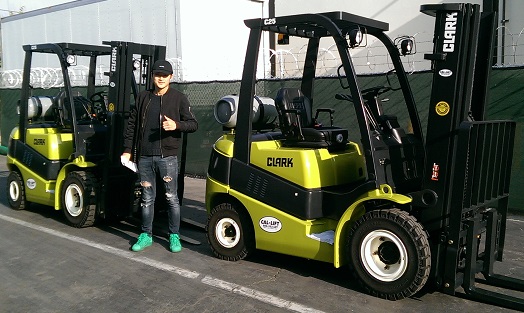
Double-R Trading, located in City of Industry has specialized in plastic recycling since 2013 and recently upgraded their forklift fleet by ordering (2) new CLARK C25L, 5,000lb pneumatic tire forklifts for their fleet.

This picture features John Fang, Operations, of Double-R, taking delivery of the new forklifts. We welcome Double-R to the Cal-Lift family and look forward a productive future for us both!

double-r-trading-new-clarks

CLARK Centennial Edition Forklift Unveiled


In 2017, CLARK Material Handling is celebrating 100 years of producing some of the world’s highest quality material handling equipment and they are celebrating by introducing the CLARK Centennial Edition forklift series.

All CLARK GEN2, pneumatic forklifts, 3,000lb to 7,000lb will automatically include;

  • Special Centennial Edition Paint Scheme
  • Centennial Edition Package Logos
  • Special Seat Trim to Commemorate the Milestone
  • In addition to the Centennial Edition forklifts, CLARK is extending ALL CLASS 1, 2, 4 and 5 forklift warranties for 2017. The special warranty includes an additional 1 year to the existing warranty or 2,000 hours, whichever comes first. CLARK Centennial Warranty for 2017

Cal-Lift Inc. is proud to be your source in Southern California for CLARK forklifts. We will be celebrating this milestone with them all year, and hope you will join us.

Visit our CLARK Material Handling Showroom to see their line-up of forklifts

Four Reasons to Consider Electric Forklifts

Slowly but surely, electric forklifts are carrying more of the daily material handling load. Some of the reasons are obvious, but it is clear to most that eventually we must do more than continue to burn fossil fuels in the transportation of our products.

We still have a ways to go before electric forklifts can perform all the tasks as well as their LP forklift counterparts. However, most forklift manufacturers are improving performance and outdoor durability with each passing year. It is only a matter of time before they catch up.  There a good reasons for this transfer of power, a few major reasons are:

  1. Reduced maintenance costs – Electric forklifts have fewer moving parts than their internal combustion counterparts. Fewer parts, means reduced maintenance, which results in a considerable reduction in maintenance.
  2. Greatly reduced environmental impact – Electric forklift do not burn fossil fuels, reducing carbon footprint. They also require no disposal of motor oils. The units stay cleaner as a result and so does your operation!
  3. Improved ergonomics and working environment – Electric forklifts are quieter with nearly no vibrations to deal with. This provides a more comfortable operating atmosphere for your forklift operators as well as the rest of the personnel that work around your lift trucks. Noise in your facility is reduced to almost zero when it comes to your lift trucks, making communications between employees easier.
  4. Supply chain trends to go green – Every year, more and more companies are encouraging if not outright requiring their suppliers to improve their impact on the environment and electric forklifts are one of the major steps that companies are taking to do so.

While we have some work to do, it’s pretty clear that electric forklifts are making great strides to become a mainstay in materials handling equipment. And right now with the introduction of Lithium Ion Batteries in our BYD Forklift line-up and Section 179 tax deductions, there has never been a better time to consider trading in your internal combustion forklifts for a smooth running, cost saving electric powered lift truck.

To learn more about electric lift trucks and what they can mean to your operation, please contact us at 800-322-LIFT.

Four Essentials of a Safe Forklift Fleet

There are plenty of simple, small things you can do to improve forklift safety in your facility. These include keeping the floor clean, installing mirrors at the ends of your aisles and prominently displaying safety posters. We have identified five best practices within companies that take forklift safety to the next level.  They are:

  1. Operator and Pedestrian Training – When we say training, we mean true training. A one-day class and a 10-minute hands-on review will not suffice if your goal is to make your forklift fleet a truly safe one. In addition to initial training and refresher training, you must be sure you re-train staff any time you introduce a different piece of equipment, if an operator is re-assigned or if your operation or facility undergoes any significant changes.  In addition to operator training, you should ensure the safety of all your employees and guests by providing training to every employee about how lift equipment operates, the inherent dangers of being around them and how to conduct themselves in a facility with this equipment.
  2. Utilize available safety equipment – Ensuring that all your lift equipment and facility is equipped with up-to-date and working safety functions will go a long way in creating awareness of the presence of lift equipment. Back-up alarms, horns, lights (front and rear combo) and strobes are the hallmarks of forklifts that are easily seen and heard. In addition, be sure to ask your forklift provider about available optional safety equipment.
  3. Planned maintenance – A robust planned maintenance program will catch small maintenance issues before they blossom into giant repair headaches. This will also dramatically reduce potential accidents, making your facility a safer place to work. Your planned maintenance program should be developed based on how your forklifts are utilized, your manufacturers recommendations and should be carried out by a professional, trained staff of forklift technicians.
  4. Regular Inspections – We recommend two types of inspections. The first, as required by OSHA, are daily inspections and are a must for any company. Your operators must be trained to perform accurate and thorough inspections of both Internal Combustion (IC) forklifts, electric forklifts, and any other type of lifting equipment you operate. Damage from previous operations can occur without the operator knowing it, and failure of major components can lead to serious injury, product loss and facility damage. In addition, putting your forklift fleet on a regular service cycle or Planned Maintenance Program, performed by lift truck professionals. This is the key to achieving maximum safety, up-time and productivity.

The benefits of a safe forklift fleet go far beyond reducing injuries. They include:

  • Lower Costs – Having safe forklift operators and providing a safe operating environment, like having safe automobile drivers and better roads, will reduce your operating costs. The frequently inspected equipment will operate within normal guidelines and minor service issues won’t blossom into giant repair headaches.
  • Improved Productivity – Safe operators in a safe environment will be more productive, since down time is reduced as a result of sound equipment and reduced operator and pedestrian accidents.
  • Reduced Insurance and Workers Compensation – A safe work environment with well-trained operators will likely result in lower insurance rates and workers’ compensation in injury-related claims.

Forklift safety is no accident. Taking these measures puts you on the path to creating a safe and productive work environment for your employees.  An investment in safety and productivity adds to your company’s long-term bottom line and benefits those who operate on and around forklifts.

Have a question about forklift safety, training, service or planned maintenance? Please contact your local Cal-Lift branch, or give us a call at 800-322-5438.

OSHA Announces Top 10 Violations for 2016

Every October, the Department of Labor’s Occupational Safety and Health Administration releases a preliminary list of the 10 most frequently cited safety and health violations for the fiscal year, compiled from nearly 32,000 inspections of workplaces by federal OSHA staff.

One remarkable thing about the list is that it rarely changes. Year after year, OSHA inspectors see thousands of the same on-the-job hazards, any one of which could result in a fatality or severe injury.

More than 4,500 workers are killed on the job every year, and approximately 3 million are injured, despite the fact that by law, employers are responsible for providing safe and healthful workplaces for their workers. If all employers simply corrected the top 10 hazards, we are confident the number of deaths, amputations and hospitalizations would drastically decline.

Consider this list a starting point for workplace safety:

  1. Fall protection
  2. Hazard communication
  3. Scaffolds
  4. Respiratory protection
  5. Lockout/tagout
  6. Powered industrial trucks
  7. Ladders
  8. Machine guarding
  9. Electrical wiring
  10. Electrical, general requirements

It’s no coincidence that falls are among the leading causes of worker deaths, particularly in construction, and OSHA’s top 10 list features lack of fall protection as well as ladder and scaffold safety issues. We know how to protect workers from falls, and have an ongoing campaign to inform employers and workers about these measures.

OSHA says far too many workers are killed or gruesomely injured when machinery starts up suddenly while being repaired, or hands and fingers are exposed to moving parts. Lockout/tagout and machine guarding (including lift trucks) violations are often the culprit here. Proper lockout/tagout procedures ensure that machines are powered off and can’t be turned on while someone is working on them. And installing guards to keep hands, feet and other appendages away from moving machinery prevents amputations and worse.

The high number of fatalities associated with forklifts, and high number of violations for powered industrial truck safety, tell us that many workers are not being properly trained to safely drive these kinds of potentially hazardous equipment.

Rounding out the top 10 list are violations related to electrical safety, an area where the dangers are well-known.

Their list of top violations is far from comprehensive. OSHA regulations cover a wide range of hazards, all of which imperil worker health and safety. They urge employers to go beyond the minimal requirements to create a culture of safety at work, which has been shown to reduce costs, raise productivity and improve morale. To help them, OSHA has released new recommendations for creating a safety and health program at their workplaces.

OSHA has many additional resources, including a wealth of information on their website and their free and confidential On-site Consultation Program. But tackling the most common hazards is a good place to start saving workers’ lives and limbs.