Determining the Best Time to Replace Your Material Handling Equipment

Even a well-maintained forklift fleet needs to be replaced at some point in time. Knowing exactly when can be a difficult thing to ascertain. Industry averages reveal that somewhere between 8,000 hours and 10,000 hours of use is when you’re going to reach an optimal point to replace your forklifts. Some questions to ask to help determine if it is time include:

  • What type of operation does each forklift perform each day? Does your forklift face harsh conditions like heat, dust, rough terrain or any other condition that would put undue stress on the engine, transmission or hydraulics?
  • Is your forklift put to the test each and every lift, lower and transport? Does it handle its maximum capacity more than half the time, or less?
  • Does your forklift do a lot of starting, stopping and backing up? Does it frequently conduct long runs in large open areas?
  • Have you adequately maintained the equipment using a regularly scheduled Planned Maintenance Program?
  • How has the cost of repairs for each unit changed over the past two to three years? A dramatic increase in repairs (not normal planned maintenance or normal wear parts) can indicate that you’re spending more than you should on repairs. A cost-per-hour analysis may be in order.

The not-so-obvious costs associated with worn forklifts is downtime, lost productivity and the short-term cost of replacing them with rentals. These costs may not show up on a unit’s cost per hour, but they are costs nonetheless. Keeping count of rentals due to downtime and repairs is essential in determining replacement, as new forklifts will all but eliminate your rentals due to downtime.

There are other reasons that may eliminate the guesswork and actually require you to replace your aging fleet:

  • Safety features are outdated and cannot be updated properly. For example, safety requirements may change and a new safety harness system would replace traditional seatbelts. Also, if safety options have improved fleet safety and the cost to update them would be prohibitive, it would be a good time to consider replacement.
  • If your forklifts are exhibiting signs of unsafe operating conditions like hydraulic failure, equipment shaking or jerking or leaking components, it’s likely time to replace the units.

Another reason to consider updating your forklift fleet are improvements in technology, hardware or performance. For example, now that electric forklifts have become more powerful and reliable outdoors, it could be a great time to consider replacing your IC forklifts.

As you can see, looking at the hour meter is not the sole solution that it used to be to consider replacement. We would be glad to consult with you to assess your fleet condition and help you determine if now is a good time to consider your forklift fleet retirement or replacement. Just give us a call at 800-322-5438. Visit our website to see our new forklift line-up.

3 Reasons to Convert to Electric Forklifts in 2020

The last decade has led to many improvements in electric forklifts. Not only have they been built to withstand outdoor usage; battery and charger technology has changed dramatically. These advancements have led to a dramatic increase in electric forklift sales. The chart below shows the increasing disparity between electric and traditional forklift deliveries (chart from Industrial Truck Association presentation to the ITA President’s Forum in Coronado, California in 2019)

In 2019, the number of electric forklifts increased to 70% of forklift deliveries. As you can see, the benefits are starting to be realized by more and more companies.

Driving this growth in the electric forklift market are two primary considerations: costs and environmental concerns. While capital costs for electric forklifts are higher than their internal combustion counterparts, the decrease in fuel and maintenance costs more than make up the difference over the forklift’s useful life. But there are other factors that influence the decision-making process and causing more users to convert to electric forklifts. The top four that we observe include:

Costs – As previously stated, an electric forklift and accompanying batteries and chargers result in a higher capital investment upfront, but those initial costs are more than compensated for over time. An electric forklift produces no heat, has far fewer moving parts (no belts, fans, pumps, filters, oil, etc.).

Some estimates put maintenance costs for electric forklifts at 40% less than internal combustion counterparts (First Energy)

In addition to maintenance costs, energy costs for electric forklifts are far less costly than for LPG-, diesel- or gas-powered forklifts. The cost per hour to operate an internal combustion forklift can be as much as $.75. LP tanks are almost always exchanged with fuel still remaining in the tank. Unless you’re getting credit on unused LP fuel, you’re paying for fuel that you’re giving back to your LP provider. Visit the Electric Power Research Institute to use their savings calculator to compute a rough estimate of your own savings. We realize that not all material handling operations are identical and your savings may vary, but the illustration certainly demonstrates that it is less costly to operate electric forklifts.

Health and Safety – Electric forklifts eliminate harmful carbon monoxide and carbon dioxide from your facility, greatly improving the air your employees breathe. The effects of a build-up of CO can result in nausea, headaches, disorientation and in some cases, hospitalization and even death. This is compounded in the colder months where windows and dock doors are often not opened.

Utilizing electric forklifts allows you to keep the doors and windows closed at any time without fear of creating an unsafe work environment for your employees.

Flexibility and Performance – Just 10 years ago, electric employees could rarely compete with internal combustion forklifts, particularly outdoors. This is no longer the case. Electric forklift and charging technology have advanced greatly: fast-charge system, opportunity charging, sealed batteries and motors, and Lithium Iron Phosphate battery technology, which eliminates battery-charging altogether. Battery capacity and energy efficiency have also allowed electric forklifts to be produced in much higher capacities than in previous years. These advancements have changed the landscape of electric forklift operation. There are now few operations where electric forklift cannot compete with IC forklifts.

There has never been a better time to explore electric forklifts to replace your internal combustion fleet. Contact us at 800-322-5438 for a consultation and quote. You will be on your way to a cleaner and more efficient material handling and storage operation.

The Benefits of Renting Forklifts

Often times companies find them in a situation where they need to increase their forklift or other material handling and storage equipment fleet, but want to conserve capital for other operational objectives. This is where renting equipment on a short-term or long-term basis can be a great alternative to purchasing or traditional financing. These benefits include:

Cash Conservation – There is no cash outlay to obtain equipment under a Long-Term rental agreement. Save your cash for alternatives that produce profits for your bottom line.

Pay for what you use – Long-Term rental agreements are based upon the expected hours and operating conditions that you will use the equipment. Unlike purchasing equipment where you are paying for 100% of asset (a depreciating asset), you pay based upon the expected usage rate of the equipment.

Rental payments are 100% tax deductible* – Rental payments are an operating expense and are 100% deductible as a business expense. No confusing depreciation schedules or damaging tax ramifications at years-end. *(consult your financial adviser to confirm your tax status)

Fixed payments, no maintenance surprises – Long-Term rental agreements typically include normal maintenance. We own the equipment, so maintaining it is our responsibility. Leave the surprises to us and keep your material handling costs consistent and predictable.

Eliminate your parts and service departments – If you currently own your fleet and maintain it you need mechanics, tools and parts. Improve warehouse and plant space by eliminating the need for stocking parts and providing space to service equipment.

Eliminate obsolescence – Long-Term agreements can provide for upgrades should your business change. Don’t get stuck with equipment you no longer need due to a change in your business plans. We will find a home for the old equipment, and provide you with equipment you need today.

Keep your credit line clear – Unlike financing equipment, Long-Term Rentals have little impact on your ability to borrow money to increase your business.

Flexible terms and equipment – Whether you need new or used equipment for your operation we can provide you with the equipment you need at the terms you need. From one year to eight we can build a Long-Term rental agreement that meets your business needs.

Eliminate stand-by equipment – Do you purchase more than you need to allow for break-downs and cyclical needs? Our forklift rental fleet stands ready to supply you with immediate equipment when a need arises.

Renting hedges against inflation – Reduce the risk of labor and parts prices increases by fixing your monthly payment now for the term of your agreement.

Generate cash now – Trading in your current fleet can generate immediate cash for operations.

Flexibility, reliability and consistency are your results when you rent Long-Term with Cal-Lift Inc. In addition you will have the comfort of knowing that you have a team of professionals with a proven track record as a true partner in your material handling operations. We take all the hassle out of acquiring and maintaining a fleet of forklifts and leave you with more time to manage your business.

We would appreciate the opportunity to discuss rentals options for your company. To schedule an appointment  contact us at (800)-322-5438.

Proper Forklift Fork and Chain Inspections

Forks and chains lift hundreds of thousands of pounds each shift, and unchecked wear on either can cause a load to come crashing to the ground.  This can result in severe damage to property, or even the death of an employee. Below are some specific areas to inspect to help ensure forks and chains are in safe operating order.

Fork Inspection. Knowledge of metallurgy or its equivalent is not necessary to perform OHSA inspections, but operators must nonetheless pay attention to these key metal-related areas when examining forks.

  • Rated load capacity. Are the forks rated to carry the loads they are handling? An excellent online calculator is available here.
  • Surface cracks. Inspect each fork top and bottom for surface cracks. Pay close attention to the heel area and the welds to the areas that attach the forks to the lift truck. These areas are most likely to develop cracks. If a crack is found, the fork must be replaced before the lift truck is put back into service. OHSA does not permit a damaged fork to be repaired.
  • Straightness of the blade and shank. If either the shank or the blade has any sort of bend, the fork must be replaced before the lift truck is put back into service.
  • Excessive angle. If the shank and blade angle exceed 93 degrees, the fork must be replaced before the lift truck is put back into service.
  • Fork tip height variances. If the fork tips exceed 3 percent of the length of the blade, the forks need to be replaced before the lift truck is put back into service. For example, for 48-inch forks, the differences in the heights of the tips of your blades cannot exceed 1.44 inches.
  • Positioning lock. If the positioning lock is inoperable, it must be replaced before the fork is put back into service on the lift truck.
  • Normal wear. Use calipers to measure the heel and the blade for wear. These are the areas that wear most quickly. Once wear reaches 10 percent, the fork must be replaced. Ten percent wear results in a 20 percent reduction in rated fork capacity and represents a significant exposure for accident.

Chain Inspection. Forklift chains endure tremendous stress during operation and are subject to additional damage and wear by environmental conditions such as dust, rain and industrial chemicals. Carefully inspect chains for the following:

  • Chain elongation. Elongation of more than 3 percent indicates a 15 percent reduction in strength and means the chain should be replaced.
  • Rust and corrosion. Chains showing any rust or corrosion should be replaced. For maximum protection, chains must be completely lubricated at all times.
  • Plate cracking. Inspect closely for cracks. The discovery of any crack means the chain should be replaced before the forklift is put back into service.
  • Protruding or turned pins. Lack of lubrication results in friction between the plates and the pins, causing the pins to twist and turn their way out of place. The result is chain failure.
  • Misalignment. Look for wear patterns on pinheads or outside plates. Continued operation will result in damage to the chain and sheaves, potentially causing the chain to fail.
  • Chain anchors and sheaves. Inspect anchors for misalignment, damage or undue wear. Anchors with worn or broken fingers must be replaced.

Cal-Lift strives to help operators maintain compliance with OSHA regulations, but more importantly, we help maintain both forklifts and chains, ensuring employees are safe and productive.

If you find your forks or chains worn or damaged, please call us at 800-322-5438 to get a replacement quote.

Download our “Fork Inspection Guide and Log.”

Join the Electric Forklift Revolution

Twenty years ago, companies with a 24 hour operation moving 8,000lb loads indoors and outdoors would have laughed off a suggestion of an electric forklift being able to replace their internal combustion fleet. Those days are long gone. In fact, through June of this year, nearly 70% of the new forklifts purchased in the US have been powered by electricity!

And there is good reason. The benefits of operating electric forklifts are many and the drawbacks are few. Over the past decade, manufacturers of electric forklifts have worked tirelessly to improve the performance of electric forklifts so they can do the jobs previously relegated to their IC counterparts. The results are impressive. Most manufacturers have models that can be used indoors and outdoors with capacities often exceeding 10,000lbs. They’ve equipped them with pneumatic tires and sealed components to ensure your electric forklift will continue to perform flawlessly, whether it’s sunny and 100 degrees or rainy and 40 degrees.

In addition, battery and charger manufacturers have improved technology to make batteries more efficient, longer lasting, and less costly. Lithium batteries are now being manufactured to fit existing forklift models, which eliminates battery changing, storage and multiple batteries for each lift truck. Let’s take a quick look at the benefits of owning and operating electric forklifts.

Electric Forklifts Eliminate Emissions

The values of today’s business owners have changed. Twenty years ago, few of us were concerned with our carbon footprint. Today, that is taking front and center page with many companies’ strategies to be carbon neutral. Electric forklifts are a great way to help companies achieve this. One study found that a 2,000 hour operation emitted 20,000lbs of carbon into the atmosphere for each forklift operated! Electric forklifts emit zero emissions.

This also makes for a safer and more comfortable working environment for your employees. Eliminating carbon monoxide from your plant or warehouse operation equates to a much more desirable workplace. Many companies enjoy fewer sick days, reduced medical expenditures and improved productivity.

Fuel Savings

While batteries and chargers require an additional up-front investment in your forklift fleet, the long-term benefits prove to far outweigh those costs. Some studies reveal that powering an electric forklift can save over $4,000 per year, per forklift!

Reduced Maintenance Costs

Electric motors produce no heat. This means less heat pumped into your facility, reducing cooling costs and making it a more comfortable place to work. Your forklift operators no longer sit on top of an engine producing heat in excess of 130 degrees for an 8 hour shift. In addition, electric forklifts produce no noise except for the tires and operation of the mast. This reduces wear on your forklift operators’ auditory systems, making them more comfortable to operate.

Electric forklifts require no operating fluids and have far fewer moving parts. Eliminating the need for transmission fluid changes, oil changes, cooling system fluids and more reduces your costs. It also eliminates transmission parts, water pumps, radiators, and other engine parts that need replacing.

By eliminating many moving parts and fluids, electric forklifts spend less time down for periodic maintenance, servicing and repairs. This often eliminates the need for temporary rentals or “extra” units to operate while your IC forklift is being serviced or repaired.

We realize there still are some applications where electric forklifts are not suitable, but given time, the industry will provide a solution. For example, in the fall of 2019, one of our manufacturers, Taylor Machine Works produced two giant 90,000lb capacity container movers. The industry will continue to respond to the demand of consumers to produce cleaner, more durable products with even higher capacities.

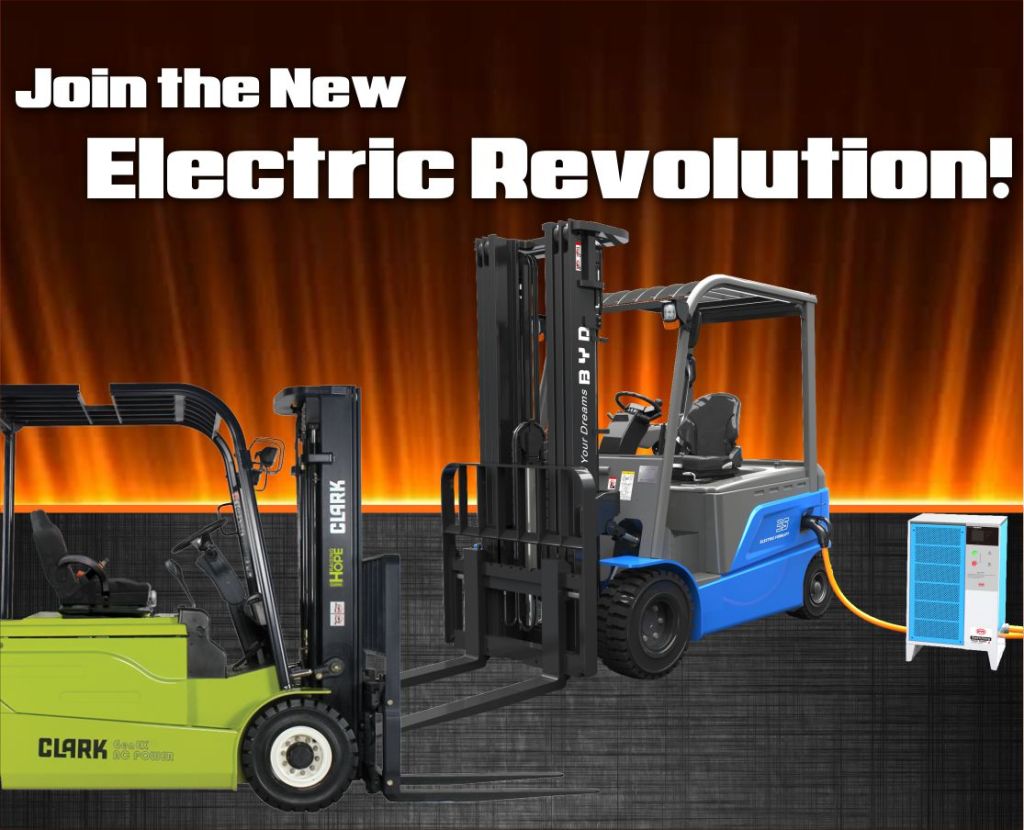
See our line-up of CLARK electric forklifts and industry changing, BYD electric forklifts featuring Lithium Iron Phosphate batteries which eliminate additional batteries, storage and changing.

Reduced costs, improved health and safety, and environmental improvement are all benefits you can enjoy by converting your internal combustion forklifts over to electric models.

Forklift Safety Day 2020; What You Can do to Celebrate

The Industrial Truck Association has announced it’s second annual Forklift Safety Day, to be held Tuesday, June 9. While the in person events have been cancelled due to the Coronavirus, there are things you can do to take advantage of this day to help create awareness about the dangers that forklifts present and how to minimize the potential for accidents that can result in injury or death, damage to your facility, equipment and financial losses.

We’ve compiled a short list of things you can do on June 9th to improve safety on and around your forklifts.

  1. Make sure all your forklift operators have been trained and that their refresher training is up to date, if applicable or necessary.
  2. Download our Forklift Operator Questionnaire to help you vet new operators about their actual experience and history with forklifts.
  3. Take time to teach your forklift operators the importance of daily inspections of their forklifts. Daily inspections reduce the risk of equipment failure and catch small problems before they blossom into giant ones. Download our IC Forklift Inspection Form and Electric Forklift Inspection Forms.
  4. Take some time to gather any staff that operates around forklifts, but not on them, to refresh them about the dangers of this equipment and how to be sure to use safe procedures when they are in an area of your facility where forklifts are being operated.
  5. Make sure all your forklift’s maintenance is up to date. If you have a Planned Maintenance Agreement, this would be a good time to review it with your service provider to ensure all standard checkpoints as well as unique equipment attachments are being inspected and maintained properly. Learn more about Cal-Lift Services.
  6. Review any unique “site specific” features your facility may have and be sure your operators are aware of proper handling of equipment while on or around these features (ramps, areas where floors can be slick, floor substrates that vary etc…)
  7. Make sure that training is part of your company’s orientation for anyone that will or MIGHT operate a forklift. Remember, employees that have not been properly trained aren’t even allowed to sit on and start a forklift, much less move it out of the way of anything.
  8. Make sure you have lock-out kits to ensure that forklifts that do not pass an inspection are locked out immediately until repairs are made.
  9. Review all your forklifts for possible replacement. Old forklifts, or those that are getting “up there” in hours, might be potential threats. Review safety records and maintenance logs for your equipment. You might find this could be a good time to replace some or even all of your forklifts.-

Our goal is to help you operate safe, efficient and productive forklift equipment in and around the Southern California area. To discuss forklift safety, planned maintenance – or to get a quote on new equipment, please contact us at 800-322-5438.

4 Tips to Improve Dock Safety

Improving safety on a warehouse dock is crucial for preventing accidents and maintaining a secure work environment. Here are some recommendations to enhance safety:
  1. Conduct regular safety training: Train all dock workers on proper safety protocols, including equipment operation, handling hazardous materials, and emergency procedures. Offer refresher courses periodically and ensure everyone understands safety regulations.
  2. Provide personal protective equipment (PPE): Supply all workers with appropriate PPE, such as hard hats, safety glasses, high-visibility vests, steel-toed boots, and gloves. Encourage their consistent use and enforce PPE policies.
  3. Maintain clear communication: Establish effective communication systems, such as two-way radios or intercoms, to allow clear communication between dock workers, truck drivers, and supervisors. Ensure everyone can effectively relay information, warnings, and instructions.
  4. Implement traffic management: Develop a comprehensive traffic management plan for the dock area to prevent collisions and improve pedestrian safety. Clearly mark pedestrian walkways and separate them from vehicle lanes. Install signage and mirrors to enhance visibility, and consider using barriers or guardrails where necessary.
  5. Ensure proper lighting: Adequate lighting is essential for a safe dock environment. Install sufficient lighting fixtures to eliminate dark areas and shadows that could obscure visibility. Regularly inspect and maintain lighting systems to address any issues promptly.
  6. Regular maintenance of equipment: Establish a planned maintenance program for all dock equipment, including forklifts, loading ramps, and conveyor systems. Regular inspections and maintenance help identify potential hazards, preventing equipment malfunctions that could lead to accidents.
  7. Promote good housekeeping: Encourage a clean and organized work environment. Ensure that walkways, ramps, and loading areas are free of clutter, debris, spills, and obstacles that can cause slips, trips, or falls. Provide adequate waste management systems to prevent accumulation of waste materials.
  8. Implement safety barriers and guards: Install safety barriers, guardrails, and bollards to protect pedestrians and prevent unauthorized access to restricted areas. Implement dock edge protection systems to prevent accidental falls from the dock.
  9. Use warning signs and labels: Clearly display warning signs and labels to communicate potential hazards, such as restricted areas, low clearance, slippery surfaces, or areas with moving equipment. Ensure signage is prominently visible and easily understood.
  10. Regular safety inspections: Conduct routine safety inspections to identify potential hazards, non-compliance with safety protocols, or equipment issues. Encourage reporting of safety concerns by workers and promptly address any identified problems.
  11. Emergency preparedness: Develop and communicate emergency procedures specific to the dock area. Clearly mark emergency exits, fire extinguishers, and other safety equipment. Conduct drills periodically to ensure workers are familiar with emergency protocols.
  12. Encourage employee involvement: Involve employees in safety initiatives by establishing a safety committee or encouraging their participation in safety discussions. Encourage workers to report safety concerns, near-miss incidents, or potential hazards, and reward proactive safety behavior.

Partnering with a professional material handling company gives you insight from industry professionals whose goal is to help you create a safe working environment for anyone that operates in or around your docks.

We’re Southern California’s source for material handling equipment, service, parts and rentals. Give us a call at 800-322-LIFT.

Stay Strong America During Covid-19

Stay Strong America Page Header

Cal-Lift is bullish on the Covid-19 virus. This country, and the World have seen far darker days and we’ve overcome them. Right now, it’s important we all, the World and American citizens do the right thing to overcome this crisis. By working together, looking out for each other and doing the right thing, it won’t be too long until we can resume our normal lives.

Our idea for this page is to bring you information, news and tips to help you and your employees through these trying times. We’ll provide links to useful information and news to help all of us understand that we will be ok as a nation and it will be sooner rather than later.

Cal-Lift Corporate Bulletin Regarding Covid-19
The transportation and logistics industry has been designated a “Critical Infrastructure Segment” under Presidential Policy Directive 21 and Department of Homeland Security emergency readiness programs implementing the USA PATRIOT Act of 2001. 42 U.S.C. § 5195c(e). It is therefore the policy of the United States government that these industries continue to function with minimal disruption in the event of an emergency.

Furthermore, in a March 16, 2020 guidance, the President of the United States instructed that employees of Critical  Infrastructure Industries, including the transportation and logistics sector, should be permitted to continue to perform their normal job functions during the Coronavirus pandemic.

What We’re Doing to Ensure Your Safety
We have been working with our staff to ensure they are taking the proper precautions not only here, but when working at your facility. Our goal is to continue to provide you with the great service and support you’re used to, without undue exposure to this virus.

Useful Covid-19 Links
Positive and Useful Covid-19 Related Articles

Working together, our region and our nation will get through this. History has shown we are resilient and by working together can and will continue to weather adversity. Hopefully, if we all work together and do the right things for our fellow citizens, this will soon pass and we can get back on the path of productivity.

About Cal-Lift
Cal-Lift is Southern California’s source for material handling equipment, service, parts, rentals and training. We are here for you, fully operational during this crisis. Please contact us for any of your material handling needs at 800-322-LIFT.

The Benefits of Electric Forklifts

There is little doubt that the world is looking for cleaner and more responsible products to use in nearly every facet of life.  So it only makes sense that forklift companies and their suppliers would be looking at alternative and cleaner burning energy sources.  The surprise is that technology is allowing manufacturers to build forklifts that not only reduce carbon footprints, but also use less energy, cost less to operate, and in many instances, are providing as much power as their internal combustion counterparts.  This is leading to an obvious shift in the market and is prompting many manufacturers to invest more into research and development of this emerging trend.

Electric forklifts represent nearly 60% of the forklift market today, up from just 45% twenty years ago, and for good reason. More and more companies are realizing lower operating costs, including maintenance and fuel, reduced emissions in their facility and longer life out of their fleet. The major benefits of choosing electric forklifts include:

  1. Reduced costs – Fewer moving parts and less heat mean lower operating costs.
  2. Reduced fuel costs – If used appropriately, batteries and chargers cost less than LP, and energy costs are more stable.
  3. Reduced emissions – No output of carcinogens and carbons means improved operating conditions and better health for your employees.
  4. Improved operator ergonomics – IC engines produce not only emissions, but also vibration and heat, both of which contribute to operator fatigue.

The introduction of AC technology has been a major advancement of electric material handling equipment.  With the elimination of brushes, contactors and commutators, fewer parts need to be replaced, meaning reduced operating costs.  But beyond this, a lot of the advancement is coming from the power supply, your battery and charger. While manufacturers work to improve the efficiency and power of their forklifts, battery companies are working to provide the power in more efficient and convenient ways.

One of the major advancements in power supply for electric forklifts has been the High Frequency Charger.  HFC’s allow much more flexibility in how you charge your batteries and can reduce battery maintenance.  In addition they can also dramatically increase the life of your forklift batteries particularly if your operators are prone to opportunity charge, which happens to be a major cause of premature battery failure.

There are several lift truck battery companies leading the way in forklift battery charger options.  Engineering chargers and batteries that work the way you need them to work have been the key to designing combinations that provide the right amount of power for the right amount of time, and under the conditions you use them.

Traditionally a multi-shift operation needs two or more batteries, 8 hours of charging, 8 hours of cooling and multiple chargers for varying voltage batteries.  When the power begins to fade at the end of the shift, the operator is faced with the decision of changing batteries or opportunity charging (plugging in for short periods of time when it’s convenient).  We know that the decision tends to be opportunity charging and this affects battery life and increases costs.  High Frequency Chargers have changed all of that.

There has never been a better time to “go green” and take advantage of the advancements made in operating an electric forklift fleet.  By doing so you will have a safer and cleaner facility, reduced operating costs, and you will leave a smaller footprint behind while you improve the profits of your material handling operation.  Going green can provide your company with many benefits. To be sure you are setting up the right electric powered system we recommend the following:

  1. Consult with a dealership that has a great deal of experience with electric material handling equipment and can help you make the right choice.
  2. Talk with your operators to find out how they would use the new equipment, what would be most convenient for them, and how they use their LP equipment right now.
  3. If you have a large operation and can segment one department or facility, start there.  You can then tweak your program as you implement it in other areas.
  4. Be sure you are working with a partner that can help you select the right battery and charger combination.
  5. Be sure regular battery and charger maintenance is part of the plan.  Properly maintained batteries and chargers provide a much longer life and work more efficiently.

Allow us to be that partner to help you achieve these results.  You can count Cal-Lift to bring you the latest in material handling technology.  Call us today to speak with us about how we can help you improve your material handling operations.  You will be glad you did.

Keeping the Heat IN This Winter

Winter is upon us, which means increased energy expenses to keep your warehouse warm and productive. While Southern California is not as effected by colder weather as our friends on the east coast, we will still be turning on the heat and anything we can do to minimize the impact of that on our bottom is helpful to a profitable 2020.

The following steps are five of our top recommendations for reducing energy consumption without turning down the thermostat.

Ensure Efficient Heat Generation Processes

Whatever thermal system you use, now is the time to make sure it is up to date with regular maintenance. Keeping your system in good operating order extends its life and ensures that it operates at optimal efficiency. Meanwhile, a poorly maintained system—particularly a gas-fired one—can pose a significant safety risk.

Another area of concern is the quantity, type, and location of your heating units. If you have made any changes to your warehouse configuration since your HVAC system was installed, now would be a good time for consultation. Technology advances quickly, and you want to be sure your HVAC system is up-to-date with current technology to ensure efficiency and effectiveness.

Maintain Proper Air Circulation

We all know that heat rises, and 20-degree temperature variances between the warehouse floor and the typical 40-foot ceiling are not uncommon. Circulating warmth to the floor can save hundreds—if not thousands—of dollars each month during the winter. The best means to accomplish this is through large industrial ceiling fans.

Determining what size, how many, and where to install industrial ceiling fans is our specialty. Fans can save up to 30 percent of your heating costs and deliver positive ROI in less than two years in many applications. Contact us for more information on fans and how many you might need to improve your energy circulation.

Retain as Much Heat as Possible

If you operate a warehouse, you have doors—very large doors. Although it is impossible to eliminate heat exchanges with cold outdoor air, you can take specific steps to significantly reduce it. These steps are more cost-effective than you probably expect.

Insulated dock panel doors can help retain warm air. However, depending on the number of dock positions, investment in them can be prohibitively costly. Instead, consider an insulation kit for each door. Insulation kits are less expensive, provide an R-Value of 6.81, and are easy to install.

Gaps around your dock doors can also cause significant heat loss. Inspect the top, bottom, and both sides of each door. If you see daylight, you are losing energy. Weather stripping kits are available to fill these gaps. The kits include weather stripping for the perimeter of the door as well as a 5-inch double-loop bottom rubber astragal to ensure that doors close tightly at the bottom. In addition to preserving heat, the seals keep bugs and other debris outside your warehouse facility. Caulking and sealants available at your local DIY big box store can help improve retention of heat dramatically over the winter.

Dock seals or shelters are imperative for preventing tremendous heat loss during trailer loading and unloading. If you are running a high-traffic operation without seals or even with worn seals, tens of thousands of expensive BTUs can blow out the door each winter day. If your seals or shelters are in good condition, be sure each tractor trailer is backed up tight against them before the dock doors are opened. Many types of dock seals and shelters are available. We can help you choose the right ones for your doors and budget.

One final area we recommend assessing is your dock leveler. If you use pit-mounted levelers, it makes sense to ensure that the side and rear seals are in good condition. Worn seals on your dock leveler result in air infiltration. We can inspect your levelers and seals, and service or replace any that are worn

Install Windows and/or Skylights

Although it is not always practical depending on the construction of your warehouse (or if you own or lease it), we certainly recommend investigating ways to improve the natural light and heat generated by the sun! Strategically placed windows or skylights can dramatically reduce your warehouse energy costs during the winter not only by using the sun’s energy for heat, but also by improving the natural lighting in your warehouse. This reduces your reliance on lighting fixtures and further reduces your energy costs. Using retractable blinds allows you to close the windows during the summer months, which reduces heat generation when it is not required.

And if you facility has windows, consider replacing them with energy efficient windows that can provide better heat retention and help keep the cold air out. If your windows are more than 10 years old, chances are you can improve energy consumption with new, more efficient windows.

Use Air Curtains or High-Speed Doors to Segment Your Warehouse Energy Needs

Some areas of your warehouse may not be used by employees often, who do most of their work in other areas of your warehouse. These low-use areas can be kept much cooler than the areas that employees use most. Air curtains and high-speed doors are excellent ways to keep the two areas temperature controlled while dramatically decreasing your energy consumption.

Winter can be an expensive time for warehouse operators, but the right steps taken the right way can significantly reduce the negative impact to your bottom line. We can help you find the right products to ensure you’re maximizing the use of energy in your facility during the colder winter months. Contact us at 800-322-5438 to speak to one of our representatives.
