Time for Section 179 Tax Savings is Running Our for 2025, But It’s Not Too Late

Investing in forklifts, terminal tractors, container handlers and other material-handling equipment is a necessity for warehouse, manufacturing, distribution and port operations. But in 2025, thanks to favorable tax rules, such purchases can also deliver a powerful tax benefit right away: Section 179 expensing (plus bonus depreciation).

Below, we will explain:

  • What Section 179 is, in simple terms
  • How it applies specifically to forklifts and material-handling equipment
  • The 2025 limits and mechanics you need to be aware of
  • The benefits — and some cautions — of using Section 179 for forklift purchases

What Is Section 179?

Under U.S. tax law, “Section 179” is a provision that allows a business to deduct (i.e. “expense”) the cost of certain qualifying property in the year it is placed in service — rather than capitalizing the cost and writing it off gradually through depreciation over many years.

Ordinarily, most machinery or equipment would be subject to depreciation (for example, over 5 or 7 years, using the Modified Accelerated Cost Recovery System, MACRS). Section 179 lets you “front-load” that deduction, within limits, so you get more tax benefit right away.

Because the tax code also provides bonus depreciation (or “special depreciation allowances”), many businesses combine Section 179 and bonus depreciation to immediately write off 100% of the cost in the first year, provided certain rules are satisfied.

Why Forklifts, Terminal Tractors, Container Handlers and Material-Handling Equipment Qualify

Forklifts, lift trucks, warehouse racking, conveyors, loading dock equipment, terminal tractors, container handlers and similar material-handling machinery are generally tangible property used in business operations. Because they are “property used in a trade or business,” they often qualify for Section 179 expensing.

Key points:

  1. New or used are both eligible (if “new to you”)
    The equipment doesn’t necessarily need to be brand new — a used forklift may qualify, as long as it was not previously in your books and is used predominantly for business purposes.
  2. Business use requirement
    The forklift must be used more than 50% for business. If there’s any personal or non-business use, you must allocate accordingly.
  3. “Placed in service” in the tax year
    The purchase (or financing) must occur, and the equipment must be ready to use (i.e. installed, operational) by December 31 of the tax year in question.
  4. Within overall limits
    There are ceilings to how much total Section 179 deduction you can take in a year. Also, if your total qualifying purchases exceed a threshold, the deduction begins to phase out.

Thus, for many businesses purchasing related equipment, Section 179 (plus bonus depreciation) offers a way to deduct large capital outlays immediately, rather than stretching them over years.

How the Deduction Works in Practice (Example)

To illustrate, let’s run through a hypothetical scenario. (This is illustrative only; consult your tax advisor for your numbers.)

  • Your business buys new equipment for $100,000 in 2025.
  • You use it 100% for business.
  • You have not met the Section 179 cap, and your total qualifying equipment purchases are below the phase-out threshold.

Step 1: Elect Section 179
You apply Section 179 to deduct, say, the full $100,000 (or a portion, depending on your other asset purchases and your taxable business income).

Step 2: Bonus Depreciation
Because Bonus Depreciation is 100%, any remaining basis (if any) may also be deducted immediately, essentially allowing a full first-year expensing.

Result:
You deduct the full $100,000 in 2025, reducing your taxable income (and your tax liability) in that year, instead of spreading depreciation over 5–7 years under MACRS.

Without Section 179 + bonus depreciation, you might have been limited to a smaller first-year depreciation (e.g. a fraction under MACRS), with the balance spread over future years.

Imagine your tax rate is 25%. That $100,000 deduction saves you $25,000 in taxes now (assuming you have sufficient taxable income). And because you got the deduction sooner, you keep more of that cash to reinvest in operations, maintenance, or additional equipment.

Benefits of Using Section 179

Here are the main advantages:

  1. Immediate tax relief
    Rather than waiting years to depreciate equipment, you can significantly reduce your tax burden in the year of purchase. That’s cash you can use earlier.
  2. Improved cash flow
    Because your tax liability is lower, you retain more liquidity to invest back into operations.
  3. Incentive to modernize/upgrade fleets
    The tax code is encouraging capital investment — making it more financially compelling to replace older, less efficient forklifts.
  4. Simplicity & flexibility
    You choose how much of your eligible purchases to expense under Section 179 (i.e. you don’t have to take the maximum).
  5. Used equipment qualifies
    You can apply Section 179 to used forklifts, terminal tractors or container handlers, which helps small or growing operations invest more affordably.
  6. Stacking with bonus depreciation
    Because bonus depreciation is 100% in 2025, you can often deduct the entire cost, even beyond the Section 179 cap (subject to rules).

Things to Watch Out For / Potential Risks

While Section 179 offers a strong incentive, there are pitfalls or constraints to be aware of:

  • Income limitation
    Your Section 179 deduction cannot exceed your business’s taxable income from active operations. If you don’t have enough income, unused deduction may carry forward.
  • Phase-out / cap on total purchases
    If your total qualifying purchases exceed the phase-out threshold, your Section 179 deduction is reduced.
  • Recapture rules
    If your business usage of the equipment falls below 50% in later years, or if you sell the equipment prematurely, some of the deduction may be “recaptured” (i.e. added back to income) in those later years.
  • State conformity
    Some states do not fully conform to the federal Section 179 and bonus depreciation rules. You might not get the same benefit on your state tax return. (Always check your state laws.)
  • Proper documentation
    You need to maintain good records: purchase invoices, installation, date placed in service, percentage of business use, logs, etc. The IRS may ask for proof.
  • Mind the year-end timing
    To qualify, the equipment must be placed in service by December 31. Delays in delivery, installation, or setup could jeopardize eligibility for the tax year.

We always recommend you consult your own tax professional to ensure you receive all the benefits of Section 179 and that your business qualifies for the benefits.

Visit our website to see our selection of new and used forklifts, terminal tractors and container handlers. For more information or pricing, contact us at 800-322-5438.

Kalmar T2 EV Electric Terminal Tractor

Kalmar Ottawa’s third generation of electric terminal trucks or yard trucks will help improve the eco-efficiency of your operations while maintaining the highest levels of productivity and safety. With a range of modular battery options and charging solutions, we can work with you to design a solution that will deliver for your yard, terminal or distribution centre.

Eco efficiency built in

Your electric terminal tractor will produce zero carbon emission at source, making them cleaner and safer to operate in your yard, terminal or distribution centre. Getting an electrically powered yard truck is only the start of your eco-efficient journey. One that we will be with you every step of the way.

Three big benefits

There are three distinct differences and many small ones to our new generation of electric terminal tractors for you to benefit from:

  1. Charge times reduced. Our first big change has been to incorporate a DC FastChargeTM System, which has allowed us to decrease our charge time significantly.
  2. Electric motor. The second is that we have eliminated the transmission from the driveline, moving to a direct drive solution where the electric motor is powering the drive axle, reducing the complexity of the driveline.
  3. Ability to operate in extreme temperatures. Thirdly, we have included an Active Thermal Management System, which will allow your electric terminal tractor to operate optimally at full power in extreme temperatures. The system keeps your core battery temperature between 77-86˚F for optimal performance even when the temperature outside gets down to -22˚F or up to 122˚F.

When all brought together you have the Kalmar Ottawa T2 EV Electric Terminal Tractor which can be charged quickly and easily, will operate optimally in extreme weather conditions, is easier to service and maintain.

Modular by design

Batteries and chargers are a big part of your overall investment in your electrically powered yard  truck  making it critical that you get a solution that is matched to your operational requirements, which is why Kalmar has taken a modular approach to our battery and charging solutions. 

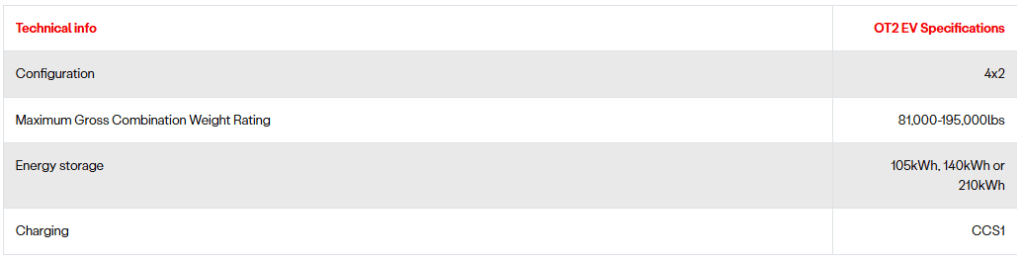
There are different charging solutions available with charging capacities up to 150kW and three different Li-ion battery capacities to choose from. 

Our battery solutions all come with a 6 year/2800 charge cycle warranty*. Kalmar can help you work out which battery option and charging solution is right for your business based on your current work cycles.

Managing your power

Kalmar’s Battery Monitoring System continually monitors the voltage, temperature, coolant and current flow of your battery solution to ensure that it operates optimally over its lifetime. This system also controls the charging of the batteries by utilizing regenerative breaking, sending recovered energy back into the battery packs making sure you are using the power available as efficiently as possible.

Our battery solutions all come with a 6 year/2800 charge cycle warranty*. Kalmar can help you work out which battery option and charging solution is right for your business based on your current work cycles.

*First life measured as 80% capacity left in the battery.

For complete peace of mind.

All Kalmar Electric Terminal Tractors come with a 3 year/6500 hour warranty on major electric components, and a 6 year warranty on the batteries. Kalmar Ottawa also offers a full range of service packages and genuine parts to keep your terminal tractor operating optimally, thus minimizing downtime.

Link to Kalmar webpage to learn more about the T2 EV

Kalmar T2 EV Technical Information

Take the T2 EV for a Test Drive!

For more information, a demo or pricing on a new Kalmar T2 EV, please contact us at 800-322-5438. Cal-Lift is your source in California, Arizona and Nevada for Kalmar equipment, service, rentals and parts.

Section 179 for 2023 at a Glance

What is the Section 179 Deduction

Most people think the Section 179 deduction is some mysterious or complicated tax code. It really isn’t, as you will see below.

Essentially, Section 179 of the IRS tax code allows businesses to deduct the full purchase price of qualifying equipment and/or software purchased or financed during the tax year. That means that if you buy (or lease) a piece of qualifying equipment, you can deduct the FULL PURCHASE PRICE from your gross income. It’s an incentive created by the U.S. government to encourage businesses to buy equipment and invest in themselves.

How Section 179 works:

In years past, when your business bought qualifying equipment like a forklift, terminal tractor or container handler, (see our line-up) it typically wrote it off a little at a time through depreciation. In other words, if your company spends $50,000 on a machine, it gets to write off (say) $10,000 a year for five years (these numbers are only meant to give you an example).

Now, while it’s true that this is better than no write-off at all, most business owners would really prefer to write off the entire equipment purchase price for the year they buy it.

And that’s exactly what Section 179 does – it allows your business to write off the entire purchase price of qualifying equipment for the current tax year.

This has made a big difference for many companies (and the economy in general.) Businesses have used Section 179 to purchase needed equipment right now, instead of waiting. For most small businesses, the entire cost of qualifying equipment can be written-off on the 2023 tax return (up to $1,160,000). See example below.

Limits of Section 179

Section 179 does come with limits – there are caps to the total amount written off ($1,160,000 for ), and limits to the total amount of the equipment purchased ($2,890,000 in ). The deduction begins to phase out on a dollar-for-dollar basis after $2,890,000 is spent by a given business (thus, the entire deduction goes away once $4,050,000 in purchases is reached), so this makes it a true small and medium-sized business deduction.

Who Qualifies for Section 179?

All businesses that purchase, finance, and/or lease new or used business equipment during tax year 2023 should qualify for the Section 179 Deduction (assuming they spend less than $4,050,000).

Most tangible goods used by American businesses, including “off-the-shelf” software and business-use vehicles (restrictions apply) qualify for the Section 179 Deduction.

For basic guidelines on what property is covered under the Section 179 tax code, please refer to this list of qualifying equipment. Also, to qualify for the Section 179 Deduction, the equipment and/or software purchased or financed must be placed into service between January 1, 2023 and December 31, 2023.

For 2023, $1,160,000 of assets can be expensed; that amount phases out dollar for dollar when $2,890,000 of qualified assets are placed in service.

What’s the difference between Section 179 and Bonus Depreciation?

Bonus depreciation is offered some years, and some years it isn’t. Right now in 2023, it’s being offered at 80%.

The most important difference is both new and used equipment qualify for the Section 179 Deduction (as long as the used equipment is “new to you”), while Bonus Depreciation has only covered new equipment only until the most recent tax law passed. In a switch from recent years, the bonus depreciation now includes used equipment.

Bonus Depreciation is useful to very large businesses spending more than the Section 179 Spending Cap (currently $2,890,000) on new capital equipment. Also, businesses with a net loss are still qualified to deduct some of the cost of new equipment and carry-forward the loss.

When applying these provisions, Section 179 is generally taken first, followed by Bonus Depreciation – unless the business had no taxable profit, because the unprofitable business is allowed to carry the loss forward to future years.

Section 179’s

The equipment, vehicle(s), and/or software must be used for business purposes more than 50% of the time to qualify for the Section 179 Deduction. Simply multiply the cost of the equipment, vehicle(s), and/or software by the percentage of business-use to arrive at the monetary amount eligible for Section 179.

To take advantage of Section 179 for 2023, equipment must be in service by year’s end, so now is the time to act. Contact us at 800-322-5438 for equipment pricing and calculate your tax savings for 2023.

California’s CORE Is Updated for 2023-2024; What You Need to Know

What is CORE?

The California Air Resources Board (CARB), in partnership with CALSTART, launched the Clean Off-Road Equipment Voucher Incentive Project (CORE) to accelerate the purchase of zero-emission off-road equipment in California.

CORE, analogous to the Hybrid and Zero-Emission Truck and Bus Voucher Incentive Project (HVIP), is a project intended to encourage California companies to purchase or lease currently commercialized zero-emission off-road freight equipment by providing a streamlined voucher process to offset the higher cost of such technologies.

CORE voucher amounts are based on the incremental cost difference between traditional equipment and new zero-emission alternatives. Additional funding is available for charging infrastructure, equipment deployed in pollution overburdened communities (DACs), and equipment purchased by small businesses.

How You Can Participate in CORE

Criteria for Eligibility:

Any off-road equipment Purchaser in California is eligible. If you want to participate, the purchased equipment must be domiciled and operated for at least three years in California after the voucher redemption date. Equipment Purchasers must also submit activity reports for three years. 

The fleet size does not affect voucher amounts, and equipment Purchasers are not limited to the number of vouchers they can apply for. 

Steps for Participating in CORE:

  1. Select equipment that suits your needs from the Eligible Equipment Catalog.
  2. Contact a CORE-approved Dealer. The Dealer will submit the voucher request on your behalf.
  3. Provide the dealer with equipment domicile location, small business designation, and other information.
  4. Purchase your CORE-discounted equipment.

Review the CORE Implementation Manual for additional information.

Eligible Equipment

From lawn and garden equipment and agriculture equipment to the equipment our customers use (cargo container handlers and large forklifts) there is a wide variety of equipment that is eligible for vouchers. See the full list at the CORE website. Our customer’s eligible equipment includes:

Loaded Container Handlers from Taylor Machine Works

Large Capacity Forklifts

All voucher figures are base numbers.  Additional funds are available for:

  • Chargers: up to $30,000 in additional incentives
  • Disadvantage Community (DAC): 10% of voucher amount
  • Small Business: 15% of voucher amount

Having a partner to help you navigate the CORE process and get your equipment in service is key to a successful program. Contact us today for more information on any of these models and potential vouchers, at 800-322-5438. We’re proud to represent Taylor Machine Works products in California, Arizona and Nevada.

Cal-Lift Achieves Premier Partner Status with Kalmar Ottawa for 2022

We are proud to announce that we have achieved Premier Partner Status with Kalmar Ottawa for 2022. We are equally proud to represent American-made Kalmar Ottawa Terminal Tractors and Yard Spotters.

Kalmar sets a high bar for product sales, service, parts and customer service for their users and we are pleased that our team has met these objectives and service parameters.

We will continue to strive to provide our customers with the right Kalmar product for their unique applications and back it up with superior service and parts. Visit our Kalmar showroom to learn more about their line-up. The Kalmar Ottawa T2 has set the bar even higher providing the optimal terminal tractor for your operation. All Kalmar Ottawa’s are built at the US manufacturing plant in Ottawa, Kansas. Along with being the original manufacturer of terminal tractors, Kalmar Ottawa was the first to offer machines with an automatic transmission, a rear door entry, integral air conditioning units, power cab tilt and ABS brake systems. Kalmar Ottawa terminal tractors were also the first on the market to receive DOT/EPA certification – a paramount classification for distribution and industrial customers whose operation entails shunting trailers between yards via public streets and roadways. 

We value and appreciate all our great employees and customers that made this possible.