When is it Time to Update Your Equipment?

Even a well-maintained forklift fleet needs to be replaced at some point in time. Knowing exactly when can be a difficult thing to ascertain. Industry averages reveal that somewhere between 8,000 hours and 10,000 hours of use is when you’re going to reach an optimal point to replace your forklifts. Some questions to ask to help determine if it is time include:

  • What type of operation does each forklift perform each day? Does your forklift face harsh conditions like heat, dust, rough terrain or any other condition that would put undue stress on the engine, transmission or hydraulics?
  • Is your forklift put to the test each and every lift, lower and transport? Does it handle its maximum capacity more than half the time, or less?
  • Does your forklift do a lot of starting, stopping and backing up? Does it frequently conduct long runs in large open areas?
  • Have you adequately maintained the equipment using a regularly scheduled Planned Maintenance Program?
  • How has the cost of repairs for each unit changed over the past two to three years? A dramatic increase in repairs (not normal planned maintenance or normal wear parts) can indicate that you’re spending more than you should on repairs. A cost-per-hour analysis may be in order.

The not-so-obvious costs associated with worn forklifts is downtime, lost productivity and the short-term cost of replacing them with rentals. These costs may not show up on a unit’s cost per hour, but they are costs nonetheless. Keeping count of rentals due to downtime and repairs is essential in determining replacement, as new forklifts will all but eliminate your rentals due to downtime.

There are other reasons that may eliminate the guesswork and actually require you to replace your aging fleet:

  • Safety features are outdated and cannot be updated properly. For example, safety requirements may change and a new safety harness system would replace traditional seatbelts. Also, if safety options have improved fleet safety and the cost to update them would be prohibitive, it would be a good time to consider replacement.
  • If your forklifts are exhibiting signs of unsafe operating conditions like hydraulic failure, equipment shaking or jerking or leaking components, it’s likely time to replace the units.

Another reason to consider updating your forklift fleet are improvements in technology, hardware or performance. For example, now that electric forklifts have become more powerful and reliable outdoors, it could be a great time to consider replacing your IC forklifts.

As you can see, looking at the hour meter is not the sole solution that it used to be to consider replacement. We would be glad to consult with you to assess your fleet condition and help you determine if now is a good time to consider your forklift fleet retirement or replacement. Check out our line-up of new forklifts and terminal tractors, then give us a call at 800-322-5438 for a demo and quote.
Taylor Zero Emission Top-Handlers Performing Well at the Port of Los Angeles

SAN PEDRO, Calif. – August 6, 2020 – The world’s first zero-emissions top handlers, unveiled last fall as part of a pre-commercial demonstration project at the Port of Los Angeles, are now being used in daily operations at the Everport Container Terminal. 

“We are pleased with performance results that we are receiving from drivers, mechanics and Everport management as the equipment is tested daily in real-world conditions,” said Port of Los Angeles Executive Director Gene Seroka. “We are doing everything possible to advance commercially feasible solutions to meet our goal of transitioning all cargo-handling equipment to zero emissions by 2030.” 

The two battery-electric top handlers were designed and built in the U.S. by Taylor Machine Works, Inc., a leading heavy-duty equipment manufacturer and the largest supplier of top handlers in service at the Port. Also known as top picks, top handlers are off-road vehicles with an overhead boom for loading containers weighing up to 100,000 pounds onto trucks and trains, unloading them, and stacking them on terminals between pickups and deliveries.

The top handlers run on a one-megawatt battery designed to operate for up to 18 hours between charges. Each top handler has a data logger for tracking hours of operation, charging frequency, energy usage and other performance indicators. Additionally, drivers and mechanics are providing input on the maneuverability, noise level and safety of the equipment. 

The battery-electric top handlers are a key component of the Port’s $7.7 million Everport Advanced Cargo-Handling Demonstration Project. The California Energy Commission (CEC) is supporting the large-scale zero-emissions technology project with a $4.5 million sustainability grant. 

The Everport demonstration is one of 16 projects in which the Port is either the lead agency or a participant working with multiple partners to test near-zero emissions and zero-emissions engines, emissions control technology, and alternative fueling and charging stations.

In addition to the battery-electric top handlers, the projects include testing ultra-low NOx renewable natural gas equipment and fully battery-electric fuel cell heavy-duty trucks; battery-electric forklifts, yard tractors, and rubber-tired gantry cranes; and emissions control equipment on large ships and harbor craft. 

Eliminating tailpipe emissions from cargo-handling equipment is essential to achieving the Port’s larger goal of reducing greenhouse gases (GHGs) from all port-related sources. Port targets call for reducing GHGs 40% below 1990 levels by 2030 and 80% below 1990 levels by 2050. 

The Port of Los Angeles remains open with all terminals operational during the COVID-19 pandemic. North America’s leading seaport by container volume and cargo value, the Port of Los Angeles facilitated $276 billion in trade during 2019. San Pedro Bay port complex operations and commerce facilitate one in nine jobs in the five-county Southern California region.

Cal-Lift Inc. is Southern California’s source for Taylor Big Red forklifts and container handlers, including service, parts and rentals.

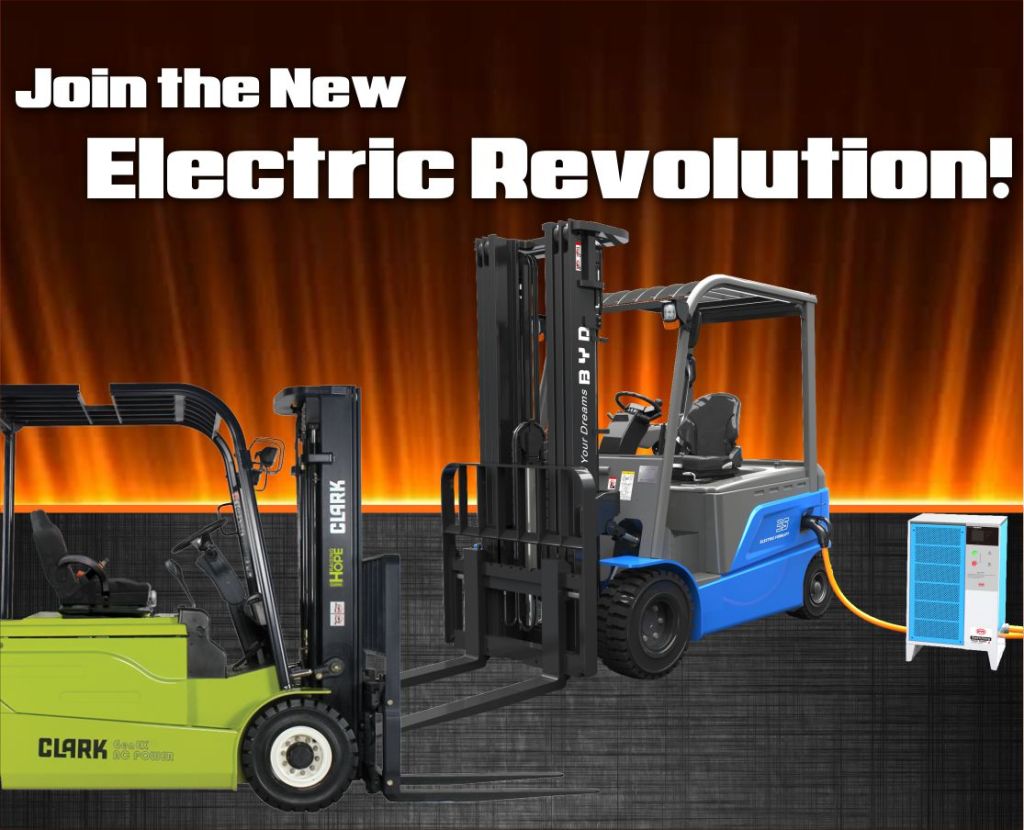
Join the Electric Forklift Revolution

Twenty years ago, companies with a 24 hour operation moving 8,000lb loads indoors and outdoors would have laughed off a suggestion of an electric forklift being able to replace their internal combustion fleet. Those days are long gone. In fact, through June of this year, nearly 70% of the new forklifts purchased in the US have been powered by electricity!

And there is good reason. The benefits of operating electric forklifts are many and the drawbacks are few. Over the past decade, manufacturers of electric forklifts have worked tirelessly to improve the performance of electric forklifts so they can do the jobs previously relegated to their IC counterparts. The results are impressive. Most manufacturers have models that can be used indoors and outdoors with capacities often exceeding 10,000lbs. They’ve equipped them with pneumatic tires and sealed components to ensure your electric forklift will continue to perform flawlessly, whether it’s sunny and 100 degrees or rainy and 40 degrees.

In addition, battery and charger manufacturers have improved technology to make batteries more efficient, longer lasting, and less costly. Lithium batteries are now being manufactured to fit existing forklift models, which eliminates battery changing, storage and multiple batteries for each lift truck. Let’s take a quick look at the benefits of owning and operating electric forklifts.

Electric Forklifts Eliminate Emissions

The values of today’s business owners have changed. Twenty years ago, few of us were concerned with our carbon footprint. Today, that is taking front and center page with many companies’ strategies to be carbon neutral. Electric forklifts are a great way to help companies achieve this. One study found that a 2,000 hour operation emitted 20,000lbs of carbon into the atmosphere for each forklift operated! Electric forklifts emit zero emissions.

This also makes for a safer and more comfortable working environment for your employees. Eliminating carbon monoxide from your plant or warehouse operation equates to a much more desirable workplace. Many companies enjoy fewer sick days, reduced medical expenditures and improved productivity.

Fuel Savings

While batteries and chargers require an additional up-front investment in your forklift fleet, the long-term benefits prove to far outweigh those costs. Some studies reveal that powering an electric forklift can save over $4,000 per year, per forklift!

Reduced Maintenance Costs

Electric motors produce no heat. This means less heat pumped into your facility, reducing cooling costs and making it a more comfortable place to work. Your forklift operators no longer sit on top of an engine producing heat in excess of 130 degrees for an 8 hour shift. In addition, electric forklifts produce no noise except for the tires and operation of the mast. This reduces wear on your forklift operators’ auditory systems, making them more comfortable to operate.

Electric forklifts require no operating fluids and have far fewer moving parts. Eliminating the need for transmission fluid changes, oil changes, cooling system fluids and more reduces your costs. It also eliminates transmission parts, water pumps, radiators, and other engine parts that need replacing.

By eliminating many moving parts and fluids, electric forklifts spend less time down for periodic maintenance, servicing and repairs. This often eliminates the need for temporary rentals or “extra” units to operate while your IC forklift is being serviced or repaired.

We realize there still are some applications where electric forklifts are not suitable, but given time, the industry will provide a solution. For example, in the fall of 2019, one of our manufacturers, Taylor Machine Works produced two giant 90,000lb capacity container movers. The industry will continue to respond to the demand of consumers to produce cleaner, more durable products with even higher capacities.

See our line-up of CLARK electric forklifts and industry changing, BYD electric forklifts featuring Lithium Iron Phosphate batteries which eliminate additional batteries, storage and changing.

Reduced costs, improved health and safety, and environmental improvement are all benefits you can enjoy by converting your internal combustion forklifts over to electric models.

4 Tips to Improve Dock Safety

Improving safety on a warehouse dock is crucial for preventing accidents and maintaining a secure work environment. Here are some recommendations to enhance safety:
  1. Conduct regular safety training: Train all dock workers on proper safety protocols, including equipment operation, handling hazardous materials, and emergency procedures. Offer refresher courses periodically and ensure everyone understands safety regulations.
  2. Provide personal protective equipment (PPE): Supply all workers with appropriate PPE, such as hard hats, safety glasses, high-visibility vests, steel-toed boots, and gloves. Encourage their consistent use and enforce PPE policies.
  3. Maintain clear communication: Establish effective communication systems, such as two-way radios or intercoms, to allow clear communication between dock workers, truck drivers, and supervisors. Ensure everyone can effectively relay information, warnings, and instructions.
  4. Implement traffic management: Develop a comprehensive traffic management plan for the dock area to prevent collisions and improve pedestrian safety. Clearly mark pedestrian walkways and separate them from vehicle lanes. Install signage and mirrors to enhance visibility, and consider using barriers or guardrails where necessary.
  5. Ensure proper lighting: Adequate lighting is essential for a safe dock environment. Install sufficient lighting fixtures to eliminate dark areas and shadows that could obscure visibility. Regularly inspect and maintain lighting systems to address any issues promptly.
  6. Regular maintenance of equipment: Establish a planned maintenance program for all dock equipment, including forklifts, loading ramps, and conveyor systems. Regular inspections and maintenance help identify potential hazards, preventing equipment malfunctions that could lead to accidents.
  7. Promote good housekeeping: Encourage a clean and organized work environment. Ensure that walkways, ramps, and loading areas are free of clutter, debris, spills, and obstacles that can cause slips, trips, or falls. Provide adequate waste management systems to prevent accumulation of waste materials.
  8. Implement safety barriers and guards: Install safety barriers, guardrails, and bollards to protect pedestrians and prevent unauthorized access to restricted areas. Implement dock edge protection systems to prevent accidental falls from the dock.
  9. Use warning signs and labels: Clearly display warning signs and labels to communicate potential hazards, such as restricted areas, low clearance, slippery surfaces, or areas with moving equipment. Ensure signage is prominently visible and easily understood.
  10. Regular safety inspections: Conduct routine safety inspections to identify potential hazards, non-compliance with safety protocols, or equipment issues. Encourage reporting of safety concerns by workers and promptly address any identified problems.
  11. Emergency preparedness: Develop and communicate emergency procedures specific to the dock area. Clearly mark emergency exits, fire extinguishers, and other safety equipment. Conduct drills periodically to ensure workers are familiar with emergency protocols.
  12. Encourage employee involvement: Involve employees in safety initiatives by establishing a safety committee or encouraging their participation in safety discussions. Encourage workers to report safety concerns, near-miss incidents, or potential hazards, and reward proactive safety behavior.

Partnering with a professional material handling company gives you insight from industry professionals whose goal is to help you create a safe working environment for anyone that operates in or around your docks.

We’re Southern California’s source for material handling equipment, service, parts and rentals. Give us a call at 800-322-LIFT.

Minimizing the Costs of Your Forklift Tires

Your forklift tires are the only thing that stands between thousands of pounds of forklift and the Earth beneath. As many can attest, if you ignore the importance of the tires, bad things can happen including more frequent replacement, increased operating costs, accidents and even injuries. Some experts estimate that forklift tires can account for as much as 30% of a forklift’s operating budget.

Following are a few things you can do to ensure that you have optimized the performance of your forklift tires and are getting the best performance and useful life.

Selecting the right tire

We could write an encyclopedia on this topic as there are many factors to consider. Our best suggestion is to meet with a professional who knows forklift tires (like one of our aftermarket customer support representatives).  A trained professional will consider factors like the types of equipment you operate, what type of surface they are operating on and what are the conditions of operation? Do your forklifts operate on a smooth surface in a temperature-controlled environment, or is the surface rough, gravel, blacktop or is the floor subject to debris? Are your forklifts making frequent turns, never getting to full speed, or do your forklifts frequently make long runs which generate much more heat?

After consulting with you and observing your operation, a professional can suggest tires that will last longer, wear better, resist heat, while maximizing operator comfort.

And if you’re purchasing a new forklift, make sure the right forklift tire is part of the quote. Standard issue tires can work for some operations, but be sure you’re getting the right tire for your operation before you put it into service.

Little known fact: If your forklifts frequently carry loads that are half the rated capacity of the forklift, it puts more pressure on your steer tires as the load up front does not balance out the load of the counterweight.

Keep up the Pressure

Keep tires inflated to the recommended pressure. Over-inflation and under-inflation both cause uneven wear.

Purchase a Premium Tire

We’re not suggesting you simply purchase the most expensive tire. However, purchasing a tire simply because it’s on sale or is the lowest cost alternative, will often end up costing you more in the long-run. After consulting with a professional, there are usually options based upon your operation and budgetary constraints. Finding the BEST tire for your operation, usage, wear and tear, will pay off in the long run. The quality of tire should likely increase with the weight of the load, length of the run and condition of the surface on which it operates.

Match Tires to Application

Use tires that are suitable for the specific conditions of your warehouse, such as cushion tires for indoor use or pneumatic tires for outdoor use.

Rotation and Alignment

  • Regular Rotation: Rotate tires regularly to ensure even wear.
  • Alignment: Ensure the forklift’s alignment is correct to prevent uneven tire wear.

Frequent Inspections

Pre-shift inspections are required by OSHA and tire inspections are part of that process.  Look for things like stress cracks, tread wear and chunking. Knowing how to determine wear on your tires depends upon the type of tire and how the manufacturer determines it is time to replace. When you purchase your forklift tires, be sure the representative explains how to inspect them and when it is time for “re-tirement.” And make that inspection part of your forklift operator training. All your operators should know how to inspect all your forklift tires.

Keep it Clean

Keeping the surface a forklift operates on clean will provide additional useful life of your forklift tires. Metal bands, shrapnel, nails, screws and the like are the obvious enemies of a forklift tire and if your operation is manufacturing, you probably have plenty of debris to consider. Often times a floor sweeper (rider or push) will pay for itself over time in reduced damage to your tires.

In addition to the obvious culprits there are other concerns with operating surface. Dirt and debris can build which can reduce traction of the forklift tires creating a dangerous operating environment. A regular review of your floor can also reduce damaging factors. Things like uneven concrete joints, cracks in pavement or concrete surfaces and dock plates that are un-even or damaged can reduce wear and increase damage. Some customers even consider the condition of the tractor trailer floors. Things like nails in the floors or large splinters in trailer floors can wreak havoc on your forklift tires.

Creating a regular process for purchasing and caring for forklift tires can provide many benefits to safety, productivity and your bottom line. Our Planned Maintenance program can take a lot of these considerations off your hands. Learn more and get a quote customized to your operational needs.

To consult with one of our tire professionals, please contact us at 800-322-5438.

CLARK S-Series Forklift “Smart-Dash”

Smart Dash is programmed to provide operators with real-time information and on-board diagnostics. The dash integrates with multiple truck options including optional backup camera, optional load weight scale, operator checklist and telematics. The dash intelligence also provides the ability to limit access for unauthorized operation of the truck or changing settings via password protection.

The optional Load Weight Scale will display the lifted load value on the main screen in large, easy to read text. The Smart Dash allows the customer to “tune” the truck to their specific requirements. The truck’s maximum speed can be set and password protected directly through the screen. Learn more about the S-Series.

CLARK’s New WPL25 Electric Walkie Pallet Jack Video

CLARK’s new Lithium Ion battery powered pallet jack, weighs in at less than 300lbs, but can carry quite a load and improve productivity in your materials handling operation. See the features and advantages of this little workhorse, then contact us for a quote or call us at 800-322-LIFT.

Taylor Machine Works, All-American, All the Time

Designed, engineered and built in Louisville, Mississippi, Taylor Machine Works are the most dependable, reliable, lowest cost heavy-duty forklifts on the market.This short video highlights a company built on trust and dedicated to building quality products. Next time you’re considering Container Handlers, Forklifts or other Heavy-Duty Lift Trucks, check out our line-up of Taylor Machine Works, then Contact Us for more information or a quote.

CLARK GEX Electric Forklifts

4,000lb. – 10,000lb. Capacities

100% All AC Electric, 80 Volts

Solid Pneumatic Tire

See more specs at our website.

Electric forklifts like the GEX are a rare breed. Many models are not engineered or equipped to work outdoors in the elements. Not the GEX! CLARK Material Handling’s GEX is built to perform indoors and outdoors, with capacities to handle the tough applications traditionally reserved for internal combustion models. GEX’s features include:

80 Volt, 100% AC Electric Power

  • HIGH PERFORMANCE – Rivals IC truck performance in speed, acceleration and gradeability
  • MORE EFFICIENT SYSTEM – Higher voltage = lower line loss & heating = greater efficiency
  • BETTER SUITED TO RAPID CHARGE – Only requires one receptacle via single battery connector
  • INCREASED BATTERY CAPACITY – GEX 20/25 can accommodate 54 kwh battery; GEX 30/32 can accommodate 60 kwh battery

Drive Motors and Axles

FEWER PARTS & MINIMUM WEAR = LESS DOWNTIME

  • Enclosed, brushless
  • Thermal and stall protection
  • Dual/powered reversing for tighter turns
  • Suitable for Wet Applications
  • Same motors for E & EE

Regenerative Braking/Wet Disc Brakes

THREE FORMS OF REGENERATIVE BRAKING

  • Accelerator release (Proportional to accelerator position)
  • Change of direction (Proportional to accelerator position)
  • Service brake (Foot brake)

WET DISC BRAKES

  • Enclosed and oil cooled for smooth, quiet operation
  • Built with long life lining material
  • Less downtime

To learn more about CLARK’s GEX, get a demo or a quote, please contact us at 800-322-5438. We’re Southern California’s source for CLARK forklifts, OEM parts, service and rentals.

Section 179 Renewed for 2017

section-179-header

Jan 1, 2017 –   Section 179 is still affected by the “Protecting Americans from Tax Hikes Act of 2015” (PATH Act) that was signed into law on 12/18/2015. This bill expanded the Section 179 deduction limit to $500,000, where it will remain for all of 2017. For those interested, you may read the summary from the Ways and Means committee here.

Section 179 Deduction: Until further notice, Section 179 will be permanent at the $500,000 level. Businesses exceeding a total of $2 million of purchases in qualifying equipment have the Section 179 deduction phase-out dollar-for-dollar and completely eliminated above $2.5 million. Additionally, the Section 179 cap will be indexed to inflation in $10,000 increments in future years.

50% Bonus Depreciation will be extended through 2019. Businesses of all sizes will be able to depreciate 50 percent of the cost of equipment acquired and put in service during 2015, 2016 and 2017. Then bonus depreciation will phase down to 40 percent in 2018 and 30 percent in 2019.

IMPORTANT THIS YEAR: Section 179 for Current 2017 Tax Year
Section 179 can provide you with significant tax relief for this 2017 tax year, but equipment and software must be financed and in place by midnight December 31, 2017. Use this 2017 Section 179 Calculator to see how much the Section 179 tax deduction can save your company.

2016 Section 179 Tax Information (Last Year)

The PATH ACT passed in December of 2015 affected 2016 and beyond, making the Section 179 deduction for 2016 $500,000. In addition, the 50% Bonus Depreciation was reinstated.
Click Here for the fully updated Section 179 Calculator for tax year 2016 (Last Year).

Answers to the Three Most Common Section 179 Questions

How Much Can I Save on My Taxes in 2017?
It depends on the amount of qualifying equipment and software that you purchase and put into use. See the handy Section 179 Calculator that’s fully updated for 2017, and includes any/all increases from any future legislation.

What Sort of Equipment Qualifies in 2017?
Most tangible business equipment qualifies. Click here for qualifying property.

When Do I Have to Do This By?
Section 179 for 2017 expires midnight, 12/31/2017. If you wish to deduct the full price of your equipment from your 2017 taxes and take advantage of the new higher deduction limits, it must be purchased and put into service by then.

Many businesses are finding Section 179 Qualified Financing to be an attractive option in 2017, especially since the expected Federal Discount Rate increases don’t leave much time for action. Please apply today.

More Section 179 Deduction Questions Answered

Welcome to Section179.Org, your definitive resource for all things Section 179. We’ve brought together a large amount of information regarding Section 179, and clearly and honestly discuss the various aspects of IRS §179 in plain language. This will allow you to make the best possible financial decisions for your company.

Section 179 can be extremely profitable to you, so it is to your benefit to learn as much as possible. To begin, you may have a lot of questions regarding Section 179 such as:

We’ll answer all of these questions, and make certain that you come away with all of the knowledge you need to make smart business decisions in this 2017 tax year regarding equipment and/or software purchasing and Section 179.

Why? Because if you’ve been thinking about buying or leasing new equipment and/or software, it’s definitely to your advantage to use this excellent tax break.

Successful businesses take advantage of legal tax incentives to help lower their operating costs. The Section 179 Deduction is a tax incentive that is easy to use, and gives businesses an incentive to invest in themselves by adding capital equipment. In short, taking advantage of the Section 179 Deduction will help your business keep more capital, while also getting needed equipment, vehicles, and software.

Free Tools that Make Calculating Section 179 Deductions Simple

Section 179 is really very simple. You buy, finance or lease qualifying equipment and/or software, and then take a full tax deduction on it this year (also, there are a few other things, which we’ll go over, but in a nutshell, that’s the idea). To give you an estimate of how much money you can save, here’s a Section 179 Deduction Calculator to make computing Section 179 deductions simple.

If you use the calculator, take note of the savings on your tax obligation. Many people find that, if they lease or finance their Section 179 qualified equipment, the tax savings actually exceed the first year’s payments on the equipment (making buying equipment profitable for the current tax year). This is perfectly legal, and a good example of the incentive that Section 179 provides small and medium businesses.

Visit our website to learn more about our line-up of new material handling equipment, including:

Cal-Lift is your source in Southern California for quality material handling equipment, service, parts and rentals. Visit our website to learn more. Then contact us for a quote at 800-322-5438.