What’s Reducing the Safe Lifting Capacity of Your Forklifts?

You just purchased a new forklift. Along with your purchase you made sure your forklift operators were trained properly.  Operators’ knowledge of safe lifting capacity equals a lower risk of property damage, injury or death.

Your forklift was shipped from the manufacturer with a data plate indicating lift capacities at various heights based on its equipment options, for example, side shifters, carton clamps or other attachments. Once you put the forklift into service, there are several factors that can, over time, dramatically reduce the safe lifting capacity of that forklift. Below we have highlighted the major factors effecting lift capacity.

Forks – The continual use of forklifts results in normal fork wear. The amount and rate at which they wear depends upon the weight of the loads handled, how they are handled (what type of substrate is coming in contact with the fork) and how often loads are handled (duty cycles). A 10% reduction in fork surface (wear) results in a 20% reduction in the safe lifting capacity of your forklift. A forklift rated to lift 5,000lbs is reduced to 4,000lb once the forks are 10% worn. At this point the forks must be replaced.

Daily Inspections are required by OSHA – While a daily measurement of fork wear is not required, it is good practice to conduct a fork wear inspection on a regular basis, based on previous “FORK” criteria previously mentioned. During daily inspections, forks should be visually inspected for cracks or bends. Both reduce the safe lifting capacity of your forklift and create a dangerous operating condition.

If the load you are carrying changes requiring a need to use longer forks, the load center changes. This results in a reduction of safe lifting capacity. It will be important that you work with the manufacturer to determine the new safe lifting capacity of your forklift with the new fork configuration.

Chains – Chains should be inspected as part of any normal Planned Maintenance Program. Your service technicians should be properly trained to measure chains to determine when they need to be replaced. When a 3% elongation results in a 15% reduction in safe lifting capacity the chains should be replaced. Never attempt repairs on chains that are worn. Replacing them with the proper chains per manufacturer’s specifications is recommended to ensure a safe working environment for your employees.

Load Center – The data plate on your forklift indicates safe load capacities at given fork load centers. Not every pallet received by your facility is loaded according to the forklift manufactures specifications. It is important for safe operation to recognize and adjust your lifting practices to ensure safe handling of materials. As a rule, for every inch beyond the manufacturers recommended fork load center, one hundred pounds of lifting capacity is lost at a lowered height of six to eight inches.

Upon replacing the following, verify:

  • Tires – Verify they meet manufacturer’s specifications. Especially if changing the type (cushion or pneumatic) or the size.
  • Batteries – Verify they meet manufacturer’s specifications. If you have purchased a used forklift this can be an issue. Seek assistance from a professional that you are equipping it with the proper battery.
  • Attachments – Anytime you add an attachment of any kind, regardless of how benign it may seem, work with a professional or the manufacturer to determine if the attachment affects safe lifting capacity – if so, how much.
  • Engines – You might never replace an engine. But if you do, be certain the replacement engine meets or exceeds the weight of the current engine and that the configuration of the replacement engine does not affect the center of gravity of the forklift. This is particularly important if you purchase used forklifts. Ask the seller if the engine has been replaced or altered in any dramatic fashion. If it has, be sure the forklift has been re-rated for safe lifting capacity.

There are sites on the Internet like www.lifttruckcapacitycalculator.com that can assist you in re-rating your forklifts after minor changes such as attachments or other alterations that may affect their safe lifting capacity.

Working with a partner like Cal-Lift to institute and manage a Planned Maintenance Program is the best way to guarantee that your forklift fleet is always operating safely and your employees are not in danger. Planned Maintenance Programs have also been proven to be the best way to maximize the productivity of your forklift fleet by reducing down-time. These programs will pay for themselves over and over again throughout the life of your forklifts.

Cal-Lift Sponsors DMA Fund Raiser


Cal-Lift is once again proud to be a major sponsor of the Distribution Management Association’s 2018 Golf Outing / Fund Raiser. The DMA’s Mission is “To facilitate involvement, partnerships, professional development and connections for its members and the community.” DMA focuses assisting in logistics management in Southern California by providing support services to help its members recruit and train employees to maximize operational excellence. Below is a video of last year’s event:

Cal-Lift is proud to be a support of the DMA in Southern California. To learn more about the DMA, please visit their website.


CLARK’s New WPL25 Electric Walkie Pallet Jack Video

CLARK’s new Lithium Ion battery powered pallet jack, weighs in at less than 300lbs, but can carry quite a load and improve productivity in your materials handling operation. See the features and advantages of this little workhorse, then contact us for a quote or call us at 800-322-LIFT.

OSHA’s Free Safety Consultation Program

Safety is one of the primary pillars of a productive and profitable material handling operation. Unfortunately, most small to mid-size companies to not have the resources for a safety and compliance manager, much less a safety department. OSHA has tools available to these companies, like yours, to help you not only gain compliance, but how to look at your operation with a “safety eye” and help you identify potential hazards before they become health, safety or legal issues.

OSHA’s Compliance Assistance QuickStart will help you identify the guidelines that apply to your operation, teach you how to survey your operation for potential hazards and violations, and assist you in developing a safety program to ensure compliance and a healthy, safe operation based on your individual needs.

Once you have established needs, OSHA’s tools help you learn how to train your employees to perform their functions safely and be on the lookout for potential safety hazards that might pop up unannounced. Finally, they help you keep records and learn how to report hazards and incidents when they occur to ensure you are maintaining compliance.

Need assistance in getting started? OSHA has you covered. The OSHA Free Consultation program provides you with access to an OSHA consultant who will schedule an appointment with you for a walk-through of your facility. During this consultation, you will receive a pre-inspection conference, a walk-through and a post-inspection conference. Following, the OSHA consultant will provide you with a written report of findings and agreed upon time frame for agreed upon abatement periods. Findings of this consultation will only be reported to OSHA if you fail to correct any serious hazards or situations that present an imminent danger.

The goal is to treat every potential hazard as if someone you love, were doing the job. Getting each of your employees and visitors home safely at night is the key to having them return tomorrow, ready to work, and work productively!

OSHA Consultations Fact Sheet for more information. Or to get started, visit the OSHA Consultation Directory to find consultants nearest you.

Cal-Lift is Southern California’s source for the industry’s top material handling equipment, including BYD lithium iron battery powered forklifts. To learn more about Cal-Lift Los Angeles, please visit our website.

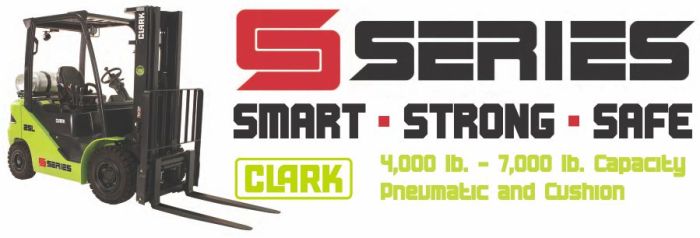
CLARK’s All-New S-Series Forklifts

S Series Web Header

Building on over 100 years of lift truck innovations, design and industry firsts. The evolution continues…. The CLARK S-Series, the next generation of lift trucks.
SMART
CLARK’s design standards have historically led the industry in innovation and firsts; the S-Series represents the next phase of lift truck design.

  • Interactive Dash
  • Built-in Reporting and Operator Performance via Optional Telemetry
  • Engine/Powertrain Protection
  • Integrated Systematic Service Tools
  • On-Board Reporting of Operator Controlled Functions
STRONG
CLARK Trucks are “Built to Last”; from their industry designs to legacy dealers, their combined strengths ensure a strong performance to your bottom line with lower cost of ownership.

  • Force-Cooled Wet Disc Brakes
  • Fully Welded Heavy Gauge Frame
  • Nested I-Beam Upright
  • 6-Roller Carriage
  • External Side-Thrust Rollers
  • Proven Steer Axles and Cooling Systems
SAFE
CLARK makes your safety their priority. Safety has been a cornerstone of CLARK design standards for over 100 years. Their standards became the industry standards. The S-Series innovates again with standard features, including:

  • Automatically Applied Parking Brake
  • Speed Limit Control
  • Increased Visibility
  • Optional Rear View Camera
  • High-Visibility Orange Seat Belt
  • Designed with Optimal Center of Gravity to Enhance Truck Stability.
S-Series-Pneumatic-Brochure

S-Series-Cushion-Brochure

S-Series-Standard-Specs

For a quote or more information, please Contact Us, or call us at 800-322-LIFT

Section 179 Improved for 2018

Section 179 Header

With the passage and signing into law of H.R.1, aka, The Tax Cuts and Jobs Act, the deduction limit for Section 179 increases to $1,000,000 for 2018 and beyond. The limit on equipment purchases likewise has increased to $2.5 million.

Further, the bonus depreciation is 100% and is made retroactive to 9/27/2017 and good through 2022. The bonus depreciation also now includes used equipment.

See the fully updated 2018 Section 179 Calculator to see how this tax deduction affects your company.

2017 Section 179 Tax Information (Last Year)

The Section 179 deduction is $500,000 for 2017, with a 50% bonus depreciation in place until late September (see 2018 information for change).

Click Here for the fully updated Section 179 Calculator for tax year 2017 (Last Year).

Answers to the Three Most Common Section 179 Questions

How Much Can I Save on My Taxes in 2018?
It depends on the amount of qualifying equipment and software that you purchase and put into use. See the handy Section 179 Calculator that’s fully updated for 2018, and includes any/all increases from any future legislation.

What Sort of Equipment Qualifies in 2018?
Most tangible business equipment qualifies. Click here for qualifying property.

When Do I Have to Do This By?
Section 179 for 2018 expires midnight, 12/31/2018. If you wish to deduct the full price of your equipment from your 2018 taxes and take advantage of the new higher deduction limits, it must be purchased and put into service by then.

Many businesses are finding Section 179 Qualified Financing to be an attractive option in 2018, especially since the expected Federal Discount Rate increases don’t leave much time for action. Please apply today.

More Section 179 Deduction Questions Answered

Welcome to Section179.Org, your definitive resource for all things Section 179. We’ve brought together a large amount of information regarding Section 179, and clearly and honestly discuss the various aspects of IRS §179 in plain language. This will allow you to make the best possible financial decisions for your company.

Section 179 can be extremely profitable to you, so it is to your benefit to learn as much as possible. To begin, you may have a lot of questions regarding Section 179 such as:

Check out our line-up of new forklifts or used forklifts, then contact us at 800-322-5438 for more information or a quote.

Scott Johnson Elected Chair of ITA

Scott JohnsonCLARK Material Handling Company (CLARK) is pleased to announce that Scott Johnson, Vice President of Sales and Marketing, has been elected the new Chairman of the Board of Directors for the Industrial Truck Association (ITA). Scott accepted the gavel from outgoing Chairman Brett Wood of Toyota at ITA’s 34th Annual Meeting held at Coeur d’Alene, Idaho, September 13-16, 2017.

“CLARK was instrumental in the formation of the Industrial Truck Association
over 65 years ago,” commented Scott upon accepting this prestigious position.
“For all these years, ITA has been the leading organization in the industrial truck
industry in North America, and has led the way for the formation of sister
organizations in other parts of the world. I am humbled and extremely proud to
support and now lead this organization which has served the forklift industry and
its members so well for so long.”

Scott previously served on ITA’s Statistics Committee and has represented
CLARK on ITA’s Executive Committee for several years. Scott has worked in the
material handling industry for over 20 years. He is also an active member of the
Material Handling Equipment Distributors Association (MHEDA). Scott is an avid
outdoorsman, and a proud alumnus of the University of Kentucky.

Lowering Energy Costs During Winter

Winter is fast approaching, which means increased energy expenses to keep your warehouse warm and productive. While Southern California is not as effected by colder weather as our friends on the east coast, we will still be turning on the heat and anything we can do to minimize the impact of that on our bottom is helpful to a profitable 2018.

The following steps are five of our top recommendations for reducing energy consumption without turning down the thermostat.

Ensure Efficient Heat Generation Processes

Whatever thermal system you use, now is the time to make sure it is up to date with regular maintenance. Keeping your system in good operating order extends its life and ensures that it operates at optimal efficiency. Meanwhile, a poorly maintained system—particularly a gas-fired one—can pose a significant safety risk.

Another area of concern is the quantity, type, and location of your heating units. If you have made any changes to your warehouse configuration since your HVAC system was installed, now would be a good time for consultation. Technology advances quickly, and you want to be sure your HVAC system is up-to-date with current technology to ensure efficiency and effectiveness.

Maintain Proper Air Circulation

We all know that heat rises, and 20-degree temperature variances between the warehouse floor and the typical 40-foot ceiling are not uncommon. Circulating warmth to the floor can save hundreds—if not thousands—of dollars each month during the winter. The best means to accomplish this is through large industrial ceiling fans.

Determining what size, how many, and where to install industrial ceiling fans is our specialty. Fans can save up to 30 percent of your heating costs and deliver positive ROI in less than two years in many applications. Contact us for more information on fans and how many you might need to improve your energy circulation.

Retain as Much Heat as Possible

If you operate a warehouse, you have doors—very large doors. Although it is impossible to eliminate heat exchanges with cold outdoor air, you can take specific steps to significantly reduce it. These steps are more cost-effective than you probably expect.

Insulated dock panel doors can help retain warm air. However, depending on the number of dock positions, investment in them can be prohibitively costly. Instead, consider an insulation kit for each door. Insulation kits are less expensive, provide an R-Value of 6.81, and are easy to install.

Gaps around your dock doors can also cause significant heat loss. Inspect the top, bottom, and both sides of each door. If you see daylight, you are losing energy. Weather stripping kits are available to fill these gaps. The kits include weather stripping for the perimeter of the door as well as a 5-inch double-loop bottom rubber astragal to ensure that doors close tightly at the bottom. In addition to preserving heat, the seals keep bugs and other debris outside your warehouse facility. Caulking and sealants available at your local DIY big box store can help improve retention of heat dramatically over the winter.

Dock seals or shelters are imperative for preventing tremendous heat loss during trailer loading and unloading. If you are running a high-traffic operation without seals or even with worn seals, tens of thousands of expensive BTUs can blow out the door each winter day. If your seals or shelters are in good condition, be sure each tractor trailer is backed up tight against them before the dock doors are opened. Many types of dock seals and shelters are available. We can help you choose the right ones for your doors and budget.

One final area we recommend assessing is your dock leveler. If you use pit-mounted levelers, it makes sense to ensure that the side and rear seals are in good condition. Worn seals on your dock leveler result in air infiltration. We can inspect your levelers and seals, and service or replace any that are worn

Install Windows and/or Skylights

Although it is not always practical depending on the construction of your warehouse (or if you own or lease it), we certainly recommend investigating ways to improve the natural light and heat generated by the sun! Strategically placed windows or skylights can dramatically reduce your warehouse energy costs during the winter not only by using the sun’s energy for heat, but also by improving the natural lighting in your warehouse. This reduces your reliance on lighting fixtures and further reduces your energy costs. Using retractable blinds allows you to close the windows during the summer months, which reduces heat generation when it is not required.

And if you facility has windows, consider replacing them with energy efficient windows that can provide better heat retention and help keep the cold air out. If your windows are more than 10 years old, chances are you can improve energy consumption with new, more efficient windows.

Use Air Curtains or High-Speed Doors to Segment Your Warehouse Energy Needs

Some areas of your warehouse may not be used by employees often, who do most of their work in other areas of your warehouse. These low-use areas can be kept much cooler than the areas that employees use most. Air curtains and high-speed doors are excellent ways to keep the two areas temperature controlled while dramatically decreasing your energy consumption.

Winter can be an expensive time for warehouse operators, but the right steps taken the right way can significantly reduce the negative impact to your bottom line. We can help you find the right products to ensure you’re maximizing the use of energy in your facility during the colder winter months. Contact us at 800-322-5438 to speak to one of our representatives.
Avoid the Flu Like the Plague

https://www.psndealer.com/dealersite/images/brodietoyotalift/Flu.pngEach flu season in America, between 5% and 20% of American’s contract the flu. This leads to 111 million lost productive work days, which costs American business approximately 7 billion dollars! In addition, the direct costs (doctor’s visits, medication, hospitalization) cost individuals over 4.5 billion dollars a year! Source: CDC

Whether it’s in your accounting department or forklift operators, you want to limit an outbreak at your company and contain any outbreak that does occur.

The effects of lost productivity can have a great effect on your ability to deliver products and services and provide customer service, which can lead to a negative impact on your bottom line. But there are things you can do to lower the risk at the department level and facility level. It all starts with planning and communication.

  1. Developing a plan to combat influenza? Businesses plan for all sorts of calamities and naturally occurring disasters. Does your company have a preparedness plan to prevent a flu outbreak? A tremendous amount of information is available to help you plan for and combat an outbreak of the flu a http://www.flu.gov/planning-preparedness/business/
  2. Educate your employees and take steps to encourage vaccination. One study showed a decrease in over 71% in hospitalizations when a flu vaccination was administered to adults of all ages (source). Flu vaccines not only reduce the chances of contracting the flu, but it also reduces the effects of the flu if an employee contracts it, thus enabling them to get back to full productivity sooner.
  3. Use Resources. The CDC has a great Business Tool Kit to help you educate your employees about the flu, how to prevent it and what to do if you think you are coming down with it. Visit the CDC Business Tool Kit Webapge.
  4. Proper sanitary procedures are also essential during the flu season. Placing hand sanitizers throughout your facility and encouraging if not outright requiring their use will help contain the spread of the virus, should an employee become infected. There are additional steps you can take to prevent the spread of the flu, including increasing janitorial services or assigning teams to assist in the sanitization of routinely used and shared points, such as water fountains, door knobs/handles, bathrooms, and kitchens.
  5. Send them home! If an employee starts to show the signs of influenza, it’s important to remove them from the facility as soon as possible and require that they remain home until symptoms have subsided, particularly a fever.
  6. Seek immediate attention. If you or anyone around starts to feel fatigue, loss of appetite, lethargy, fever or any of the other first signs of the flu, get to a doctor and ask about anti-viral drugs. These drugs can cut your misery in half, as well as your time off work, and productivity.

The effects of flu season can be dramatic if left unaddressed. But developing a plan to deal with the flu and spreading education before the flu spreads itself around your facility will help you maintain your business productivity during this flu season.

Our focus is frequently on productivity, and this is not always about equipment and processes. Sometimes peripheral components can have an impact on our bottom lines, and it is important to us to serve as your partner in addressing all facts of productivity. We encourage you to visit the flu.gov site to learn more.