At the 2019 National Safety Council Congress & Expo in San Diego, California, Patrick Kapust, deputy director of OSHA’s Directorate of Enforcement Programs, presented the agency’s top 10 violations for fiscal year 2019. The order may have changed slightly, but the list remain remains the same as last year.
And though much discussion and education has taken place over the last decade regarding forklifts and safety and training, they still remain on the list of the top cited offenses.
The top 10 violations of FY 2019 are:
- Fall protection (construction)—general requirements (29 CFR 1926.501): 6,010 violations. The duty to provide fall protection has been OSHA’s top citation for several years. According to Kapust, common violations under this standard included failure to provide fall protection near unprotected sides or edges and on both low-slope and steep roofs. Many of the citations were issued to roofing contractors, framing contractors, masonry contractors, and new single-family housing construction contractors.
- Hazard communication (29 CFR 1910.1200): 3,671 violations. Hazard communication has been in the number-two spot for several years. Common deficiencies include lack of a written program, inadequate training, and failing to properly develop or maintain safety data sheets (SDSs). Auto repair facilities and painting contractors were among the industries that received many hazard communication citations.
- Scaffolds (construction)—general requirements (29 CFR 1926.451): 2,813 violations. Common violations included improper decking, failing to provide guardrails where required, and failure to ensure that supported scaffolds are adequately supported on a solid foundation. Masonry, siding, roofing, and framing contractors were particularly prone to scaffolding violations.
- Lockout/tagout (29 CFR 1910.147): 2,606 violations. Many employers cited under this standard failed to establish an energy control procedure altogether, while others were cited for failing to provide adequate employee training, failing to conduct periodic evaluations of procedures, and failing to use lockout/tagout devices or equipment. Violations were common among plastics manufacturers, machine shops, and sawmills.
- Respiratory protection (29 CFR 1910.134): 2,450 violations. Failing to establish a program, failing to perform required fit testing, and failing to provide medical evaluations were among the most frequently cited issues. Auto body refinishing, masonry contractors, painting contractors, and wall covering contractors received many citations under this standard.
- Ladders (construction) (29 CFR 1926.1053): 2,345 violations. Common deficiencies included failure to have siderails extend 3 feet (ft) beyond a landing surface, using ladders for unintended purposes, using the top step of a stepladder, and ladders with structural defects. These violations were common among roofing, framing, siding, and painting contractors.
- Powered industrial trucks (29 CFR 1910.178): 2,093 violations. Violations commonly addressed deficient or damaged forklifts that were not removed from service, failing to safely operate a forklift, failing to retain certification of training, and failing to evaluate forklift drivers every 3 years as required. Forklift violations were widespread across a number of industries, but were particularly prevalent in warehousing and storage facilities, fabricated and structural metal manufacturing, and among framing contractors.
- Fall protection (construction)—training requirements (29 CFR 1926.503): 1,773 violations. Commonly cited issues include failing to provide training to each person required to receive it, failing to certify training in writing, inadequacies in training leading to the failure of retention by the trainee, and failing to retrain in instances where the trainee failed to retain the training content.
- Machine guarding (29 CFR 1910.212): 1,743 violations. Violations included failing to guard points of operation, failing to ensure that guards are securely attached to machinery, improper guarding of fan blades, and failing to properly anchor fixed machinery. Machine guarding violations occur in many industries, but common targets include machine shops, and fabricated metal manufacturing.
- Personal protective and lifesaving equipment (construction)—eye and face protection (29 CFR 1926.102): 1,411 violations. A newcomer to OSHA’s top 10 list in 2018, eye and face protection made the list again in FY 2019. Commonly cited issues included failing to provide eye and face protection where employees are exposed to hazards from flying objects; failing to provide eye protection with side protection; and failing to provide protection from caustic hazards, gases, and vapors.
 Recently, we shared some information about the effects forty years of OSHA has had on industries. This led to a conversation about the real intents, effects and outcomes of OSHA on the American worker. We thought we would share some of the content of those discussions with you in order to bring a renewed perspective about the agency and what they do every day to ensure people like you, me and our children can go to work and be relatively confident that they will be protected from hazards seen, and sometimes unseen, in their workplace.
 Ismaning near Munich, 14.1.2019. The finalists for this year’s IFOY AWARD (International Intralogistics and Forklift Truck of the Year) are nominated. From the pool of applicants for the seventh round of the world-renowned award the jury will send 15 products and solutions from a dozen manufacturers into the race for the best products and solutions of the year.
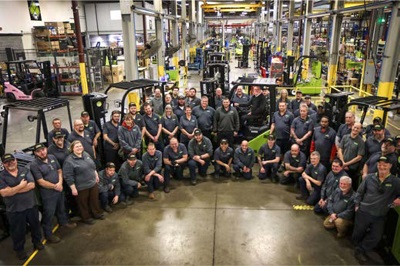 Lexington, KY – March 5, 2019 – CLARK Material Handling Company, one of the most recognized forklift brands in North America, plans to expand facilities at its North American corporate headquarters in Lexington, Kentucky by adding a third facility to the company’s manufacturing operation. In conjunction with this expansion, CLARK will begin re-shoring to Lexington production of its “heart-of-the-line” internal combustion products, the “S-Series.” Volume production of the S-Series is expected this summer.
 Like anything else in life, whether it’s your car, your home or even your body, planning and conducting preventive maintenance creates long-term benefits that are well worth the investment. Why would your forklift and other materials handling equipment be any different?
 Cal-Lift Inc.