CLARK S25XE-S35XE Lithium Powered Electric Forklift

Power Meets Style in the All-New Lithium-Powered S25XE “Renegade”

The ultimate yard truck that achieves new levels of cost savings and outside performance. The new 80-volt electric Renegade delivers the power you need with a fresh, dynamic look that stands out anywhere.

Models Available:

  • S25XE – 5,000 lb. capacity
  • S30XE – 6,000 lb. capacity
  • S35XE – 7,000 lb. capacity

Built with the trusted engineering of our famous S Series line of premium lift trucks, the Renegade features enhanced styling, blending form and function with a striking visual identity that is pure CLARK!

Renegade 25XE

Go Electric Without Compromise Step into the future of material handling with the all-electric RENEGADE. Designed to match the performance of traditional internal combustion (IC) trucks, this zero-emissions powerhouse delivers exceptional results both indoors and out while helping your operation lower its operational costs .

  • 80 Volt Electric
  • 5,000lb – 7,000lb Capacities
  • Up to 11MPH Travel Speed
  • 82.5″ Overhead Guard
  • 94.1″ Turning Radius

Features

Electric Power. IC Performance. Zero Emissions.

The RENEGADE is built to replace IC trucks without sacrificing capability. Travel, lift, and lower speeds all match or exceed traditional IC trucks, while delivering the added benefits of clean, quiet operation and lower total cost of ownership.

Built for the Outdoors

Why limit electric forklifts to indoor work? With 6.1” ground clearance, 27% gradeability, and weather-protected components, the RENEGADE goes where IC trucks go, without the fuel bill. Pneumatic-style tires (7.00-12 front, 6.00-9 rear) deliver traction and stability in any yard or dock environment.

Smart Dash – Standard on Every RENEGADE

The 5.2″ full-color LCD Smart Dash offers a clear view of all truck operations, diagnostics, and performance settings, making operation intuitive and maintenance faster than ever.

Smart Dash Features Include:

  • Continuous monitoring of motor & hydraulic pump temperatures
  • Automatic performance adjustment to prevent overheating
  • Turtle mode for controlled travel speed
  • Adjustable top speed and acceleration settings
  • Dealer contact info automatically displays with error codes

We’re Southern California’s source for CLARK Material Handling products, service, parts and rentals. For more information or pricing on the Renegade, please contact us at 800-322-5438.

Time for Section 179 Tax Savings is Running Our for 2025, But It’s Not Too Late

Investing in forklifts, terminal tractors, container handlers and other material-handling equipment is a necessity for warehouse, manufacturing, distribution and port operations. But in 2025, thanks to favorable tax rules, such purchases can also deliver a powerful tax benefit right away: Section 179 expensing (plus bonus depreciation).

Below, we will explain:

  • What Section 179 is, in simple terms
  • How it applies specifically to forklifts and material-handling equipment
  • The 2025 limits and mechanics you need to be aware of
  • The benefits — and some cautions — of using Section 179 for forklift purchases

What Is Section 179?

Under U.S. tax law, “Section 179” is a provision that allows a business to deduct (i.e. “expense”) the cost of certain qualifying property in the year it is placed in service — rather than capitalizing the cost and writing it off gradually through depreciation over many years.

Ordinarily, most machinery or equipment would be subject to depreciation (for example, over 5 or 7 years, using the Modified Accelerated Cost Recovery System, MACRS). Section 179 lets you “front-load” that deduction, within limits, so you get more tax benefit right away.

Because the tax code also provides bonus depreciation (or “special depreciation allowances”), many businesses combine Section 179 and bonus depreciation to immediately write off 100% of the cost in the first year, provided certain rules are satisfied.

Why Forklifts, Terminal Tractors, Container Handlers and Material-Handling Equipment Qualify

Forklifts, lift trucks, warehouse racking, conveyors, loading dock equipment, terminal tractors, container handlers and similar material-handling machinery are generally tangible property used in business operations. Because they are “property used in a trade or business,” they often qualify for Section 179 expensing.

Key points:

  1. New or used are both eligible (if “new to you”)
    The equipment doesn’t necessarily need to be brand new — a used forklift may qualify, as long as it was not previously in your books and is used predominantly for business purposes.
  2. Business use requirement
    The forklift must be used more than 50% for business. If there’s any personal or non-business use, you must allocate accordingly.
  3. “Placed in service” in the tax year
    The purchase (or financing) must occur, and the equipment must be ready to use (i.e. installed, operational) by December 31 of the tax year in question.
  4. Within overall limits
    There are ceilings to how much total Section 179 deduction you can take in a year. Also, if your total qualifying purchases exceed a threshold, the deduction begins to phase out.

Thus, for many businesses purchasing related equipment, Section 179 (plus bonus depreciation) offers a way to deduct large capital outlays immediately, rather than stretching them over years.

How the Deduction Works in Practice (Example)

To illustrate, let’s run through a hypothetical scenario. (This is illustrative only; consult your tax advisor for your numbers.)

  • Your business buys new equipment for $100,000 in 2025.
  • You use it 100% for business.
  • You have not met the Section 179 cap, and your total qualifying equipment purchases are below the phase-out threshold.

Step 1: Elect Section 179
You apply Section 179 to deduct, say, the full $100,000 (or a portion, depending on your other asset purchases and your taxable business income).

Step 2: Bonus Depreciation
Because Bonus Depreciation is 100%, any remaining basis (if any) may also be deducted immediately, essentially allowing a full first-year expensing.

Result:
You deduct the full $100,000 in 2025, reducing your taxable income (and your tax liability) in that year, instead of spreading depreciation over 5–7 years under MACRS.

Without Section 179 + bonus depreciation, you might have been limited to a smaller first-year depreciation (e.g. a fraction under MACRS), with the balance spread over future years.

Imagine your tax rate is 25%. That $100,000 deduction saves you $25,000 in taxes now (assuming you have sufficient taxable income). And because you got the deduction sooner, you keep more of that cash to reinvest in operations, maintenance, or additional equipment.

Benefits of Using Section 179

Here are the main advantages:

  1. Immediate tax relief
    Rather than waiting years to depreciate equipment, you can significantly reduce your tax burden in the year of purchase. That’s cash you can use earlier.
  2. Improved cash flow
    Because your tax liability is lower, you retain more liquidity to invest back into operations.
  3. Incentive to modernize/upgrade fleets
    The tax code is encouraging capital investment — making it more financially compelling to replace older, less efficient forklifts.
  4. Simplicity & flexibility
    You choose how much of your eligible purchases to expense under Section 179 (i.e. you don’t have to take the maximum).
  5. Used equipment qualifies
    You can apply Section 179 to used forklifts, terminal tractors or container handlers, which helps small or growing operations invest more affordably.
  6. Stacking with bonus depreciation
    Because bonus depreciation is 100% in 2025, you can often deduct the entire cost, even beyond the Section 179 cap (subject to rules).

Things to Watch Out For / Potential Risks

While Section 179 offers a strong incentive, there are pitfalls or constraints to be aware of:

  • Income limitation
    Your Section 179 deduction cannot exceed your business’s taxable income from active operations. If you don’t have enough income, unused deduction may carry forward.
  • Phase-out / cap on total purchases
    If your total qualifying purchases exceed the phase-out threshold, your Section 179 deduction is reduced.
  • Recapture rules
    If your business usage of the equipment falls below 50% in later years, or if you sell the equipment prematurely, some of the deduction may be “recaptured” (i.e. added back to income) in those later years.
  • State conformity
    Some states do not fully conform to the federal Section 179 and bonus depreciation rules. You might not get the same benefit on your state tax return. (Always check your state laws.)
  • Proper documentation
    You need to maintain good records: purchase invoices, installation, date placed in service, percentage of business use, logs, etc. The IRS may ask for proof.
  • Mind the year-end timing
    To qualify, the equipment must be placed in service by December 31. Delays in delivery, installation, or setup could jeopardize eligibility for the tax year.

We always recommend you consult your own tax professional to ensure you receive all the benefits of Section 179 and that your business qualifies for the benefits.

Visit our website to see our selection of new and used forklifts, terminal tractors and container handlers. For more information or pricing, contact us at 800-322-5438.

CLARK FUSION Battery – The Future of Forklift Power

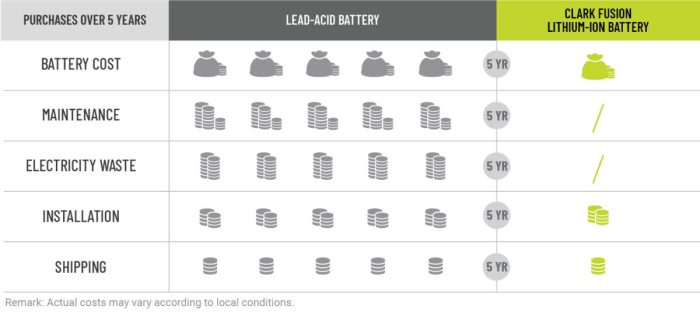
CLARK proudly offers a full line of electric forklifts that can be equipped with an aftermarket CLARK FUSION lithium-ion battery. With an operator-friendly BDI, customers can enjoy all of the benefits of a lithium-ion-powered lift truck, including longer service life, no maintenance, opportunity charging, and more! CLARK FUSION Lithium-Ion batteries can be ordered through the local CLARK dealer in addition to any CLARK electric forklift in the lineup.

CLARK FUSION Lithium-ion batteries offer several advantages over lead-acid batteries, starting with their impressive efficiency and longevity. Unlike traditional lead-acid batteries, lithium-ion batteries provide a higher energy density, which translates into longer operational hours between charges. This efficiency is particularly beneficial in high-demand environments where forklifts are in constant use, as it reduces downtime associated with frequent recharging. Additionally, lithium-ion batteries maintain consistent power output throughout their discharge cycle, ensuring that forklifts operate at full capacity until the battery is nearly depleted, unlike lead-acid batteries that experience a drop in performance as they discharge.

Maintenance-Free

CLARK FUSION Lithium-Ion batteries are low maintenance, requiring no watering or acid refills. Sealed, they reduce downtime, lower costs and boost operator safety, offering longer battery life without the risks of low water or acid levels.

Opportunity Charging

CLARK FUSION batteries offer opportunity charging, allowing operators to charge during breaks or downtime. Most models fully recharge in under 2 hours, reducing downtime and keeping your fleet moving efficiently.

High Energy Yield

CLARK FUSION batteries absorb 90%-95% of energy from the charger, making them more efficient and faster to charge than lead-acid batteries, which lose energy through the cable. Unlike lead-acid batteries that reduce power at 40% charge, lithium-ion batteries maintain consistent performance, all the way to the recharge point.

Decentralized Charging Points

Because lithium-ion batteries do not discharge harmful gasses or require watering during charging, a dedicated charging room is no longer required for safe charging. Simply plug the charger into any appropriate outlet and the lithium-battery can charge seamlessly. Reclaim precious floor space with CLARK FUSION lithium-ion batteries.

Double the Run Time of Lead Acid Batteries

CLARK FUSION batteries can be recharged without removal, keeping operator productive and eliminating the need to swap batteries mid-shift. With double the run time of lead-acid batteries, you’ll save on costs by using one battery per truck and improve safety by avoiding the risks associated with battery swapping.

No Battery Swapping Required

Lithium-ion batteries can be charged up to 3,500 charging cycles in normal applications, extending their lifespan by 3 to 40 times that of a standard lead-acid battery. The increase lifespan means fewer battery replacements and extends the life of your Built to Last forklift as well. For a durable and long-lasting way to power your truck, trust CLARK FUSION Lithium Ion Batteries.

Save Up to 70% Expenses in 5 Years

Reduce downtime, increase productivity and safety with CLARK FUSION batteries. To learn more about all the options available with the CLARK FUSION battery system, please contact us in Southern California at 800-322-5438.

Kalmar T2 EV Electric Terminal Tractor

Kalmar Ottawa’s third generation of electric terminal trucks or yard trucks will help improve the eco-efficiency of your operations while maintaining the highest levels of productivity and safety. With a range of modular battery options and charging solutions, we can work with you to design a solution that will deliver for your yard, terminal or distribution centre.

Eco efficiency built in

Your electric terminal tractor will produce zero carbon emission at source, making them cleaner and safer to operate in your yard, terminal or distribution centre. Getting an electrically powered yard truck is only the start of your eco-efficient journey. One that we will be with you every step of the way.

Three big benefits

There are three distinct differences and many small ones to our new generation of electric terminal tractors for you to benefit from:

  1. Charge times reduced. Our first big change has been to incorporate a DC FastChargeTM System, which has allowed us to decrease our charge time significantly.
  2. Electric motor. The second is that we have eliminated the transmission from the driveline, moving to a direct drive solution where the electric motor is powering the drive axle, reducing the complexity of the driveline.
  3. Ability to operate in extreme temperatures. Thirdly, we have included an Active Thermal Management System, which will allow your electric terminal tractor to operate optimally at full power in extreme temperatures. The system keeps your core battery temperature between 77-86˚F for optimal performance even when the temperature outside gets down to -22˚F or up to 122˚F.

When all brought together you have the Kalmar Ottawa T2 EV Electric Terminal Tractor which can be charged quickly and easily, will operate optimally in extreme weather conditions, is easier to service and maintain.

Modular by design

Batteries and chargers are a big part of your overall investment in your electrically powered yard  truck  making it critical that you get a solution that is matched to your operational requirements, which is why Kalmar has taken a modular approach to our battery and charging solutions. 

There are different charging solutions available with charging capacities up to 150kW and three different Li-ion battery capacities to choose from. 

Our battery solutions all come with a 6 year/2800 charge cycle warranty*. Kalmar can help you work out which battery option and charging solution is right for your business based on your current work cycles.

Managing your power

Kalmar’s Battery Monitoring System continually monitors the voltage, temperature, coolant and current flow of your battery solution to ensure that it operates optimally over its lifetime. This system also controls the charging of the batteries by utilizing regenerative breaking, sending recovered energy back into the battery packs making sure you are using the power available as efficiently as possible.

Our battery solutions all come with a 6 year/2800 charge cycle warranty*. Kalmar can help you work out which battery option and charging solution is right for your business based on your current work cycles.

*First life measured as 80% capacity left in the battery.

For complete peace of mind.

All Kalmar Electric Terminal Tractors come with a 3 year/6500 hour warranty on major electric components, and a 6 year warranty on the batteries. Kalmar Ottawa also offers a full range of service packages and genuine parts to keep your terminal tractor operating optimally, thus minimizing downtime.

Link to Kalmar webpage to learn more about the T2 EV

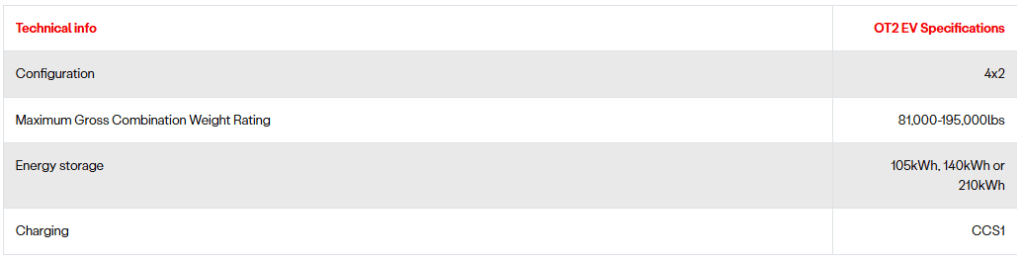
Kalmar T2 EV Technical Information

Take the T2 EV for a Test Drive!

For more information, a demo or pricing on a new Kalmar T2 EV, please contact us at 800-322-5438. Cal-Lift is your source in California, Arizona and Nevada for Kalmar equipment, service, rentals and parts.

Introducing CLARK Material Handling’s Newest S-Series, The SES Stand-up Electric Counterbalance Forklift

CLARK SES15 – SES25, Stand-up, Counterbalance, Electric Forklift

Aisle space is often at a premium in today’s fast-paced environments, so efficiency and maneuverability are key. That’s why we’ve designed the 100% AC SES15-25 to be fast, energy-efficient, and cost-effective to operate without sacrificing performance. Despite its power, we’ve made sure the SES can easily navigate those narrow aisles and tight corners, ensuring that your operators can work seamlessly in confined spaces. Whether you’re managing a warehouse, distribution center, or cold storage facility, the SES is the ideal solution to enhance productivity and keep operations running smoothly—without compromising on space or efficiency.

Unmatched Comfort. Unrivaled Control

The SES is engineered for all-day efficiency, providing operators of all sizes with ample space to work comfortably. Its natural 90° stance positions the hands outboard of the body, allowing for effortless visibility in busy environments.

  • A synchronized armrest and joystick control adjust together, ensuring optimal hand and arm alignment at any height. The cupped armrest makes it easy to maintain a centered, ergonomic grip on the joystick for precise control.
  • For superior shock absorption, the SES features a floating floor with multiple isolators—minimizing fatigue and reducing the wear and tear seen in forklifts that rely on a single shock-absorbing cylinder. A recessed footrest allows operators to adjust their stance freely for added comfort.
  • Designed with convenience in mind, the SES includes built-in storage trays, a phone holder, a cupholder, and a spring-loaded clipboard, keeping essentials within easy reach.
  • Whether navigating demanding tasks or spending hours on the job, the SES delivers an ergonomic advantage that enhances comfort, boosts productivity, and keeps operators performing at their best.

Precision Control, Effortless Operation

The intuitive joystick control simplifies operation, allowing seamless tilting, lifting, and lowering—with the ability to perform two functions simultaneously for enhanced productivity. Its ergonomic 2-way contoured shape naturally fits the hand, ensuring all-day comfort and reducing strain.

  • Advanced electric steering provides just the right amount of assist at any speed, delivering a firm, responsive feel for precise tracking and confident maneuvering.
  • For superior visibility, the sloped front angle and patented nested I-beam mast design offer an unobstructed downward and forward view, improving safety and awareness in high-traffic workspaces.
  • The SES is engineered for efficiency, precision, and operator comfort—because better control means better performance.

Smart Dash: Intelligent Monitoring at Your Fingertips

The 5-inch color LCD display puts critical safety, efficiency, and performance insights front and center while protecting your truck from unnecessary wear and tear.

  • Customize your truck with programmable travel speed limits, turtle mode speeds, operator access codes, and low battery alerts. Automatic dealer contact prompts help ensure swift issue resolution, minimizing downtime.
  • Smart Dash restricts shifting until the truck slows to a preset speed to prevent shift shock, protecting transmission components from premature wear.
  • Technicians benefit from real-time diagnostics displayed directly on the screen, eliminating the need to open service hatches or manually inspect components. Integrated with the CAN bus system, Smart Dash ensures seamless communication across all truck systems for reliable, data-driven performance.

Unmatched Strength, Stability, and Efficiency

The SES is built for durability and peak performance, delivering superior stability with patented, industry-leading nested I-beam masts engineered for greater strength than traditional C-channel designs.

  • With exceptional capacity retention, this forklift maintains more weight capacity at higher fork heights, eliminating the need for a higher-capacity truck and reducing overall investment costs. The 8-roller carriage—featuring six vertical rollers and two side thrust rollers—minimizes mast wobble, giving operators the confidence to handle heavy loads efficiently.
  • The maintenance-free electric braking system reduces operating costs with no service requirements, no brake pads to replace, and no risk of oil leaks. Its energy-efficient design extends battery runtime and lowers energy costs.
  • Designed for reliability, the SES features a fully welded frame, providing exceptional durability compared to competitor bolt-together designs. For easy servicing, the front cover opens for quick access to wiring, fuses, and controllers, minimizing downtime and simplifying maintenance.
  • Backed by an industry-leading full warranty of 2 years or 4,000 hours, the SES is engineered to deliver strength, stability, and efficiency you can trust—every shift, every day.

We are your source for Clark Material Handling products in Southern California. For more information on the SES, a demo or pricing, please contact us at 800-322-5438.

Proper Inspection of Your Forklift’s Forks

Your forklift’s forks bear the brunt of your loading and unloading operations. Wear and tear, or damage to either component can create a dangerous situation for your employees and anyone working around your fleet. And a 10% wear on your forks can reduce your safe lifting capacity by 20%, making your 5,000lb. forklift, a 4,000lb. forklift.

Inspecting your forklift forks regularly is essential for safety and efficiency. Here’s a step-by-step guide to inspecting your forks properly:

  1. Visual Inspection
    ✔ Check for Cracks & Damage – Look closely for cracks, bends, or other signs of damage. Pay special attention to welds and stress points.
    ✔ Inspect for Bending or Warping – Lay a straight edge along the fork blade to check for any bending. Even slight bends can reduce lifting capacity.
    ✔ Look for Wear on the Heel – The fork heel (where the blade meets the shank) is a high-stress area. If it’s worn down by 10% or more, replace the fork.
    ✔ Check for Surface Damage – Rust, deep scratches, and chipped paint could indicate hidden damage or weak spots.
  2. Measure Fork Thickness
    Use calipers to measure the thickness of the fork heel.
    Compare it to the original thickness. If it has worn down by 10% or more, replace the fork (this reduces load capacity by about 20%).
  3. Check Fork Hooks & Mounting Points
    ✔ Ensure the hooks are not cracked or excessively worn.
    ✔ Verify that the locking pins are functional and secure.
    ✔ Make sure the forks are properly mounted and not loose.
  4. Confirm Even Fork Height
    Set the forks on a level surface and check if the tips are even.
    A difference of more than 3% of fork length means one fork is more worn than the other and should be replaced.
  5. Inspect Load Markings
    ✔ Make sure the load capacity markings on the forks are visible and legible.
    ✔ If they are missing or unreadable, you may need to replace the forks or have them re-marked.
  6. Test Fork Operation
    ✔ Engage and disengage the forks to ensure smooth movement.
    ✔ Look for signs of unusual resistance, sticking, or instability.
  7. Follow OSHA or Manufacturer Guidelines
    OSHA and forklift manufacturers typically recommend daily pre-shift inspections and full inspections at least once per year (or more in high-use environments).

If any defects or wear exceed safety limits, replace the forks immediately rather than attempting repairs. Forklifts depend on strong, reliable forks to operate safely. Contact us at 800-322-5438 and we will help you select the proper forks for your forklift and operational requirements.

Selecting The Right Tires for Your Forklifts

It is easy to overlook the humble tire when it comes to maintaining a forklift. Choose the wrong tire, however, and you could end up with a dramatic increase in fleet operating costs or, worse yet, increased safety risks. Choose the right one, and you can realize significant cost-savings, improved safety, and a more efficient operation. For example, a properly chosen tire can last 40 percent longer. Read “Minimizing the Cost of Your Forklift Tires.”

Tires are a safety item that is often over looked, but a good set of tires provide the traction, stability and ground clearance essential for safe lift truck operation. Excessively worn tires reduce ground clearance; bring the bottom of the mast and the engine oil pan dangerously close to the ground.

Making those right decisions can be difficult, because contrary to conventional wisdom, tires are very complex components. There are many brands, types, compounds and treads, which means you must be fully armed with data before making a purchase. Here are some questions we typically ask our customers:

  1. What type of fuel (IC or electric) does your forklift use?
  2. How heavy is your typical load?
  3. How long is your typical run?
  4. What kind of problems are you experiencing with your tires now?
  5. Does your forklift operate over dock plates?
  6. On what types of surfaces do you operate your forklift?
  7. Is your forklift used for multiple shifts?
  8. What percent of time is your forklift loaded?
  9. What is your average and top speed of your forklift?
  10. If you are evaluating tires for more than one forklift be prepared to answer the previous questions for each unit.

In addition to knowing the specifics about your tire needs, it will be helpful for you to understand the unique wording used for forklift tires. Durometer is used to describe the hardness of forklift tires. The higher the durometer number, the harder the tire. Most load tires range in durometer from 83 to 95. Our industry uses a couple of standard classifications that cover 80 percent of the tires purchased today.

Softer tires, like rubber, provide better traction for facilities where frequent maneuvering is required. They also are more forgiving of floor debris and offer the operator a more comfortable ride. Be aware, however, tires made of softer compounds create heat and wear faster, making them a less desirable choice for applications where maximum speed and long runs are the norm.

Harder tires are excellent for maximum loads, multiple shifts, long runs and high speed applications. They will wear better and last longer than tires made of softer compounds. But the ride will be harder and the tire more vulnerable to floor debris. They offer less resistance and are well suited to operators especially concerned with energy efficiency. Universal Compound tires are good all-around tires for the average user, but not always the best choice for durability and traction depending upon your application.

The actual tread of the tire is important to consider, too. Pay special attention to whether you want a smooth tire, such as for indoor applications, or a treaded one, for forklifts operated outdoors or over uneven terrain.

We recommend operators track by application how well their tires perform. Create a spreadsheet with rows for each of your forklifts. Track the date tires were purchased, the type of tire, the reason for the replacement and the hour meter reading. Over time, you will see trends emerge that will help you adjust purchasing decisions for the type of performance you need, such as correlations between harder tires and damage, or softer tires and premature wearing. Inspecting tires is always part of our Planned Maintenance Program. 

In the end, there is no one tire that can optimize tread life, traction, durability and fuel efficiency. The key is finding the best fit for each of your forklift material-handling applications. Working with a company that is knowledgeable about forklift tires can assist you in selecting the right application and optimize your fleets for performance.

Cal-Lift Inc. has been helping companies select the right tires for forklifts, terminal tractors and container handlers for decades. Give us a call today at 800-322-5438 to discuss your tire performance and let us help you improve your bottom line!