3 Reasons to Convert to Electric Forklifts in 2020

The last decade has led to many improvements in electric forklifts. Not only have they been built to withstand outdoor usage; battery and charger technology has changed dramatically. These advancements have led to a dramatic increase in electric forklift sales. The chart below shows the increasing disparity between electric and traditional forklift deliveries (chart from Industrial Truck Association presentation to the ITA President’s Forum in Coronado, California in 2019)

In 2019, the number of electric forklifts increased to 70% of forklift deliveries. As you can see, the benefits are starting to be realized by more and more companies.

Driving this growth in the electric forklift market are two primary considerations: costs and environmental concerns. While capital costs for electric forklifts are higher than their internal combustion counterparts, the decrease in fuel and maintenance costs more than make up the difference over the forklift’s useful life. But there are other factors that influence the decision-making process and causing more users to convert to electric forklifts. The top four that we observe include:

Costs – As previously stated, an electric forklift and accompanying batteries and chargers result in a higher capital investment upfront, but those initial costs are more than compensated for over time. An electric forklift produces no heat, has far fewer moving parts (no belts, fans, pumps, filters, oil, etc.).

Some estimates put maintenance costs for electric forklifts at 40% less than internal combustion counterparts (First Energy)

In addition to maintenance costs, energy costs for electric forklifts are far less costly than for LPG-, diesel- or gas-powered forklifts. The cost per hour to operate an internal combustion forklift can be as much as $.75. LP tanks are almost always exchanged with fuel still remaining in the tank. Unless you’re getting credit on unused LP fuel, you’re paying for fuel that you’re giving back to your LP provider. Visit the Electric Power Research Institute to use their savings calculator to compute a rough estimate of your own savings. We realize that not all material handling operations are identical and your savings may vary, but the illustration certainly demonstrates that it is less costly to operate electric forklifts.

Health and Safety – Electric forklifts eliminate harmful carbon monoxide and carbon dioxide from your facility, greatly improving the air your employees breathe. The effects of a build-up of CO can result in nausea, headaches, disorientation and in some cases, hospitalization and even death. This is compounded in the colder months where windows and dock doors are often not opened.

Utilizing electric forklifts allows you to keep the doors and windows closed at any time without fear of creating an unsafe work environment for your employees.

Flexibility and Performance – Just 10 years ago, electric employees could rarely compete with internal combustion forklifts, particularly outdoors. This is no longer the case. Electric forklift and charging technology have advanced greatly: fast-charge system, opportunity charging, sealed batteries and motors, and Lithium Iron Phosphate battery technology, which eliminates battery-charging altogether. Battery capacity and energy efficiency have also allowed electric forklifts to be produced in much higher capacities than in previous years. These advancements have changed the landscape of electric forklift operation. There are now few operations where electric forklift cannot compete with IC forklifts.

There has never been a better time to explore electric forklifts to replace your internal combustion fleet. Contact us at 800-322-5438 for a consultation and quote. You will be on your way to a cleaner and more efficient material handling and storage operation.

The Benefits of Renting Forklifts

Often times companies find them in a situation where they need to increase their forklift or other material handling and storage equipment fleet, but want to conserve capital for other operational objectives. This is where renting equipment on a short-term or long-term basis can be a great alternative to purchasing or traditional financing. These benefits include:

Cash Conservation – There is no cash outlay to obtain equipment under a Long-Term rental agreement. Save your cash for alternatives that produce profits for your bottom line.

Pay for what you use – Long-Term rental agreements are based upon the expected hours and operating conditions that you will use the equipment. Unlike purchasing equipment where you are paying for 100% of asset (a depreciating asset), you pay based upon the expected usage rate of the equipment.

Rental payments are 100% tax deductible* – Rental payments are an operating expense and are 100% deductible as a business expense. No confusing depreciation schedules or damaging tax ramifications at years-end. *(consult your financial adviser to confirm your tax status)

Fixed payments, no maintenance surprises – Long-Term rental agreements typically include normal maintenance. We own the equipment, so maintaining it is our responsibility. Leave the surprises to us and keep your material handling costs consistent and predictable.

Eliminate your parts and service departments – If you currently own your fleet and maintain it you need mechanics, tools and parts. Improve warehouse and plant space by eliminating the need for stocking parts and providing space to service equipment.

Eliminate obsolescence – Long-Term agreements can provide for upgrades should your business change. Don’t get stuck with equipment you no longer need due to a change in your business plans. We will find a home for the old equipment, and provide you with equipment you need today.

Keep your credit line clear – Unlike financing equipment, Long-Term Rentals have little impact on your ability to borrow money to increase your business.

Flexible terms and equipment – Whether you need new or used equipment for your operation we can provide you with the equipment you need at the terms you need. From one year to eight we can build a Long-Term rental agreement that meets your business needs.

Eliminate stand-by equipment – Do you purchase more than you need to allow for break-downs and cyclical needs? Our forklift rental fleet stands ready to supply you with immediate equipment when a need arises.

Renting hedges against inflation – Reduce the risk of labor and parts prices increases by fixing your monthly payment now for the term of your agreement.

Generate cash now – Trading in your current fleet can generate immediate cash for operations.

Flexibility, reliability and consistency are your results when you rent Long-Term with Cal-Lift Inc. In addition you will have the comfort of knowing that you have a team of professionals with a proven track record as a true partner in your material handling operations. We take all the hassle out of acquiring and maintaining a fleet of forklifts and leave you with more time to manage your business.

We would appreciate the opportunity to discuss rentals options for your company. To schedule an appointment  contact us at (800)-322-5438.

Proper Forklift Fork and Chain Inspections

Forks and chains lift hundreds of thousands of pounds each shift, and unchecked wear on either can cause a load to come crashing to the ground.  This can result in severe damage to property, or even the death of an employee. Below are some specific areas to inspect to help ensure forks and chains are in safe operating order.

Fork Inspection. Knowledge of metallurgy or its equivalent is not necessary to perform OHSA inspections, but operators must nonetheless pay attention to these key metal-related areas when examining forks.

  • Rated load capacity. Are the forks rated to carry the loads they are handling? An excellent online calculator is available here.
  • Surface cracks. Inspect each fork top and bottom for surface cracks. Pay close attention to the heel area and the welds to the areas that attach the forks to the lift truck. These areas are most likely to develop cracks. If a crack is found, the fork must be replaced before the lift truck is put back into service. OHSA does not permit a damaged fork to be repaired.
  • Straightness of the blade and shank. If either the shank or the blade has any sort of bend, the fork must be replaced before the lift truck is put back into service.
  • Excessive angle. If the shank and blade angle exceed 93 degrees, the fork must be replaced before the lift truck is put back into service.
  • Fork tip height variances. If the fork tips exceed 3 percent of the length of the blade, the forks need to be replaced before the lift truck is put back into service. For example, for 48-inch forks, the differences in the heights of the tips of your blades cannot exceed 1.44 inches.
  • Positioning lock. If the positioning lock is inoperable, it must be replaced before the fork is put back into service on the lift truck.
  • Normal wear. Use calipers to measure the heel and the blade for wear. These are the areas that wear most quickly. Once wear reaches 10 percent, the fork must be replaced. Ten percent wear results in a 20 percent reduction in rated fork capacity and represents a significant exposure for accident.

Chain Inspection. Forklift chains endure tremendous stress during operation and are subject to additional damage and wear by environmental conditions such as dust, rain and industrial chemicals. Carefully inspect chains for the following:

  • Chain elongation. Elongation of more than 3 percent indicates a 15 percent reduction in strength and means the chain should be replaced.
  • Rust and corrosion. Chains showing any rust or corrosion should be replaced. For maximum protection, chains must be completely lubricated at all times.
  • Plate cracking. Inspect closely for cracks. The discovery of any crack means the chain should be replaced before the forklift is put back into service.
  • Protruding or turned pins. Lack of lubrication results in friction between the plates and the pins, causing the pins to twist and turn their way out of place. The result is chain failure.
  • Misalignment. Look for wear patterns on pinheads or outside plates. Continued operation will result in damage to the chain and sheaves, potentially causing the chain to fail.
  • Chain anchors and sheaves. Inspect anchors for misalignment, damage or undue wear. Anchors with worn or broken fingers must be replaced.

Cal-Lift strives to help operators maintain compliance with OSHA regulations, but more importantly, we help maintain both forklifts and chains, ensuring employees are safe and productive.

If you find your forks or chains worn or damaged, please call us at 800-322-5438 to get a replacement quote.

Download our “Fork Inspection Guide and Log.”

Taylor Machine Works Announces Cal-Lift New Territory Expansion

Taylor Machine Works, Inc. is excited to announce Cal-Lift, Inc. is expanding into the following counties in California which are in addition to their already existing territory as an Authorized Taylor dealer:
Alameda, Alpine, Amador, Calaveras, Contra Costa, El Dorado, Fresno, Imperial, Inyo, Kern, Kings, Los Angeles, Madera, Marin, Mariposa, Merced, Mono, Monterey, Napa, Orange, Placer, Riverside, Sacramento, San Benito, San Bernardino, San Diego, San Francisco, San Joaquin, San Luis Obispo, San Mateo, Santa Barbara, Santa Clara, Santa Cruz, Solano, Sonoma, Stanislaus, Tulare, Tuolumne, Ventura, and Yolo.


Cal-Lift, Inc. has been an Authorized Taylor Dealer for over forty years putting Taylor material handling equipment in ports, and intermodal applications throughout the Long Beach and Los Angeles area. Cal-Lift was instrumental in helping place Taylor’s ZLC Series, the first Battery Electric Zero-Emissions Container Handler, in the port of LA, a milestone project introduced in October 2019.


Hal Nowell, Director of Sales for Taylor Machine Works, Inc., stated, “I have worked with Cal-Lift for over twenty years. It has been a privilege to work with a company that has the dedication to the Taylor brand that Cal-Lift does, and their attention to detail when it comes to the needs of our customers is what makes them an exemplary Taylor Authorized dealer.”
Taylor Machine Works, Inc., one of the only privately held manufacturers of industrial lift trucks in America, has been providing customers for over 93 years with quality and dependable equipment. We are committed to our customers in both sales and service and want them to be assured that “Taking Care of our Customers is Priority One!”

###

Tips to Improve Pedestrian Safety in Your Warehouse

When it comes to forklift safety, a lot of emphasis is placed upon safe forklift operation; as it should be. What we see quite frequently, though, is a lack of training for employees working in a warehouse situation but who do not operate forklifts but merely work around them all day, every day. Working around them without knowledge pertaining to their potential hazards creates a dangerous scenario for catastrophe.

We recommend formal forklift operator classroom training for all of your facility employees who could encounter a forklift in the course of their responsibilities. This training should cover the following:

How forklifts and similar equipment operate: While operator training is not required, it is nevertheless important for employees to know the limitations of forklifts and their operators in a warehouse setting.

  • Visibility: The operator’s vision is severely limited, especially when carrying a load. There are many other pitfalls of assuming that the operator is aware of the employee’s presence.
  • Eye contact: Employees should try to make eye contact with an operator. This ensures that the operator is fully aware of the employee’s presence. Busy operators may or may not be aware of the pedestrian, and any sudden move could result in a collision.
  • Stopping: A 7,000-lb. forklift carrying a 5,000-lb. load cannot stop as quickly as a car, and if the operator slams on the brakes to avoid an employee, the employee could find 5,000 pounds of product hurtling in his direction.
  • Keeping your distance: Never approach a forklift from the rear. Keep beyond three feet of the side, and never stand in front of a forklift or on the forks. This keeps the pedestrian safe should any sudden movement of the forklift occur.
  • Forklifts cannot be heard: Electric forklifts are completely silent, and even internal combustion units can approach without being heard in a busy, noisy facility. Be certain that all pedestrians understand this and are diligently LOOKING for lift trucks and equipment at all times, particularly at intersections.

The potential dangers of working around this equipment: Rear ends swing wide, loads can spill, toes can be run over, and many other dangers exist if the employee is not cognizant of how to behave around a forklift. Lift trucks present a number of dangers. The operators are aware of these hazards, but pedestrians often consider forklifts benign pieces of equipment.

  • Falling loads: When walking near a lift truck depositing or retrieving a load at various heights, a pedestrian should know that loads can tumble down. The pedestrian should avoid the area at all costs.
  • Wide swings: The rear of the forklift can swing quickly to one side or the other, resulting in collision with a pedestrian or running over feet.
  • Weight: People rarely understand that forklifts are very heavy machines that cannot stop quickly. A collision often results in serious injury and sometimes death. Pedestrians need to understand this and respect the potential dangers.
  • Proper use: Pedestrians should know that they are not allowed to operate this equipment without proper training, even if it is to hop on a quickly moving lift truck to find the product they are seeking.
  • Reporting: Any unsafe conditions should be reported by pedestrians immediately to a supervisor. These include unsafe operation or conditions in the facility that create a potential for accident.

What you can do to minimize these potential dangers: As a manager or supervisor, you must ensure that each person entering your facility, whether he is another employee or a guest, understands these potential hazards and is alert for them when in your facility.

  • Training and briefing: Training pedestrians or employees who regularly enter your facility should be a requirement, whether the person is an employee, vendor, or other guest who is a regular visitor. If you have an occasional visitor, this guest should be briefed on what type of equipment you operate, how it operates, your safety procedures, and the need to be alert at all times.
  • Install lanes and pedestrian islands: Simple pedestrian lanes painted on the floor and training on how to use them are the ultimate scenario to protect pedestrians. Having protected islands for pedestrians to pack or perform other duties keeps them safe when working among forklifts.
  • Lighting: Provide adequate lighting in aisles and other areas to ensure maximum visibility.
  • Set speed limits: Finding the balance between maximizing productivity and creating a safe environment for employees is key. Aisle speeds and intersection speeds will vary and are different for each facility.
  • Install mirrors at intersections: Then, train employees and operators alike to use them to see what’s coming around the corner.
  • Ensure that all safety devices on all of your lift trucks are operational: Items like back-up alarms, horns, and lights should be checked daily to ensure operational effectiveness.

It takes only a few seconds of inattentiveness for an accident to occur. Training, informing, and monitoring produce a safe work environment and minimize your bottom line exposure, should an accident occur.

Safety is no accident, and if we can be of any service to you in creating a safe work environment, we are here to help.

Learn more about Cal-Lift.

Taylor Zero Emission Top-Handlers Performing Well at the Port of Los Angeles

SAN PEDRO, Calif. – August 6, 2020 – The world’s first zero-emissions top handlers, unveiled last fall as part of a pre-commercial demonstration project at the Port of Los Angeles, are now being used in daily operations at the Everport Container Terminal. 

“We are pleased with performance results that we are receiving from drivers, mechanics and Everport management as the equipment is tested daily in real-world conditions,” said Port of Los Angeles Executive Director Gene Seroka. “We are doing everything possible to advance commercially feasible solutions to meet our goal of transitioning all cargo-handling equipment to zero emissions by 2030.” 

The two battery-electric top handlers were designed and built in the U.S. by Taylor Machine Works, Inc., a leading heavy-duty equipment manufacturer and the largest supplier of top handlers in service at the Port. Also known as top picks, top handlers are off-road vehicles with an overhead boom for loading containers weighing up to 100,000 pounds onto trucks and trains, unloading them, and stacking them on terminals between pickups and deliveries.

The top handlers run on a one-megawatt battery designed to operate for up to 18 hours between charges. Each top handler has a data logger for tracking hours of operation, charging frequency, energy usage and other performance indicators. Additionally, drivers and mechanics are providing input on the maneuverability, noise level and safety of the equipment. 

The battery-electric top handlers are a key component of the Port’s $7.7 million Everport Advanced Cargo-Handling Demonstration Project. The California Energy Commission (CEC) is supporting the large-scale zero-emissions technology project with a $4.5 million sustainability grant. 

The Everport demonstration is one of 16 projects in which the Port is either the lead agency or a participant working with multiple partners to test near-zero emissions and zero-emissions engines, emissions control technology, and alternative fueling and charging stations.

In addition to the battery-electric top handlers, the projects include testing ultra-low NOx renewable natural gas equipment and fully battery-electric fuel cell heavy-duty trucks; battery-electric forklifts, yard tractors, and rubber-tired gantry cranes; and emissions control equipment on large ships and harbor craft. 

Eliminating tailpipe emissions from cargo-handling equipment is essential to achieving the Port’s larger goal of reducing greenhouse gases (GHGs) from all port-related sources. Port targets call for reducing GHGs 40% below 1990 levels by 2030 and 80% below 1990 levels by 2050. 

The Port of Los Angeles remains open with all terminals operational during the COVID-19 pandemic. North America’s leading seaport by container volume and cargo value, the Port of Los Angeles facilitated $276 billion in trade during 2019. San Pedro Bay port complex operations and commerce facilitate one in nine jobs in the five-county Southern California region.

Cal-Lift Inc. is Southern California’s source for Taylor Big Red forklifts and container handlers, including service, parts and rentals.

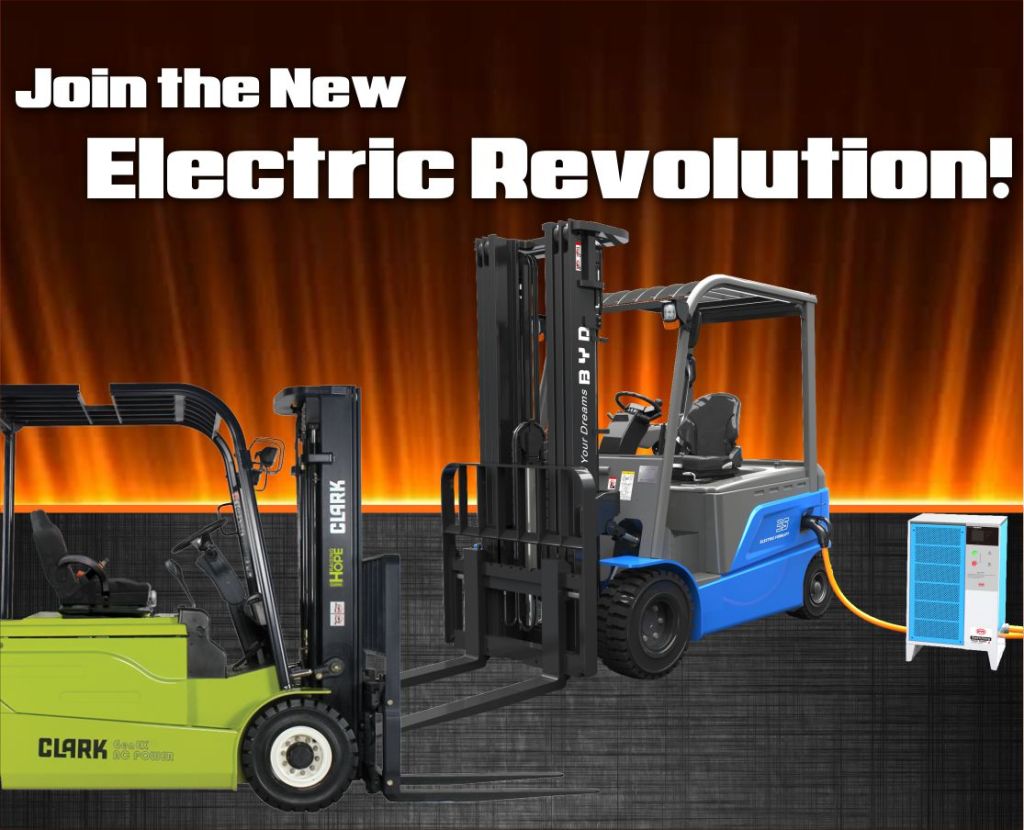
Join the Electric Forklift Revolution

Twenty years ago, companies with a 24 hour operation moving 8,000lb loads indoors and outdoors would have laughed off a suggestion of an electric forklift being able to replace their internal combustion fleet. Those days are long gone. In fact, through June of this year, nearly 70% of the new forklifts purchased in the US have been powered by electricity!

And there is good reason. The benefits of operating electric forklifts are many and the drawbacks are few. Over the past decade, manufacturers of electric forklifts have worked tirelessly to improve the performance of electric forklifts so they can do the jobs previously relegated to their IC counterparts. The results are impressive. Most manufacturers have models that can be used indoors and outdoors with capacities often exceeding 10,000lbs. They’ve equipped them with pneumatic tires and sealed components to ensure your electric forklift will continue to perform flawlessly, whether it’s sunny and 100 degrees or rainy and 40 degrees.

In addition, battery and charger manufacturers have improved technology to make batteries more efficient, longer lasting, and less costly. Lithium batteries are now being manufactured to fit existing forklift models, which eliminates battery changing, storage and multiple batteries for each lift truck. Let’s take a quick look at the benefits of owning and operating electric forklifts.

Electric Forklifts Eliminate Emissions

The values of today’s business owners have changed. Twenty years ago, few of us were concerned with our carbon footprint. Today, that is taking front and center page with many companies’ strategies to be carbon neutral. Electric forklifts are a great way to help companies achieve this. One study found that a 2,000 hour operation emitted 20,000lbs of carbon into the atmosphere for each forklift operated! Electric forklifts emit zero emissions.

This also makes for a safer and more comfortable working environment for your employees. Eliminating carbon monoxide from your plant or warehouse operation equates to a much more desirable workplace. Many companies enjoy fewer sick days, reduced medical expenditures and improved productivity.

Fuel Savings

While batteries and chargers require an additional up-front investment in your forklift fleet, the long-term benefits prove to far outweigh those costs. Some studies reveal that powering an electric forklift can save over $4,000 per year, per forklift!

Reduced Maintenance Costs

Electric motors produce no heat. This means less heat pumped into your facility, reducing cooling costs and making it a more comfortable place to work. Your forklift operators no longer sit on top of an engine producing heat in excess of 130 degrees for an 8 hour shift. In addition, electric forklifts produce no noise except for the tires and operation of the mast. This reduces wear on your forklift operators’ auditory systems, making them more comfortable to operate.

Electric forklifts require no operating fluids and have far fewer moving parts. Eliminating the need for transmission fluid changes, oil changes, cooling system fluids and more reduces your costs. It also eliminates transmission parts, water pumps, radiators, and other engine parts that need replacing.

By eliminating many moving parts and fluids, electric forklifts spend less time down for periodic maintenance, servicing and repairs. This often eliminates the need for temporary rentals or “extra” units to operate while your IC forklift is being serviced or repaired.

We realize there still are some applications where electric forklifts are not suitable, but given time, the industry will provide a solution. For example, in the fall of 2019, one of our manufacturers, Taylor Machine Works produced two giant 90,000lb capacity container movers. The industry will continue to respond to the demand of consumers to produce cleaner, more durable products with even higher capacities.

See our line-up of CLARK electric forklifts and industry changing, BYD electric forklifts featuring Lithium Iron Phosphate batteries which eliminate additional batteries, storage and changing.

Reduced costs, improved health and safety, and environmental improvement are all benefits you can enjoy by converting your internal combustion forklifts over to electric models.

Taylor T1025 Recycler Wheel Loader

The Taylor T-1025 Recycler Wheel Loader features tier compliant engine technology. Taylor’s reputation was built while performing in the harshest industrial environments the Material Handling Industry has to offer.

We strive to keep things simple and use appropriate technology that brings value and the Taylor T-1025 Recycler Wheel Loader continues that tradition!

Learn more about the T1025 at Taylor’s website.

We’re Southern California’s source for American Made Taylor Machine Works products.

Forklift Safety Day 2020; What You Can do to Celebrate

The Industrial Truck Association has announced it’s second annual Forklift Safety Day, to be held Tuesday, June 9. While the in person events have been cancelled due to the Coronavirus, there are things you can do to take advantage of this day to help create awareness about the dangers that forklifts present and how to minimize the potential for accidents that can result in injury or death, damage to your facility, equipment and financial losses.

We’ve compiled a short list of things you can do on June 9th to improve safety on and around your forklifts.

  1. Make sure all your forklift operators have been trained and that their refresher training is up to date, if applicable or necessary.
  2. Download our Forklift Operator Questionnaire to help you vet new operators about their actual experience and history with forklifts.
  3. Take time to teach your forklift operators the importance of daily inspections of their forklifts. Daily inspections reduce the risk of equipment failure and catch small problems before they blossom into giant ones. Download our IC Forklift Inspection Form and Electric Forklift Inspection Forms.
  4. Take some time to gather any staff that operates around forklifts, but not on them, to refresh them about the dangers of this equipment and how to be sure to use safe procedures when they are in an area of your facility where forklifts are being operated.
  5. Make sure all your forklift’s maintenance is up to date. If you have a Planned Maintenance Agreement, this would be a good time to review it with your service provider to ensure all standard checkpoints as well as unique equipment attachments are being inspected and maintained properly. Learn more about Cal-Lift Services.
  6. Review any unique “site specific” features your facility may have and be sure your operators are aware of proper handling of equipment while on or around these features (ramps, areas where floors can be slick, floor substrates that vary etc…)
  7. Make sure that training is part of your company’s orientation for anyone that will or MIGHT operate a forklift. Remember, employees that have not been properly trained aren’t even allowed to sit on and start a forklift, much less move it out of the way of anything.
  8. Make sure you have lock-out kits to ensure that forklifts that do not pass an inspection are locked out immediately until repairs are made.
  9. Review all your forklifts for possible replacement. Old forklifts, or those that are getting “up there” in hours, might be potential threats. Review safety records and maintenance logs for your equipment. You might find this could be a good time to replace some or even all of your forklifts.-

Our goal is to help you operate safe, efficient and productive forklift equipment in and around the Southern California area. To discuss forklift safety, planned maintenance – or to get a quote on new equipment, please contact us at 800-322-5438.

4 Tips to Improve Dock Safety

Improving safety on a warehouse dock is crucial for preventing accidents and maintaining a secure work environment. Here are some recommendations to enhance safety:
  1. Conduct regular safety training: Train all dock workers on proper safety protocols, including equipment operation, handling hazardous materials, and emergency procedures. Offer refresher courses periodically and ensure everyone understands safety regulations.
  2. Provide personal protective equipment (PPE): Supply all workers with appropriate PPE, such as hard hats, safety glasses, high-visibility vests, steel-toed boots, and gloves. Encourage their consistent use and enforce PPE policies.
  3. Maintain clear communication: Establish effective communication systems, such as two-way radios or intercoms, to allow clear communication between dock workers, truck drivers, and supervisors. Ensure everyone can effectively relay information, warnings, and instructions.
  4. Implement traffic management: Develop a comprehensive traffic management plan for the dock area to prevent collisions and improve pedestrian safety. Clearly mark pedestrian walkways and separate them from vehicle lanes. Install signage and mirrors to enhance visibility, and consider using barriers or guardrails where necessary.
  5. Ensure proper lighting: Adequate lighting is essential for a safe dock environment. Install sufficient lighting fixtures to eliminate dark areas and shadows that could obscure visibility. Regularly inspect and maintain lighting systems to address any issues promptly.
  6. Regular maintenance of equipment: Establish a planned maintenance program for all dock equipment, including forklifts, loading ramps, and conveyor systems. Regular inspections and maintenance help identify potential hazards, preventing equipment malfunctions that could lead to accidents.
  7. Promote good housekeeping: Encourage a clean and organized work environment. Ensure that walkways, ramps, and loading areas are free of clutter, debris, spills, and obstacles that can cause slips, trips, or falls. Provide adequate waste management systems to prevent accumulation of waste materials.
  8. Implement safety barriers and guards: Install safety barriers, guardrails, and bollards to protect pedestrians and prevent unauthorized access to restricted areas. Implement dock edge protection systems to prevent accidental falls from the dock.
  9. Use warning signs and labels: Clearly display warning signs and labels to communicate potential hazards, such as restricted areas, low clearance, slippery surfaces, or areas with moving equipment. Ensure signage is prominently visible and easily understood.
  10. Regular safety inspections: Conduct routine safety inspections to identify potential hazards, non-compliance with safety protocols, or equipment issues. Encourage reporting of safety concerns by workers and promptly address any identified problems.
  11. Emergency preparedness: Develop and communicate emergency procedures specific to the dock area. Clearly mark emergency exits, fire extinguishers, and other safety equipment. Conduct drills periodically to ensure workers are familiar with emergency protocols.
  12. Encourage employee involvement: Involve employees in safety initiatives by establishing a safety committee or encouraging their participation in safety discussions. Encourage workers to report safety concerns, near-miss incidents, or potential hazards, and reward proactive safety behavior.

Partnering with a professional material handling company gives you insight from industry professionals whose goal is to help you create a safe working environment for anyone that operates in or around your docks.

We’re Southern California’s source for material handling equipment, service, parts and rentals. Give us a call at 800-322-LIFT.