Keeping the Heat IN This Winter

Winter is upon us, which means increased energy expenses to keep your warehouse warm and productive. While Southern California is not as effected by colder weather as our friends on the east coast, we will still be turning on the heat and anything we can do to minimize the impact of that on our bottom is helpful to a profitable 2020.

The following steps are five of our top recommendations for reducing energy consumption without turning down the thermostat.

Ensure Efficient Heat Generation Processes

Whatever thermal system you use, now is the time to make sure it is up to date with regular maintenance. Keeping your system in good operating order extends its life and ensures that it operates at optimal efficiency. Meanwhile, a poorly maintained system—particularly a gas-fired one—can pose a significant safety risk.

Another area of concern is the quantity, type, and location of your heating units. If you have made any changes to your warehouse configuration since your HVAC system was installed, now would be a good time for consultation. Technology advances quickly, and you want to be sure your HVAC system is up-to-date with current technology to ensure efficiency and effectiveness.

Maintain Proper Air Circulation

We all know that heat rises, and 20-degree temperature variances between the warehouse floor and the typical 40-foot ceiling are not uncommon. Circulating warmth to the floor can save hundreds—if not thousands—of dollars each month during the winter. The best means to accomplish this is through large industrial ceiling fans.

Determining what size, how many, and where to install industrial ceiling fans is our specialty. Fans can save up to 30 percent of your heating costs and deliver positive ROI in less than two years in many applications. Contact us for more information on fans and how many you might need to improve your energy circulation.

Retain as Much Heat as Possible

If you operate a warehouse, you have doors—very large doors. Although it is impossible to eliminate heat exchanges with cold outdoor air, you can take specific steps to significantly reduce it. These steps are more cost-effective than you probably expect.

Insulated dock panel doors can help retain warm air. However, depending on the number of dock positions, investment in them can be prohibitively costly. Instead, consider an insulation kit for each door. Insulation kits are less expensive, provide an R-Value of 6.81, and are easy to install.

Gaps around your dock doors can also cause significant heat loss. Inspect the top, bottom, and both sides of each door. If you see daylight, you are losing energy. Weather stripping kits are available to fill these gaps. The kits include weather stripping for the perimeter of the door as well as a 5-inch double-loop bottom rubber astragal to ensure that doors close tightly at the bottom. In addition to preserving heat, the seals keep bugs and other debris outside your warehouse facility. Caulking and sealants available at your local DIY big box store can help improve retention of heat dramatically over the winter.

Dock seals or shelters are imperative for preventing tremendous heat loss during trailer loading and unloading. If you are running a high-traffic operation without seals or even with worn seals, tens of thousands of expensive BTUs can blow out the door each winter day. If your seals or shelters are in good condition, be sure each tractor trailer is backed up tight against them before the dock doors are opened. Many types of dock seals and shelters are available. We can help you choose the right ones for your doors and budget.

One final area we recommend assessing is your dock leveler. If you use pit-mounted levelers, it makes sense to ensure that the side and rear seals are in good condition. Worn seals on your dock leveler result in air infiltration. We can inspect your levelers and seals, and service or replace any that are worn

Install Windows and/or Skylights

Although it is not always practical depending on the construction of your warehouse (or if you own or lease it), we certainly recommend investigating ways to improve the natural light and heat generated by the sun! Strategically placed windows or skylights can dramatically reduce your warehouse energy costs during the winter not only by using the sun’s energy for heat, but also by improving the natural lighting in your warehouse. This reduces your reliance on lighting fixtures and further reduces your energy costs. Using retractable blinds allows you to close the windows during the summer months, which reduces heat generation when it is not required.

And if you facility has windows, consider replacing them with energy efficient windows that can provide better heat retention and help keep the cold air out. If your windows are more than 10 years old, chances are you can improve energy consumption with new, more efficient windows.

Use Air Curtains or High-Speed Doors to Segment Your Warehouse Energy Needs

Some areas of your warehouse may not be used by employees often, who do most of their work in other areas of your warehouse. These low-use areas can be kept much cooler than the areas that employees use most. Air curtains and high-speed doors are excellent ways to keep the two areas temperature controlled while dramatically decreasing your energy consumption.

Winter can be an expensive time for warehouse operators, but the right steps taken the right way can significantly reduce the negative impact to your bottom line. We can help you find the right products to ensure you’re maximizing the use of energy in your facility during the colder winter months. Contact us at 800-322-5438 to speak to one of our representatives.

Taylor Unveils a World’s First

Taylor Machine Works builds some of the toughest, most durable and reliable material handling equipment anywhere on Earth, right here in the U.S.A. We are proud to represent Taylor here in Southern California and we are even more proud to be able to join them in presenting the World’s first two all-electric top handlers to the Port of Los Angeles.

The ZLC Series has ZERO EMISSIONS, can run for two shifts on a single charge, fully charge in two hours and handle up to 90,000lbs! See the introduction in the video below which includes the Eric Garcetti, Mayor of Los Angeles and Robert Taylor, President and CEO of Taylor Machine Works.

These are amazing machines and while they are the first two in existence, Taylor is already working on making the next delivery even better.  Eliminating emissions, particularly in Southern California is critical to the environment, our national health and security and we are proud to be part of a group making big strides in electric vehicle technology.

Even more impressive is that all of Taylor Machine Works products are built in America, by Americans in Louisville, Mississippi.  As you might be able to tell, we’re excited about these products and the future of material handling at the Port of Los Angeles, and other ports all around our great country, and perhaps the World.

More pictures of the ZLC.

www.cal-lift.com

OSHA Reveals its Top Ten for 2019

At the 2019 National Safety Council Congress & Expo in San Diego, California, Patrick Kapust, deputy director of OSHA’s Directorate of Enforcement Programs, presented the agency’s top 10 violations for fiscal year 2019. The order may have changed slightly, but the list remain remains the same as last year.

And though much discussion and education has taken place over the last decade regarding forklifts and safety and training, they still remain on the list of the top cited offenses.

The top 10 violations of FY 2019 are:

  1. Fall protection (construction)—general requirements (29 CFR 1926.501): 6,010 violations. The duty to provide fall protection has been OSHA’s top citation for several years. According to Kapust, common violations under this standard included failure to provide fall protection near unprotected sides or edges and on both low-slope and steep roofs. Many of the citations were issued to roofing contractors, framing contractors, masonry contractors, and new single-family housing construction contractors.
  2. Hazard communication (29 CFR 1910.1200): 3,671 violations. Hazard communication has been in the number-two spot for several years. Common deficiencies include lack of a written program, inadequate training, and failing to properly develop or maintain safety data sheets (SDSs). Auto repair facilities and painting contractors were among the industries that received many hazard communication citations.
  3. Scaffolds (construction)—general requirements (29 CFR 1926.451): 2,813 violations. Common violations included improper decking, failing to provide guardrails where required, and failure to ensure that supported scaffolds are adequately supported on a solid foundation. Masonry, siding, roofing, and framing contractors were particularly prone to scaffolding violations.
  4. Lockout/tagout (29 CFR 1910.147): 2,606 violations. Many employers cited under this standard failed to establish an energy control procedure altogether, while others were cited for failing to provide adequate employee training, failing to conduct periodic evaluations of procedures, and failing to use lockout/tagout devices or equipment.  Violations were common among plastics manufacturers, machine shops, and sawmills.
  5. Respiratory protection (29 CFR 1910.134): 2,450 violations. Failing to establish a program, failing to perform required fit testing, and failing to provide medical evaluations were among the most frequently cited issues. Auto body refinishing, masonry contractors, painting contractors, and wall covering contractors received many citations under this standard.
  6. Ladders (construction) (29 CFR 1926.1053): 2,345 violations. Common deficiencies included failure to have siderails extend 3 feet (ft) beyond a landing surface, using ladders for unintended purposes, using the top step of a stepladder, and ladders with structural defects. These violations were common among roofing, framing, siding, and painting contractors.
  7. Powered industrial trucks (29 CFR 1910.178): 2,093 violations. Violations commonly addressed deficient or damaged forklifts that were not removed from service, failing to safely operate a forklift, failing to retain certification of training, and failing to evaluate forklift drivers every 3 years as required. Forklift violations were widespread across a number of industries, but were particularly prevalent in warehousing and storage facilities, fabricated and structural metal manufacturing, and among framing contractors.
  8. Fall protection (construction)—training requirements (29 CFR 1926.503): 1,773 violations. Commonly cited issues include failing to provide training to each person required to receive it, failing to certify training in writing, inadequacies in training leading to the failure of retention by the trainee, and failing to retrain in instances where the trainee failed to retain the training content.
  9. Machine guarding (29 CFR 1910.212): 1,743 violations. Violations included failing to guard points of operation, failing to ensure that guards are securely attached to machinery, improper guarding of fan blades, and failing to properly anchor fixed machinery. Machine guarding violations occur in many industries, but common targets include machine shops, and fabricated metal manufacturing.
  10. Personal protective and lifesaving equipment (construction)—eye and face protection (29 CFR 1926.102): 1,411 violations. A newcomer to OSHA’s top 10 list in 2018, eye and face protection made the list again in FY 2019. Commonly cited issues included failing to provide eye and face protection where employees are exposed to hazards from flying objects; failing to provide eye protection with side protection; and failing to provide protection from caustic hazards, gases, and vapors.

5 Main Benefits of Planned Maintenance

Like anything else in life, whether it’s your car, your home or even your body, planning and conducting preventive maintenance creates long-term benefits that are well worth the investment. Why would your forklift and other materials handling equipment be any different?

There are many benefits of properly maintaining your forklift fleet and other equipment. However, we have recognized five major benefits that our customers have enjoyed. Planned Maintenance has been proven to:

Lower Your Maintenance Costs
Proactive and preventive maintenance has proven to lower costs by catching small service issues before they blossom into giant repair headaches. Replacing worn or damaged parts early decreases the likelihood of breakdowns.

Improve Useful Equipment Life
Equipment that is serviced regularly does not have to be “turned over” as frequently. This lowers your equipment costs over time.

Increased Productivity
Equipment that is well maintained does not break down. This improves productivity as well as your
bottom line performance. And equipment that is well maintained performs better and more efficiently

Increase Residual Values
When you trade-in your forklifts, or sell it to purchase new equipment, well maintained equipment
has proven to have higher values than equipment serviced on an “as needed” basis.

Enhance Facility Safety
Equipment failures can have catastrophic consequences. Properly maintaining your forklifts will improve operator safety, as well as those that work around your equipment.

Having the right partner in maintaining your equipment is as important as selecting the right doctor for the maintenance of your health. Our trained, experienced technicians perform thousands of Planned Maintenance service calls each year. Whether we’re servicing a giant Taylor Machine Works container handler a forklift or terminal tractor, you can count on our professional staff to minimize your downtime and maximize your productivity.

Learn more about Cal-Lift’s service capabilities, then Contact Us or give us a call at 800-322-5438 for a plan tailored to your equipment and operation.

Who Created OSHA, Why, and the Outcomes

OSHA-Logo-300x298Recently, we shared some information about the effects forty years of OSHA has had on industries. This led to a conversation about the real intents, effects and outcomes of OSHA on the American worker. We thought we would share some of the content of those discussions with you in order to bring a renewed perspective about the agency and what they do every day to ensure people like you, me and our children can go to work and be relatively confident that they will be protected from hazards seen, and sometimes unseen, in their workplace.

To understand any company’s operating philosophy, you must understand their mission. Congress created OSHA to assure safe and healthful conditions for working men and women by setting and enforcing standards and providing training, outreach, education, and compliance assistance.

We won’t belabor a long study of history. But OSHA formed for a reason. While many companies, past and present, do their best to ensure the safety of their employees, there also were, and still are, many that do not place worker safety in high regard. Given that one of the roles of government is to “promote the general welfare” of its citizens, something needed to be done to ensure that all companies were doing the “right thing” when it came to the safety and welfare of their workforce. With that purpose in mind, OSHA was formed and signed into law by President Richard Nixon under the Occupational Health and Safety Act of 1971.

When OSHA establishes a new regulation, it seeks and receives a tremendous amount of input from the public via RFIs (Requests for Information) and announcements that a new regulation is pending. They consult both large and small businesses to ensure the regulation will not put undue burdens on small businesses and cause them to suffer financially or potentially close. The bottom line is that OSHA has a systematic process to try to balance the need for safety and health with the productivity of business.

Within our industry, OSHA provides educational tools like the Powered Industrial Truck eTool to help businesses understand the dangers of lift trucks and how to ensure that each father, mother, sister and brother who operates one gets home safely each night. This site is packed full of information for the sole purpose of seeing that each person who operates a lift truck knows the dangers of the equipment and has guidance on how to operate it safely within the parameters of their work environment.

The outcome cannot be debated. Since its inception, workplace fatalities and occupational injuries have dropped by 60%. In fact, in 1971, when OSHA was signed into law, workplace fatalities numbered about 14,000 per year. In 2009, even though the American workforce has doubled in size, the number of American deaths due to workplace injury had dropped to 4,400. OSHA has helped businesses accomplish this by creating best practices for any given job, sharing them with other companies through its education process, and enforcing them through inspections.

We perform a tremendous amount of forklift operator training to meet OSHA requirements. When we engage a customer in training, we encourage them not to approach it as simply another hoop government forces us to jump through. While yes, we do recognize that it does place a burden on a business, and there’s no doubt that there have been times when OSHA has not gotten it completely right, we believe OSHA brings value to every American in the workplace.

We have found that companies that provide comprehensive training programs have higher levels of employee satisfaction, leading to better productivity, better care for the equipment they operate, fewer accidents and injuries, and a healthier bottom line for the company. Now that’s a by-product of OSHA we can all live with! Visit our website to learn more about Cal-Lift, Inc., Southern California’s source for material handling equipment, service, parts and rentals.

www.cal-lift.com

Minimizing the Costs of Your Forklift Tires

Your forklift tires are the only thing that stands between thousands of pounds of forklift and the Earth beneath. As many can attest, if you ignore the importance of the tires, bad things can happen including more frequent replacement, increased operating costs, accidents and even injuries. Some experts estimate that forklift tires can account for as much as 30% of a forklift’s operating budget.

Following are a few things you can do to ensure that you have optimized the performance of your forklift tires and are getting the best performance and useful life.

Selecting the right tire

We could write an encyclopedia on this topic as there are many factors to consider. Our best suggestion is to meet with a professional who knows forklift tires (like one of our aftermarket customer support representatives).  A trained professional will consider factors like the types of equipment you operate, what type of surface they are operating on and what are the conditions of operation? Do your forklifts operate on a smooth surface in a temperature-controlled environment, or is the surface rough, gravel, blacktop or is the floor subject to debris? Are your forklifts making frequent turns, never getting to full speed, or do your forklifts frequently make long runs which generate much more heat?

After consulting with you and observing your operation, a professional can suggest tires that will last longer, wear better, resist heat, while maximizing operator comfort.

And if you’re purchasing a new forklift, make sure the right forklift tire is part of the quote. Standard issue tires can work for some operations, but be sure you’re getting the right tire for your operation before you put it into service.

Little known fact: If your forklifts frequently carry loads that are half the rated capacity of the forklift, it puts more pressure on your steer tires as the load up front does not balance out the load of the counterweight.

Keep up the Pressure

Keep tires inflated to the recommended pressure. Over-inflation and under-inflation both cause uneven wear.

Purchase a Premium Tire

We’re not suggesting you simply purchase the most expensive tire. However, purchasing a tire simply because it’s on sale or is the lowest cost alternative, will often end up costing you more in the long-run. After consulting with a professional, there are usually options based upon your operation and budgetary constraints. Finding the BEST tire for your operation, usage, wear and tear, will pay off in the long run. The quality of tire should likely increase with the weight of the load, length of the run and condition of the surface on which it operates.

Match Tires to Application

Use tires that are suitable for the specific conditions of your warehouse, such as cushion tires for indoor use or pneumatic tires for outdoor use.

Rotation and Alignment

  • Regular Rotation: Rotate tires regularly to ensure even wear.
  • Alignment: Ensure the forklift’s alignment is correct to prevent uneven tire wear.

Frequent Inspections

Pre-shift inspections are required by OSHA and tire inspections are part of that process.  Look for things like stress cracks, tread wear and chunking. Knowing how to determine wear on your tires depends upon the type of tire and how the manufacturer determines it is time to replace. When you purchase your forklift tires, be sure the representative explains how to inspect them and when it is time for “re-tirement.” And make that inspection part of your forklift operator training. All your operators should know how to inspect all your forklift tires.

Keep it Clean

Keeping the surface a forklift operates on clean will provide additional useful life of your forklift tires. Metal bands, shrapnel, nails, screws and the like are the obvious enemies of a forklift tire and if your operation is manufacturing, you probably have plenty of debris to consider. Often times a floor sweeper (rider or push) will pay for itself over time in reduced damage to your tires.

In addition to the obvious culprits there are other concerns with operating surface. Dirt and debris can build which can reduce traction of the forklift tires creating a dangerous operating environment. A regular review of your floor can also reduce damaging factors. Things like uneven concrete joints, cracks in pavement or concrete surfaces and dock plates that are un-even or damaged can reduce wear and increase damage. Some customers even consider the condition of the tractor trailer floors. Things like nails in the floors or large splinters in trailer floors can wreak havoc on your forklift tires.

Creating a regular process for purchasing and caring for forklift tires can provide many benefits to safety, productivity and your bottom line. Our Planned Maintenance program can take a lot of these considerations off your hands. Learn more and get a quote customized to your operational needs.

To consult with one of our tire professionals, please contact us at 800-322-5438.

CLARK S-Series Nominated for IFOY 2019

CLARK IFOY 2019Ismaning near Munich, 14.1.2019. The finalists for this year’s IFOY AWARD (International Intralogistics and Forklift Truck of the Year) are nominated. From the pool of applicants for the seventh round of the world-renowned award the jury will send 15 products and solutions from a dozen manufacturers into the race for the best products and solutions of the year.
The competition will soon enter its second round: The finalists have to undergo the IFOY audit at the international IFOY TEST DAYS at the beginning of March at the IFOY partner CeMAT’s exhibition grounds in Hannover (Germany). In the IFOY Test experts measure the key figures of the finalists in a standardized procedure. In the IFOY Innovation Check renowned scientist assess the innovation value of the nominated products and solutions. This is carried out by specialists from the Dortmund Fraunhofer Institute for Material Flow and Logistics (IML), the Chair for Technical Logistics at the University of Dresden, the Chair for Materials Handling, Material Flow and Logistics (fml) at the Technical University of Munich and the Chair for Machine Elements and Technical Logistics at the Helmut Schmidt University in Hamburg.

As a highlight of the IFOY TEST DAYS jurors from all over Europe, Australia, Brazil, Russia and the US will travel to Hannover to inspect and test the nominated equipment. Among other things the innovation value, technology, design, ergonomics and handling, safety, marketability and customer benefit as well as economy and sustainability will be evaluated. The jury consists of 29 renowned journalists from leading logistics media in 19 countries.

“A golden rule of the IFOY test series is: The finalists are not compared with each other in their respective categories but with their rival trucks or machines on the market. Only those nominees who outperform their direct competitors in terms of innovation have a chance of winning the trophy,” explains Anita Würmser, chairwoman of the IFOY jury.

The trophies will be awarded on April 26 2019. As the IFOY organisation already announced in 2018 the IFOY AWARD Night will take place for the first time in the Hofburg in the Austrian Capital Vienna. In cooperation with LOGISTIK.Kurier and the Austrian Chamber of Commerce the award ceremony will take place during the gala of the Austrian HERMES Transport.Logistics.Award. More than 600 international guests are expected in the traditional Great Festival Hall in the Hofburg among them leading persons in transport, logistics and intralogistics. Until then the result will remain a secret – for both the finalists and the public.

n the counterbalanced truck segment the Clark S25 gas driven forklift with a lifting capacity of 2.5 tons has been nominated for the finals. Tthe S-Series offers low total cost of ownership and significantly higher comfort. The three s (smart, strong and safe) are the core characteristics of the completely newly developed model. Learn more about CLARK’s S-Series.

CLARK Expands Lexington KY Facility

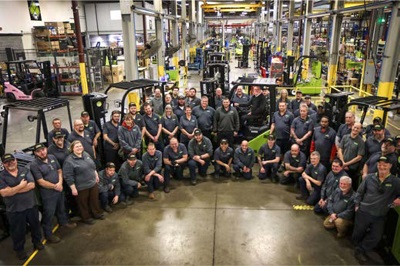
CLARK employeesLexington, KY – March 5, 2019 – CLARK Material Handling Company, one of the most recognized forklift brands in North America, plans to expand facilities at its North American corporate headquarters in Lexington, Kentucky by adding a third facility to the company’s manufacturing operation. In conjunction with this expansion, CLARK will begin re-shoring to Lexington production of its “heart-of-the-line” internal combustion products, the “S-Series.” Volume production of the S-Series is expected this summer.

“This is the third expansion of CLARK’s Lexington campus in four years,” said Scott Johnson, Vice President of Sales and Marketing for CLARK. “We completed a new R & D/Engineering Center in 2017, and in 2016 we expanded our manufacturing footprint to include high volume models previously produced in Mexico. To meet the growing demand for the company’s electric and internal combustion products, CLARK will produce nearly 80% of its products in Lexington.”

At a recent groundbreaking ceremony held in Lexington, Dennis Lawrence, CLARK’s President & CEO commented: “This is an important step to position CLARK for the future. This expansion will enable us to improve our operations, drive out waste and reduce lead times. We are excited to be strengthening our investment in the Lexington area. The dedication and productivity of the local workforce is key to helping expand our production capacity. Our expanded facilities are important elements in our desire to exceed customer expectations and fuel global growth.”

About CLARK Material Handling Company

CLARK Material Handling Company has been an industry leader since its production of the first gasoline powered material handling truck in 1917. CLARK is privately held by the Young An Company. CLARK has over 550 locations worldwide with dealer representation in more than 80 countries. A full range of I.C. and Electric trucks for diverse applications are available in the CLARK product line. CLARK was named a Best Place to Work in Kentucky for 2019.

About Cal-Lift

Cal-Lift is a full-service material handling equipment dealership in Southern California. Lift Truck brands include, BYD Lithium Iron Phosphate battery powered forklifts, CLARK Material Handling forklifts, Combilift multi-directional narrow aisle forklifts, Lift Master narrow aisle articulating forklifts and Taylor Big Red, heavy-duty forklifts and container handlers. We also specialize in service and parts for all makes and models of forklifts. In addition, we are the local distributor and servicing company for Kalmar Ottawa yard tractors and spotters. Learn more about Cal-Lift at our website.


Four Traits of Safety Minded Companies

When companies are safety-minded these are four things that almost all of them do proactively to ensure a safe operation.
As managers and owners, we want a safe work environment for all of our employees. Unfortunately, all too often it escapes us. Time passes quickly, and initiatives that were once important standards become guidelines or even merely suggestions. How can we ensure that when we put safety measures in place, they will stay in place as employees come and go in a business climate that is constantly in flux?While we lack the space to answer this question in full detail here, there are a few major approaches to providing a safe work environment that transcend industries, equipment and facilities. We outline these “hows and whys” of workplace safety below.

Since 1970, OSHA has worked to create a safer workplace for all employees, and their mission has been very successful. However, accidents still happen, and not only at companies willfully violating OSHA standards. Sometimes safety goes beyond meeting standards due to unique circumstances in certain operations.

The following are a few approaches to safety that have helped both large and small companies to achieve better workplace safety, fewer incidents and accidents, lower costs, more productivity and better workplace attitudes.

Safety is integrated with company mission – Safe companies put as much emphasis on doing things safely as on doing them productively. From day one, every employee knows they are working for a company that would rather they do their job safely than quickly. These employees will lockout a piece of equipment when something goes wrong, will replace light bulbs that need it instead of ignoring them and will report unsafe behavior or unsafe conditions.

Training never ends – Employees are involved in ongoing training – how to lift more safely, how to sit properly in a chair, how to operate a certain piece of equipment and so on. Your business is fluid: things change; equipment changes; and equipment, building space and employees are added. As your conditions change, your training must address these changes. Training for the safest work environments is never a one-time event or a two- or three-day training initiation. It is an ongoing pursuit of the safest possible work facility. It should be a goal of all employees to see that their coworkers go home safe every night.

Involvement at all levels
 – While involvement in a safe work environment must start from the corner office, the mission and strategy it is also important to ensure that every employee knows that they are involved and responsible. It is a good idea to create safety teams for every facet of your business, to revolve people in and out of those teams, and to have them conduct frequent facility or department reviews to identify potential threats. The most successful companies have reward systems for reporting anything that could be a potential threat, even if it is as minor as a sharp corner on a coat rack. This keeps all employees engaged in creating a safe work environment.

Accountability – Once you have established your safety mission and mapped out your strategy, everyone involved must be held accountable. No one can shirk their safety responsibilities. If a sharp corner on a coat rack is missed and someone gets cut, find out why no one noticed. Are they doing regular inspections? If safety standards are not being met, it is the leadership’s job to find out why and fix it. Everyone must know that if an accident happens on their watch, it must be accounted for and a plan must be designed to ensure that it will not happen again.

A truly safe, productive and profitable workplace is attained through ongoing efforts, and these are just a few of the major traits of successful organizations. We encourage you to seek the assistance of OSHA, NIOSH or other private safety consultants to help you organize and strategize your safety plans.

If there is anything we can help you with in regard to your equipment and its operators, please contact us at 800-322-5438. We would be happy to assist you!

Planned Maintenance as Part of Your Safety Program

CLARKMaintenance smallLike anything else in life, whether it’s your car, your home or even your body, planning and conducting preventive maintenance creates long-term benefits that are well worth the investment. Why would your forklift and other materials handling equipment be any different?

Having your forklifts regularly serviced reduces the likelihood of component failure, which improves the safety of not only your forklift fleet, but anyone that works around them.

There are many benefits of properly maintaining your forklift fleet and other equipment. However, we have recognized five major benefits that our customers have enjoyed.

Planned Maintenance has been proven to:

Lower Your Maintenance Costs – Proactive and preventive maintenance has proven to lower costs by catching small service issues before they blossom into giant repair headaches.

Improve Useful Equipment Life – Equipment that is serviced regularly does not have to be “turned over” as frequently. This lowers your equipment costs over time.

Increased Productivity – Equipment that is well maintained does not break down. This improves productivity as well as your bottom line performance.

Increase Residual Values – When you trade-in your equipment, or sell it to purchase new equipment, well maintained equipment has proven to have higher values than equipment serviced on an “as needed” basis.

Enhance Facility Safety – Equipment failures can have catastrophic consequences. Properly maintaining your equipment will improve operator safety, as well as those that work around your equipment.

Having the right partner in maintaining your equipment is as important as selecting the right doctor for the maintenance of your health. Our trained, experienced technicians perform thousands of Planned Maintenance service calls each year.

Get more information or a quote on a Planned Maintenance program for your material handling equipment.